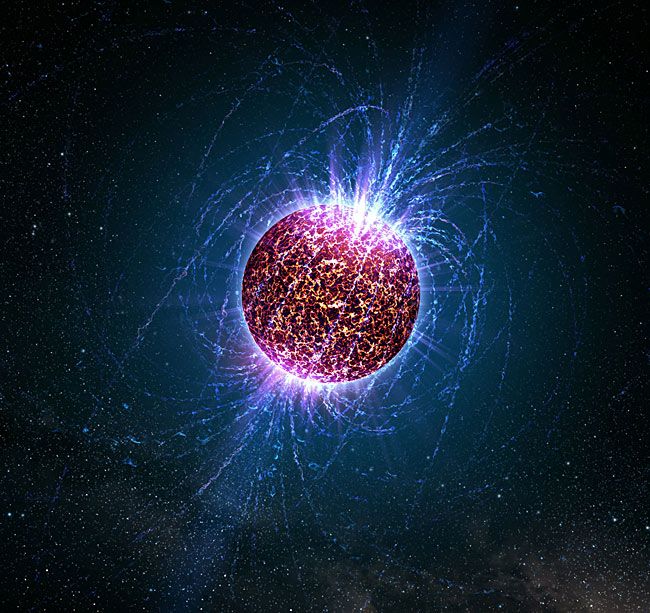
Neutron star
81
MENTIONS
8
EPISODES
8
PODCASTS
Search complete. 81 mentions across 8 episodes found for "Neutron star".
Sep 20, 2026

Katie MackGUEST
So when that supernova happens, the remnant, the core of that star that did the implosion, it can go a couple of different ways.
Katie MackGUEST
So it can either become a neutron star or a black hole.
Katie MackGUEST
And I'm going to say a little bit about neutron stars first, because neutron stars are these really amazing objects.
Katie MackGUEST
So if the star is less than something like 20 times the mass of the sun, but more than eight, then when that supernova happens and the core collapses...
Katie MackGUEST
It's too massive to be held up by even electron degeneracy pressure, even this white dwarf thing.
John GreenHOST
Wow.
John GreenHOST
Yeah.
Katie MackGUEST
And one cool thing about neutron stars is a lot of times when they're formed, when they're compressed that way, the magnetic fields of the star are kind of compressed and twisted around and the star is born like spinning really rapidly.

Charles BailynHOST
And you could imagine, you know, putting that somewhere on the periodic table.
Charles BailynHOST
Astronomers call these things neutron stars, and they exist.
Charles BailynHOST
They were discovered in the 1960s.
Charles BailynHOST
And a typical neutron star, a couple times the mass of the Sun, has mass equals 2 times the mass of the Sun, radius of about 10 kilometers.
Charles BailynHOST
Now, in fact, during the course stars' life, one of the things I glossed over is stars tend to lose mass as they live, and so they don't end up with the same mass they started with.
Charles BailynHOST
But stars with initial masses at the beginning of their lifetime, greater than, oh, I don't know, something like thirty times the mass of the Sun, will end up with masses greater than three times the mass of the Sun, and then there's nothing to stop their collapse.
Charles BailynHOST
What happens is, they turn into neutron stars, but they turn into neutron stars whose radii are smaller than the Schwarzschild radius, and that is a black hole.
Charles BailynHOST
So, they collapse down into black holes.

speaker_1HOST
Which is, uh, a very formal way of saying that we are finally figuring out how to optimize our telescopes to see one of the most violent, spectacular flashes of light in the entire universe.
speaker_0HOST
Because we know black holes eat neutron stars, right? Like, we can literally hear them doing it through gravitational waves, those ripples stretching and squeezing space time.
speaker_0HOST
But despite having world-class telescopes scanning the skies every night, we've never actually seen the visual flash of light that this collision makes.
speaker_1HOST
Yeah.
6 MINS LATER
speaker_1HOST
That wider baseline across the globe gives physicists a much sharper angle to measure those minute time delays, which shrinks that massive cosmic haystack down to a highly targeted patch of sky.
speaker_0HOST
And the numbers in the paper are incredible for this.
speaker_0HOST
They modeled a specific population of neutron star black hole mergers, they call it population one, which assumes the neutron stars are a bit squishy.
speaker_1HOST
Squishy, yeah.

David KippingHOST
But do these objects truly exist? What evidence do we have for them? And if they are real, could they be the production site for the most dangerous material in the universe? Self-replicating strange matter.
David KippingHOST
To understand the Quark star, we first have to understand the neutron star.
David KippingHOST
When a star heavier than about 8 solar masses reaches the end of its life, the outward pressure from radiation fizzles out and so gravity tries to compress the star down into a single point.
David KippingHOST
The core becomes so compressed that it reaches a critical density where it's able to resist further collapse, causing the outer layers to bounce off the core in a dramatic supernova event, specifically here a type known as a core collapse supernova.
David KippingHOST
With the outer layers gone, the core is left naked in space, and it's called a stellar remnant.
David KippingHOST
If that remnant exceeds about three solar masses, then it will collapse all the way down into a black hole.
David KippingHOST
But for remnants lighter than this, they instead will become neutron stars.
David KippingHOST
A neutron star is able to avoid collapsing all the way down to a black hole because it has enough internal strength to resist the power of gravity.

DaveNARRATOR
The arrow of time.
DaveNARRATOR
Scientists recently broke down the math of neutron stars and compared it to our existing paradigm for the forward moving arrow of time, the idea that time moves exclusively forward.
DaveNARRATOR
They found in certain conditions a neutron star's specific extremely high gravity turns this math inside out, creating a separate arrow of time traveling the opposite of its usual direction.
DaveNARRATOR
When it comes to the math, at least, these neutron stars are collapsing backward in time.
DaveNARRATOR
The researchers' work appears now in the European Physical Journal C.
DaveNARRATOR
Their investigation focuses on what are known as epoch functions, which accounts for key aspects of space-time.
DaveNARRATOR
Cosmologists who study the tiny period of time directly after the Big Bang have long tried to reconcile high, though much lower than today, entropy of the early universe with the fact that we still appear to be on the later end of the time's arrow today.
DaveNARRATOR
Could the answer be that some pockets or processes have always been winding the clock back? To investigate, the researchers basically chose to set two different ends of math equations opposite each other, epic functions of gravitational collapse and epic functions of space-time curvature and structure.

Jerry KolberHOST
Smarty pants, do you know what object I'm talking about? Is it A, black holes; B, nebuli; or C, asteroids? The answer is A.
Jerry KolberHOST
But unlike black holes, we can actually see neutron stars.
Adam Tex DavisHOST
Right now, all I'm seeing is a lot of flashing light.
Jerry KolberHOST
Yes, pulsars give off streams of light that look like flashes because the star is spinning around like a super-fast lighthouse.

speaker_0HOST
Yeah, without a doubt.
speaker_1HOST
Because we are quite literally inside the mantle of a neutron star.
speaker_0HOST
Okay, let's unpack this.
speaker_0HOST
Because the sheer imagination of this source material is blowing my mind, but frankly my brain is already hurting just trying to visualize the physics of it.
speaker_0HOST
Right.
speaker_0HOST
But before we even get to the people, I feel like we need a reality check.
speaker_0HOST
You said we are inside a neutron star.
speaker_1HOST
Yes, we are.