Neo-Assyrian Empire
CountryWikipedia
40
MENTIONS
30
EPISODES
26
PODCASTS
Search complete. 40 mentions across 30 episodes found for "Neo-Assyrian Empire".
Sep 25, 2026

Matthew LaCroixHOST
Now, we talked all about this ancient city of Shuruppak that was part of the old world and the destruction of that, and then the story of Ziusudra and how this huge, you could call it, um, overwhelming force of people and, and craftsmen came together to create some kind of a time capsule of a forgotten time.
Matthew LaCroixHOST
And on the bottom right of the screen is, of course, the Babylonian map of the world, which along with all the other ancient Mesopotamian tablets from the Akkadians and Neo-Assyrians and Babylonians, truly shows and emphasizes that this region was very special and that this is where this legacy of the ancient Sumerians and Ziusudra went.
Matthew LaCroixHOST
And so I wanna go back three years ago.
Matthew LaCroixHOST
This is where I was.

John McKeeHOST
There are no significant differences between the Dead Sea Scrolls and Septuagint versions of Nahum.
John McKeeHOST
However, because of the unique poetry of Nahum, studies in Ugaritic and of Neo-Assyrian literature can aid in one's examination of the Hebrew of the text.
John McKeeHOST
The historical backdrop of Nahum can aid one significantly in examining the text as well.
John McKeeHOST
Assyria, represented by Nineveh, had already conquered the northern kingdom and posed a significant threat to the southern kingdom.

Herman PoppleberryHOST
The Hittites at their 14th century peak.
Herman PoppleberryHOST
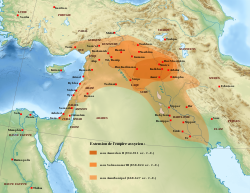
And then the Neo-Assyrian Empire, 934-609 BC, which at its height dominates from the Caucasus to Nubia, Egypt, and Arabia.
Herman PoppleberryHOST
That's not a country.
Herman PoppleberryHOST
That's a time zone.

Matt LaCroixGUEST
That was around 2800 BC, so about 3000 years ago.
Matt LaCroixGUEST
There was a civilization there that was during the same time as the Neo-Assyrian civilizations further south in ancient Mesopotamia, right? Ashurbanipal, Sennacherib, we've talked about them before.
Matt LaCroixGUEST
There was a competition going on over empires fighting during that time period, and they were being invaded constantly, and they were a war civilization.
Matt LaCroixGUEST
now that is that group the urartians is what archaeologists believe built all of these sites around not only lake vaughn but further east in armenia and other locations and we can talk about why they believe that and what we know we're getting into but the what really broke this open is that getting back to what I was just referring to, Lake Vaughan in Eastern Turkey, there's a, it's one of the, by the way, it's one of the largest and deepest lakes on earth.

Nathaniel LloydHOST
In the 19th century, a notion arose that the British people were descended from the Israelites, and these quote-unquote British Israelites believed that the multitude of nations springing from Ephraim just must be the British Empire, while the great nation springing from Manasseh must be the United States.
Nathaniel LloydHOST
So the pseudo-histories of British Israelism were born, with the principal notion being that, after the Neo-Assyrian conquest of Israel, the Lost Tribes migrated northward, to Scandinavia, the Low Countries, and the British Isles.
Nathaniel LloydHOST
You can listen to my series on the Abode of the Lost Tribes for more on this pseudo-history, but what's most relevant here is that the Lost Tribe of Dan, or the Danites, are claimed to be one and the same as the Tuhate Danan, based solely on the Dan in their name.
Nathaniel LloydHOST
These ideas of British Israelism were not, at first, an anti-Semitic philosophy.
CornHOST
It was pressing olives and pumping water.
Herman PoppleberryHOST
The screw first appears in Mesopotamia in the Neo-Assyrian period, that's 911-609 BC, and then in Egypt and Greece.
Herman PoppleberryHOST
And the thread itself is attributed by some to Archytas of Tarentum, who lived 428-350 BC.
Herman PoppleberryHOST
He was called the founder of mechanics, a contemporary of Plato.
Matthew LaCroixHOST
Don't think he actually translate the means correctly.
Matthew LaCroixHOST
Look, they had a lack of understanding when they're trying to put this in the lens of, of an Assyria, Assyrian neo-Akkadian empire culture, right? Kings and empires and war and battling.
Matthew LaCroixHOST
So he's trying to put it through the lens of that.
Matthew LaCroixHOST
And he comes up with commandments and rights.

Andrew HamiltonHOST
I can't believe you gave me a hard time.
Andrew HamiltonHOST
So when we get to the Neo-Assyrian Empire, their capital was Nineveh.
Andrew HamiltonHOST
Huge city.
Andrew HamiltonHOST
The goddess that they worship is called Ishtar.
20 more episodes mention Neo-Assyrian Empire.
Create an account to see the whole feed, search across every transcript, and follow the entities you care about.