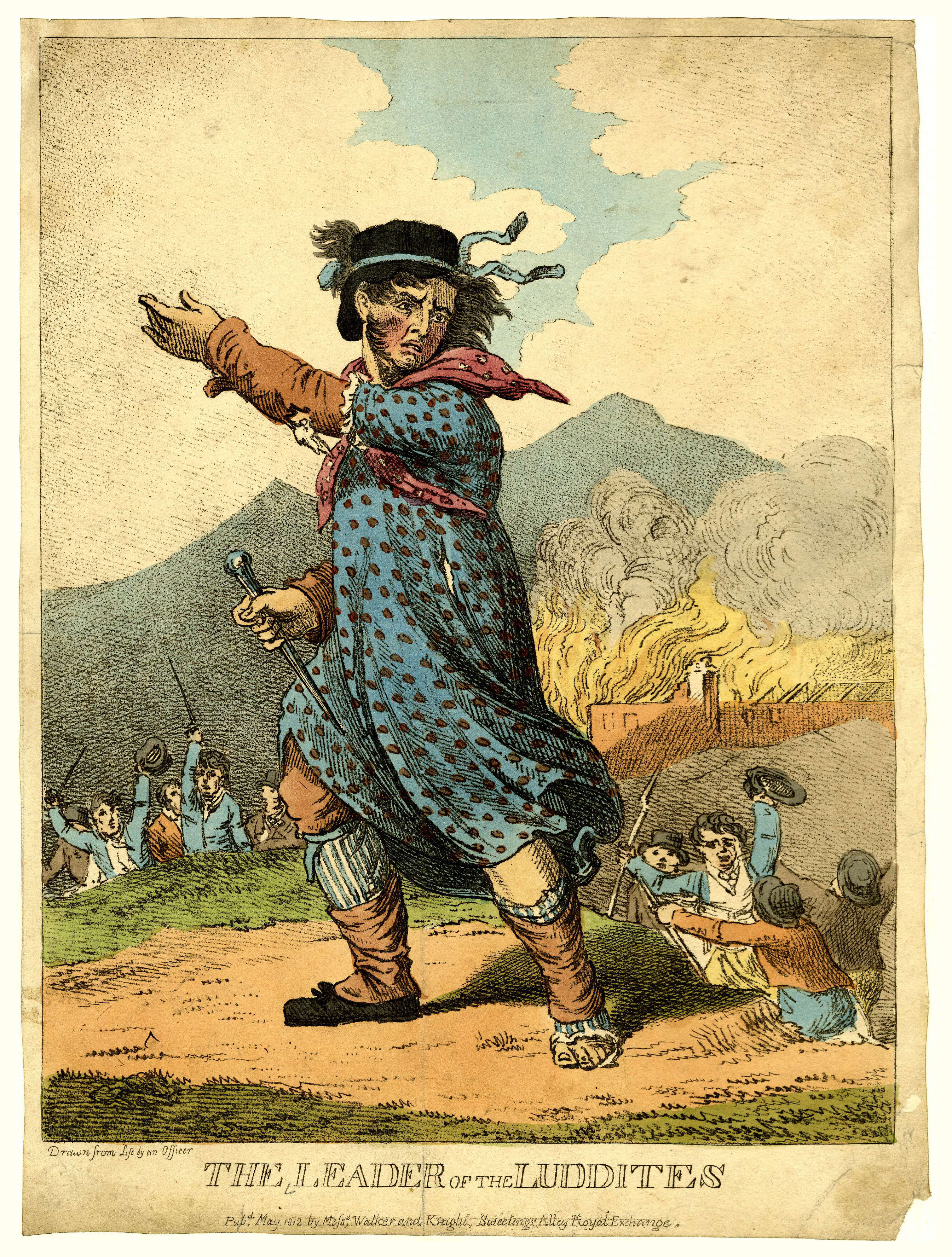
Ned Ludd

Ned Ludd

WeaverWikipedia

Search complete. 33 mentions across 15 episodes found for "Ned Ludd".

Sep 15, 2026

CorrineHOST
38:34
By Andy Kessler.
CorrineHOST
38:37
Ned Ludd writes, was the fabled hero of the early 19th century Luddites who smashed stocking frames, knitting machines for socks, and burned factories to protest job-destroying technology.
CorrineHOST
38:54
The Industrial Revolution created more jobs than it destroyed, and now a similar Luddite backlash against artificial intelligence is picking up speed like a runaway train headed towards Silicon Valley.
CorrineHOST
39:11
Pennsylvania's Josh Shapiro, New York's Kathy Hochul, Arizona's Katie Hobbs, and Illinois's J.B. Pritzker, all Democratic governors have moved to halt or restrict data center development or tax incentives.
CorrineHOST
42:33
New York City recently banned AI in public elementary and middle schools.
CorrineHOST
42:40
Never mind that only 48% of New York students in grade three through eight are proficient in English language arts and 57% in math.
CorrineHOST
42:54
Sure, let Ned Ludd teach them.
CorrineHOST
42:59
Los Angeles schools also restricted AI for all grade levels, despite proficiency scores as awful as New York's.
Olean Reads

Olean Reads

WSJ Monday

Sep 15 · 3 Mentions

CorrineHOST
38:34
By Andy Kessler.
CorrineHOST
38:37
Ned Ludd writes, was the fabled hero of the early 19th century Luddites who smashed stocking frames, knitting machines for socks, and burned factories to protest job-destroying technology.
CorrineHOST
38:54
The Industrial Revolution created more jobs than it destroyed, and now a similar Luddite backlash against artificial intelligence is picking up speed like a runaway train headed towards Silicon Valley.
CorrineHOST
39:11
Pennsylvania's Josh Shapiro, New York's Kathy Hochul, Arizona's Katie Hobbs, and Illinois's J.B. Pritzker, all Democratic governors have moved to halt or restrict data center development or tax incentives.
CorrineHOST
42:33
New York City recently banned AI in public elementary and middle schools.
CorrineHOST
42:40
Never mind that only 48% of New York students in grade three through eight are proficient in English language arts and 57% in math.
CorrineHOST
42:54
Sure, let Ned Ludd teach them.
CorrineHOST
42:59
Los Angeles schools also restricted AI for all grade levels, despite proficiency scores as awful as New York's.

Unknown podcast

The Luddite Movement: Wages, Machines and the Myth of Anti‑Progress

Sep 14 · 3 Mentions

speaker_1UNKNOWN
2:27
They had a rhythm to them, almost as if they believed order was coming from disciplined action.
speaker_1UNKNOWN
2:34
And that belief in an organised strike is why we hear about a mythical leader, Ned Ludd, as though he was the commander of a structured army.
speaker_1UNKNOWN
2:42
In reality, there was no central body or formal manifesto behind it.
speaker_1UNKNOWN
2:48
The name Ned Ludd emerged from ballads and rumours.
speaker_1UNKNOWN
2:51
Some suggest he may have once broken two frames in frustration.
speaker_1UNKNOWN
2:55
His image grew as a rallying symbol for anyone who felt powerless against the mechanised tide.

6 MINS LATER

speaker_1UNKNOWN
9:19
Laws are written with both deterrence and reform in mind.
speaker_1UNKNOWN
9:22
That dual nature is a common feature of many political crises.

Unknown podcast

From Luddite Revolts to 1960s Chic: Britain’s Cultural Shift

Sep 12 · 1 Mention

speaker_0UNKNOWN
8:23
The mills issued tokens or coupons as payment, which could only be redeemed at the mill’s own stores, locking workers into an economic bondage that mimicked serfdom in miniature.
speaker_0UNKNOWN
8:34
The legend of Ned Ludd, the supposed weaver who smashed two stocking frames in seventeen seventy-nine, was invented by these same textile workers as a symbolic hero.
speaker_0UNKNOWN
8:44
It provided them with a rallying cry: "If you strike the Ludd, we’ll strike back." Scholars agree that no historical record shows such a man.
speaker_0UNKNOWN
8:53
He appears purely within letters addressed to magistrates.
Dylan ThurasGUEST
17:13
All those weavers got together and rioted under the leadership of a kind of fake guy.
Dylan ThurasGUEST
17:20
They called Ned Ludd.
Dylan ThurasGUEST
17:22
And this is where we get the term Luddite.
Dylan ThurasGUEST
17:24
Luddites are the weavers who were rioting.

Unknown podcast

The Luddites: Myth Versus Reality

Sep 11 · 2 Mentions

speaker_2UNKNOWN
1:11
Workers were paid a fraction of what their hand-knotted pieces had earned, and entire villages that depended on cottage spinning were left with little work and fewer opportunities.
speaker_2UNKNOWN
1:22
In the first murmurs of protest, a tale surfaced about a young weaver named Ned Ludd, who allegedly smashed two stocking frames in fury.
speaker_2UNKNOWN
1:31
Newspapers spread his name, turning it into an emblem for all disgruntled laborers.
speaker_2UNKNOWN
1:37
By late eighteen eleven, these disgruntled artisans organized themselves into clandestine bands, meeting after dark on the outskirts of towns like Nottingham and Derby.
speaker_2UNKNOWN
3:15
Paradoxically, while the protests stuttered local production for weeks, they also accelerated the trend toward mechanized factories that could now churn out cloth at rates no hand worker could match, making mass production a national standard by eighteen sixteen.
speaker_2UNKNOWN
3:32
The movement’s visibility forced Parliament to confront the brutal conditions of factory life, prompting the Cotton Mills Act of eighteen nineteen, which first restricted child labor hours and laid groundwork for subsequent factory acts that improved sanitation and limited night work.
speaker_2UNKNOWN
3:51
Yet even as these reforms took root, the story of Ned Ludd and the violent raids fed into a popular narrative that equated any technology with malevolent mechanization.
speaker_2UNKNOWN
4:01
Eventually, the label Luddite entered everyday speech to brand anti-tech sentiment.

Unknown podcast

The Bedchamber Crisis: Victoria’s Palace Politics

Sep 11 · 1 Mention

TonyHOST
7:29
Their actions were motivated not simply by a hatred of progress, but by a concrete threat, the replacement of their skilled labor and the collapse of living wages that had allowed them to maintain small households.
TonyHOST
7:42
The story of Ned Ludd was a convenient mythic rally cry, but contemporary accounts show that the real fear lay in an economic reality, child labor exploitation, brutal factory conditions, and the sudden erosion of class dignity.
TonyHOST
7:58
Historians now agree that while the Luddite strikes were violent, they reflected an urgent struggle against an unjust system that could not be ignored.
TonyHOST
8:08
Then came the steam engine, not a single machine, but a series of incremental refinements that turned raw energy into a practical motive force.
Charles PayneGUEST
35:15
Uh, you know, there, there was, like, well, you know, and you had these big, big giant rooms of women weaving and clothes together, and all of a sudden you have this looming machines that can do the work of, like, 30 women.
Charles PayneGUEST
35:25
And, you know, people, there was a guy named Ned Ludd who went, and one day him and some folks went, and they, they broke up all the machines, right?
Mark SimoneHOST
35:32
Hmm.
Mark SimoneHOST
35:32
Yeah.
Charles PayneGUEST
8:45
All of a sudden you have this looming machines that can do the work of, like, 30 women.
Charles PayneGUEST
8:49
And, you know, people, there was a guy named Ned Ludd who went, and one day him and some folks went and they, they broke up all the machines, right?
Mark SimoneHOST
8:55
Hm.
Mark SimoneHOST
8:55
Yeah.
RJ WadeHOST
15:18
From 1811, a movement known as Luddism arose in Nottingham and spread further north.
RJ WadeHOST
15:24
Following the example of a mythic weaver called Ned Ludd, the Luddites would destroy the new machinery in organized raids.
RJ WadeHOST
15:32
Much of the working-class population of Bradford, Eldwick, and Bingley would have been caught in this gulf between the rural past and the steaming, speeding advance of the Industrial Revolution.
RJ WadeHOST
15:42
With its application of the word of Christ to the injustices of the day, and the promise of salvation as the reward for a pious life, Methodism held a strong appeal for the poor communities around Bradford as they absorbed the effects of this momentous change.

5 more episodes mention Ned Ludd.

Create an account to see the whole feed, search across every transcript, and follow the entities you care about.

We value your privacy

We use cookies to understand how you use our platform and to improve your experience. Click “Accept All” to consent, or “Decline non-essential” to opt out of non-essential cookies. Read our Privacy Policy.