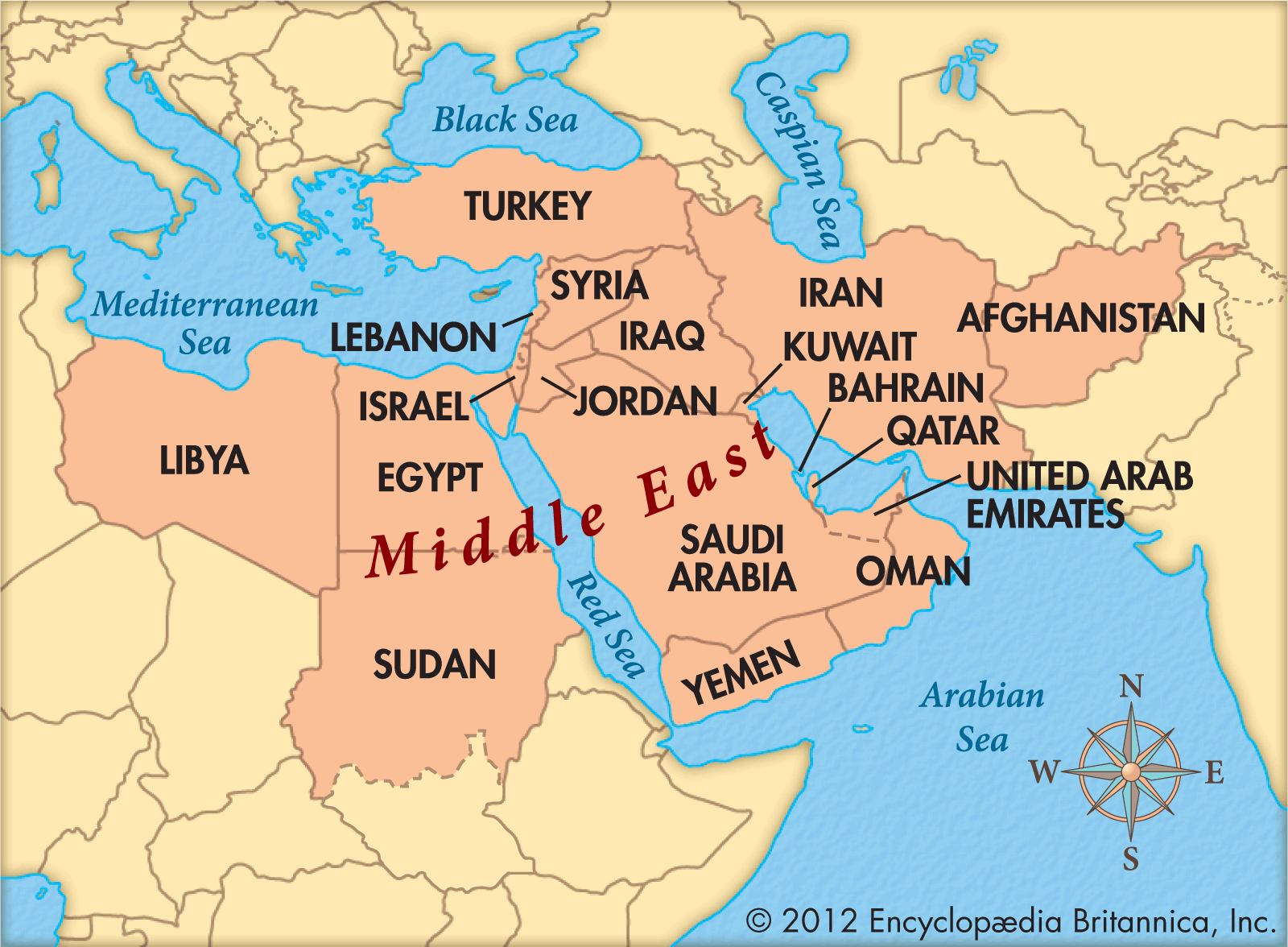
Near East
RegionWikipedia
972
MENTIONS
437
EPISODES
315
PODCASTS
Search complete. 972 mentions across 437 episodes found for "Near East".
Sep 14, 2026

Jim VieiraGUEST
So this is, um, a super ancient cold case hidden in plain sight that I first got introduced to in 1986.
Jim VieiraGUEST
Dr. Richard Barnett was a British Museum archeologist and expert on the ancient Near East, and he wrote a paper on polydactylism.
Jim VieiraGUEST
He saw that this phenomena was, was found in art and artifacts around the world, and he wrote about it.
Jim VieiraGUEST
And he said, his quote is, "This phenomena has received no attention from scholars." And this was in '86, and I, I read the article in like 2007.
51 MINS LATER
Jim VieiraGUEST
Hugh Newman, my co-author, he knows the landowner.
Jim VieiraGUEST
There's some T-shaped pillars sticking up, and I'm like, "There is something there.
Jim VieiraGUEST
I want to excavate it." And what I want to find and wrote about in the script is a statue with extra digits highlighting the r- the divinated or divinized ancestors that were worshiped by Near Eastern peoples in other sites.
Jim VieiraGUEST
So, you know, I'm not Edgar Cayce.

Irenaeus DunlevyGUEST
There we read that making graven images affects Israel's knowledge and worship of God.
Irenaeus DunlevyGUEST
In the ancient Near East, the surrounding religions did not share Plotinus' own aversion to images.
Irenaeus DunlevyGUEST
Their contemplative ascent, if we can call it that, consisted of fashioning small idols that became objects of worship.
Irenaeus DunlevyGUEST
The prohibition in Exodus is meant to demarcate Israel from the surrounding nations and pagan practices.
8 MINS LATER
Irenaeus DunlevyGUEST
We have one interpretation of this passage that suggests any sculpted image or representation of anything within creation violates the intent of this commandment.
Irenaeus DunlevyGUEST
And then we have the Catholic interpretation that has a, a narrower read.
Irenaeus DunlevyGUEST
Um, the church indicates that this prohibition is contextualized to the pagan worship of the ancient Near East where graven images were made of false gods.
Irenaeus DunlevyGUEST
The surrounding people who did not know the true God used their imaginations to construct images of false deities that they worshiped.

Monty MaderHOST
But let's talk about virginity, purity culture, how it evolved, and how it protects people like this.
Monty MaderHOST
In the ancient Near East, marriage was a property transfer between two men, a father and a husband, and it carried a price.
Monty MaderHOST
In Hebrew law, that payment is the mohar, the bride price paid by the groom to the bride's father.
Monty MaderHOST
In Acadian, it is the turhatum.
Monty MaderHOST
Verses 28 and 29 of the same chapter, "A man who seizes an unbetrothed virgin and lies with her pays her father 50 shekels of silver, marries her, and may never divorce her." The victim is sentenced to a lifetime of cohabitation with her rapist.
Monty MaderHOST
Her father is paid for the depreciation in the price of his property.
Monty MaderHOST
There is no equivalent male scrutiny of virginity anywhere In, in any of these laws, the Laws of Hammurabi, which Leviticus and Edi- Exodus and all of the Deuteronomy laws are based on, the ancient Near East, they do not track male virginity at all.
Monty MaderHOST
This is exclusive to women.

Joshua BermanHOST
Let me just ask about that, because Jacob is not the first man to marry in the Hebrew Bible, nor the last.
Joshua BermanHOST
And normally, when a man marries a woman, throughout the Bible, I think throughout the ancient Near East, it's understood that she is now leaving the domain of her father and entering into the domain of her husband.
Joshua BermanHOST
And he now... has title to her and all of her offspring are his offspring, not his father-in-law's offspring.
Joshua BermanHOST
So why does this issue require clarification and emphasis more than any other marriage anywhere in the Hebrew Bible?

Sam OyeyinkaHOST
In case you don't understand, if you know a little bit of the history of the Jewish people, how the Assyrians took them away and the Babylonians took them away.
Sam OyeyinkaHOST
A lot of people's blood was mixed biologically with the nations in the ancient Near East.
Sam OyeyinkaHOST
Paul belonged to a particular tribe that he kept.
Sam OyeyinkaHOST
They stayed in Judah when the northern kingdom came.

MalcHOST
So we'll take fish, it's a useful word.
MalcHOST
But that said This great fish, this great creature, this monster is still as dangerous as the ancient Near Eastern nations feared.
MalcHOST
And we left Jonah last week at the end of chapter 1, not merely in this beast's jaws, but trapped in its stomach.
MalcHOST
Now, what we're about to look at over these next few minutes are the trauma reflections of a believer.
13 MINS LATER
MalcHOST
We may not know what that is, but there is a plan.
MalcHOST
And his plan is to bring some good purpose in the horror of it.
MalcHOST
Secondly, secondly, what do we learn from chapter two? I want you to notice that Jonah is convinced that even in the depths of the ocean, and for an ancient Near Eastern person, the depths of the ocean is what we're talking about.
MalcHOST
We're talking about the theme of loneliness, actually.

Ron PetersHOST
I do wanna make it right." You know? And I think that speaks to maybe the conscience of the person who was involved in this situation, where it's like, "I need to fix this." So yeah, this is, this is a person who, uh, I think usual- in a general sense of it, you know, they care about the things of God, and they want to do things God's way.
Sam LongHOST
This is a very different, um, punishment than we see in a lot of the Near Eastern, ancient Near Eastern cultures.
Sam LongHOST
Like, you always hear, "If you steal something, what happens? You get your hand chopped off."
Ron PetersHOST
Yeah, exactly.
6 MINS LATER
Ron PetersHOST
[coughs]
John NugentHOST
...
John NugentHOST
I think in ancient Near Eastern culture in compared to modern culture, I think because w- when we think of stealing today, um, we often think in Robin Hood type terms.
John NugentHOST
[laughs]

Andy JonesHOST
people like this.
Monty MaderHOST
In the ancient Near East, marriage was a property transfer between two men, a father and a husband, and it carried a price.
Monty MaderHOST
In Hebrew law, that payment is the mohar, the bride price paid by the groom to the bride's father.
Monty MaderHOST
In Akkadian, it is the terhatum.
Monty MaderHOST
Verses 28 and 29 of the same chapter.
Monty MaderHOST
There is no equivalent male scrutiny of virginity anywhere.
Monty MaderHOST
In any of these laws, the laws of Hammurabi, which Leviticus and Exodus and all of the Deuteronomy laws are based on the ancient Near East, they do not track male virginity at all.
Monty MaderHOST
This is exclusive to women.

Dexter IngramGUEST
I'm going to read the mission.
Dexter IngramGUEST
It says to enhance security in the Near East and South Asia by building sustained mutually beneficial relationships, fostering regional cooperation on security issues and promoting effective communications and strategic capacity through free and candid interaction in an academic environment.
Dexter IngramGUEST
Well, that's cute.
speaker_3UNKNOWN
I miss those days, don't you?
427 more episodes mention Near East.
Create an account to see the whole feed, search across every transcript, and follow the entities you care about.