Native American Graves Protection and Repatriation Act
35
MENTIONS
15
EPISODES
15
PODCASTS
Search complete. 35 mentions across 15 episodes found for "Native American Graves Protection and Repatriation Act".
Oct 16, 2026

Aja Marie LansGUEST
Um, I actually did, like, an honors thesis using the remains of indigenous people, um, from what's now, uh, Louisiana.
Aja Marie LansGUEST
Uh, but at the time, they didn't fall under NAGPRA, the Native American Graves Protection Repatriation Act.
Aja Marie LansGUEST
There was a loophole where, um, if institutions had remains that they could argue were, like, too old to be linked to a living group of indigenous people, that they didn't fall under NAGPRA.
Aja Marie LansGUEST
Um, and at the time, I didn't comprehend the, what that, that meant.
Aja Marie LansGUEST
Um, so I did my undergrad.

Nic FrederickHOST
I think, like even from a practical standpoint, this is not a question I have for you.
Nic FrederickHOST
So this doesn't affect NAGPRA or like, you know, uh, we're talking about finding human remains, right?
Andrew GoldbergGUEST
Right of itself, right.
Andrew GoldbergGUEST
That is not-

Rachel GrantGUEST
That's one of the things I love in my books, is that I do write about the archeology that most people don't think of, you know, like, that they don't know exists, that I'm not writing the Indiana Jones because he was a looter, but that, you know.
Rachel GrantGUEST
[laughs] And, you know, I, I write about contract, uh, compliance archeology and, you know, private sector, you know, s- and NAGPRA and all of the, the laws that, that govern, um, archeological field work in the US and abroad.
Rachel GrantGUEST
And actually I'll, I'll give...
Rachel GrantGUEST
A lot of people probably wonder, you know, why I'm in Okinawa, why my husband is an archeologist for the Marine Corps.

Lizzy Ghedi-EhrlichHOST
These are, again, like, pieces of history that current people alive are living with and curating.
Lizzy Ghedi-EhrlichHOST
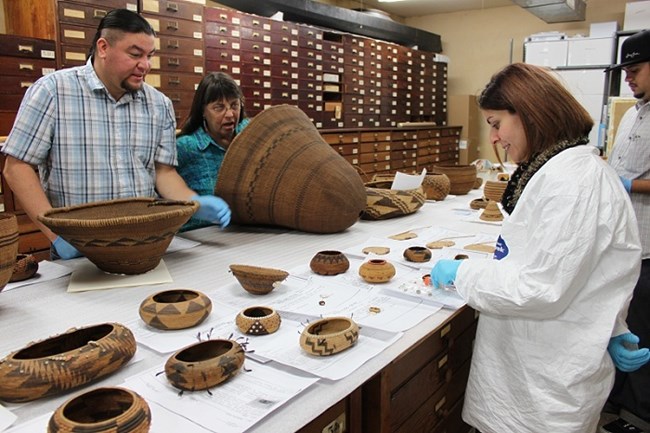
Some of these, some of these artifacts include even the remains of people's ancestors, um, and that's what the Native American Graves Protection and Repatriation Act, that's where that comes in, NAGPRA, um, and this was a law passed in the '90s, also the time of when Indigenous Peoples' Day came on the scene as part of that discussion, back to the roaring '90s, and that's something that you've written about.
Lizzy Ghedi-EhrlichHOST
Tell us a little bit about this law.
Lizzy Ghedi-EhrlichHOST
Why does it matter if we're trying to make sure that the public has full access to maybe a complete or more nuanced picture, and yet we also have objects that we're saying that the ownership of this or the way it's being handled is disputed, and it needs to be returned? How do we handle education while also respecting that, that-
Kerri J. MalloyGUEST
that-Yeah, so the Native American Graves Repatriation Act, or NAGPRA, we have to reduce everything to an acronym or something that just makes it easier.
Kerri J. MalloyGUEST
But NAGPRA says that if you are an institution that receives federal funding, so this is federal agencies, federal museums, the Smithsonian, universities, if federal dollars touch your institution, you are required to repatriate the human remains and artifacts of cultural patrimony back to a federally recognized tribe.
Kerri J. MalloyGUEST
California has a similar law called CalNAGPRA, and that outlet includes non-federally recognized tribes.
Kerri J. MalloyGUEST
One of the things that I hear a lot is we're going to diminish the amount of history people, we're going to hurt science by doing this.

Kathy StrainGUEST
We have a cave, that very cave, and it has human remains that were collected from that cave in the 1960s.
Kathy StrainGUEST
And so, um, there's a law called the Native American Graves Repatriation Act, or NAGPRA.
Kathy StrainGUEST
I probably butchered that.
Kathy StrainGUEST
But anyway, um, we tried to give those remains back to the local tribe, and they wouldn't have it.

Frank Oscar WeaverHOST
Can you tell us a little more about what's happening there?
Robert RosaGUEST
NAGPRA law deems any federal tribe within the area has the right to get the funerary objects as well as the remains.
Robert RosaGUEST
Now, the problem with that here in Florida was that...
Robert RosaGUEST
There's been a lot of building since then.
Robert RosaGUEST
So I kind of became a headache for the developer and worked out a deal where the Miccosukee and the Seminoles would both get a list of what items that were there and they were allowed to to choose what they thought was a sacred item and not what the archaeologist thinks a sacred item is or a funerary possession because they they just don't have the understanding that that maybe this necklace that i have on uh holds something which it does this one does but They don't understand that.
Robert RosaGUEST
And they would just take that and put it in their own collection or put it in a museum.
Robert RosaGUEST
So I, I got to fight with using NAGPRA to help the Seminole and the Miccosukee have better control of what they're allowed to get.
Robert RosaGUEST
We fought hard to try to have everything just stay there.

Courtney AstolfiHOST
Everybody knows that property and that farm, and this is, you know, blowing up into a big dispute.
Courtney AstolfiHOST
You know, Metroparks is beginning a process here under the federal Native American Graves Protection and Repatriation Act.
Courtney AstolfiHOST
And, you know, there's been previous connections in the past to the Wyandot Nation.
Courtney AstolfiHOST
They established a cultural affiliation after those remains were found during the 1970s.

James StoutHOST
The damage done to their homeland was still profound, but it could have been worse.
James StoutHOST
In 2025, with Trump back in office, most of the laws that had protected this land, including the Native American Graves Protection and Repatriation Act, were waived by Secretary Noem.
James StoutHOST
That wasn't the only law waived.
James StoutHOST
I want to read a list of all the laws she waived, because I think it gives a good impression of things that matter less to these people than building a giant monument to grift and hatred.
James StoutHOST
The National Environmental Policy Act, the Endangered Species Act, the Federal Water Pollution Control Act, the National Historic Preservation Act, the Migratory Bird Treaty Act, the Migratory Bird Conservation Act, the Clean Air Act, the Archaeological Resources Protection Act, the Paleontological Resources Protection Act, the Federal Cave Resources Protection Act of 1988, the National Trail System Act, the Safe Drinking Water Act, the Noise Control Act, the Solid Waste Disposal Act, as amended by the Resource Conservation and Recovery Act, the Comprehensive Environment Response Compensation and Liability Act, the Archaeological and Historic Preservation Act, the Antiquities Act, the Historic Sites, Buildings, and Antiquities Act, the Eagle Protection Act, the Native American Graves Protection and Repatriation Act, the Administrative Procedure Act, Section 438 of the Energy Independence and Security Act, the National Fish and Wildlife Act of 1956, the Fish and Wildlife Coordination Act, the Farmland Policy Protection Act, the Federal Land Policy and Management Act, the Wild Horse and Burrow Act, the Coastal Zone Management Act, and the Otay Mountain Wilderness Act of 1999.
James StoutHOST
Each of these laws was passed for a reason.
James StoutHOST
It's not easy in this country to restrain capitalism through the law.

Paulette SteevesGUEST
Rose came back, and he told me, "Yes, that person looks like a Native American from that area." And that's in his report on the National Park Service site.
Paulette SteevesGUEST
So archeologists who wanted to keep control of and do research on Kennewick Man claimed he looked Caucasoid, and that removed him from them having to follow the NAGPRA law, Native American Graves and Repatriation Act, which requires archeologists to talk to Native American communities regarding any finds or archeological sites on their lands or any ancient sites they may be related to.
Paulette SteevesGUEST
They would've been required to return the Ancient One to the communities who were claiming him as an ancestor.
Paulette SteevesGUEST
But in his silence, Kennewick Man speaks volumes about ongoing racism in American archeology.
Don WildmanHOST
What year was this, uh, find? When, when was he found?
Paulette SteevesGUEST
I don't have the exact year here.
Paulette SteevesGUEST
I was in undergrad school at the time, and I know that the NAGPRA law came in in the 1990s, so it was after that.
Don WildmanHOST
Wow, okay, so recently.

Kristin LaFolletteGUEST
They sort of served as educational tools in that way.
Kristin LaFolletteGUEST
But in the 1990s, we developed in the United States the Native American Graves Protection and Repatriation Act, which prevented, uh, bioarcheologists from observing and documenting human remains of indigenous ancestry.
Kristin LaFolletteGUEST
And the problem with that is that there are several situations that, w- we see throughout time where bioarcheologists sort of push back against that and said, "But these are educational tools that we can learn from," and these indigenous communities are saying, "But these are our ancestors that we need to honor and dignify and respect."
Karen StollznowHOST
Hmm.
19 MINS LATER
Kristin LaFolletteGUEST
And so I think that in order to create the language that's going to lessen that distance, that's going to ensure that visitors to spaces like medical museums see the humanity of the people represented by these remains, if we close that distance, it's going to bring up more of these ethical issues like, that we were just talking about.
Kristin LaFolletteGUEST
Like, did these people consent for their remains to be housed and displayed in this way? And if not, what does that mean about the fact that they're displayed here? And so yes, I think it's, it's necessary, but it's going to bring up more ethical questions that I think could potentially lead to these museums really having to think, rethink their, their displays and what to do with these remains.
Kristin LaFolletteGUEST
Because some of them probably should be repatriated per the Native American Graves Protection and Repatriation Act.
Kristin LaFolletteGUEST
There still remains in museums and archives and, and different contexts that should be repatriated that haven't.
5 more episodes mention Native American Graves Protection and Repatriation Act.
Create an account to see the whole feed, search across every transcript, and follow the entities you care about.