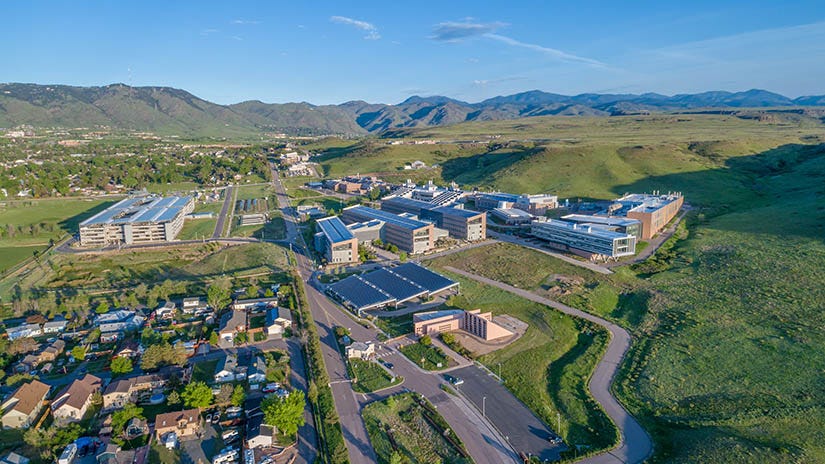
National Renewable Energy Laboratory
Research institute in Applewood, ColoradoWikipedia
35
MENTIONS
29
EPISODES
23
PODCASTS
Search complete. 35 mentions across 29 episodes found for "National Renewable Energy Laboratory".
Oct 31, 2026

Dave BorlaceHOST
Some are calibrated to work indoors in low light conditions.
Dave BorlaceHOST
Haelesel explained that testing at institutions like the US National Renewable Energy Laboratory or NREL and at the well-known Fraunhofer Institute in Germany primarily focuses on a standard known as AM 1.5G.
Dave BorlaceHOST
So what does that mean? Well AM stands for air mass and the 1.5 number represents the strength of sunlight after passing through 1.5 times the thickness of the atmosphere.
Dave BorlaceHOST
That corresponds roughly to the sun at about 48 degrees above the horizon which is typical of mid-latitude regions.

Brad PlumerGUEST
And there was a company that happened to need heat for some idiosyncratic reasons.
Brad PlumerGUEST
But like, is this a special case where it's, you know, a one off? So fortunately, smart people would be at the National God, what's it called? The National Laboratory of the Rockies used to be NREL.
Brad PlumerGUEST
They actually looked at this.
Brad PlumerGUEST
They were like, OK, this works if, you know, you can find enough electricity that's cheap enough and the battery costs are low enough and you can compete with natural gas, which is very cheap in the US.
Dave BorlaceHOST
But to achieve the conversions of energy that are needed to make these things work requires a multitude of different types of materials, and unless those materials can be efficiently separated out at the end of the product's useful life, then just like any other unloved piece of hardware there's a fair chance they'll get hurled into landfill along with everything else that we can't be bothered to deal with responsibly.
Dave BorlaceHOST
In a recent Forbes online article Jeff McMahon tells us the United States installs seven million pounds per day of solar panels according to the National Renewable Energy Laboratory, a pace that secures only fourth place among countries for installed capacity.
Dave BorlaceHOST
Those numbers are also considered in this comprehensive 2018 article by Kelly Pickerel for Solar Power World.
Dave BorlaceHOST
Kelly sets out the size of the challenge very clearly.

Justin RitchieNARRATOR
Chris asked Mackay Miller how much wind and solar grid could really support.
Justin RitchieNARRATOR
Miller was then a senior analyst at NREL, the National Renewable Energy Laboratory, speaking, as he said, in a personal capacity.
Chris NelderHOST
Defenders of the status quo have claimed for decades that the grid can't support more than 3% or 5% or 20% of variable renewables without risking blackouts, and insisted that so-called baseload power generators, which run nearly full-time, will always be needed to maintain reliability.
Chris NelderHOST
They've also claimed that because wind and solar are variable, they might have to be backed up by enough baseload power to meet 100% of demand.

Jackie SnowCORRESPONDENT
And that's the incentive problem underneath everything.
Marco PimentelHOST
Here's Paul Denholm from the National Renewable Energy Laboratory.
Paul DenholmSOUNDBITE_SPEAKER
The evidence pretty clearly points to the fact that optimization of the existing grid We're really in the early stages of how we improve the efficiency of the overall grid.
Paul DenholmSOUNDBITE_SPEAKER
And I primarily mean the transmission assets.

Jon BelkowitzGUEST
I don't care about that right now.
Jon BelkowitzGUEST
What our federal agencies did starting in 78 out in Colorado, I think it was NREL, or it changed into NREL in the 1970s, eventually caught up to us.
Jon BelkowitzGUEST
Wait, wait.
Jon BelkowitzGUEST
Wait, am I dying here? Interesting.
Jon BelkowitzGUEST
Nope, you're good.
Jon BelkowitzGUEST
NREL changed the game back in the early 2000s.
Jon BelkowitzGUEST
And then we had the Tennessee Dike Burst that, you know, unloaded a whole bunch of, you know, coal combustion residue into the subdivisions.
Jon BelkowitzGUEST
We had the Government Accountability Office 85-10R, which changed what fly ash was recognized as.
Dave BorlaceHOST
They've actually dropped 65% since 2009.
Dave BorlaceHOST
And a recent report by the National Renewable Energy Laboratory in the US projected that innovation in wind power technology could drive it down another 50% by 2030.
Dave BorlaceHOST
As a final look to the future let's go back to our two tourists at the Anonymous Airfield one last time where they seem to have made their way to the entrance of the Empire State Building.
Dave BorlaceHOST
Because researchers at the University of Virginia are working on a design for an offshore turbine that will reach the almost inconceivable height of 1640 feet or just under 500 meters.

Beowulf RochlenHOST
They qualify for SNAP.
Beowulf RochlenHOST
Scientists at Argonne National Laboratory and National Renewable Energy Laboratory planted native flowers and grasses at two solar farms in southern Minnesota in 2018.
Beowulf RochlenHOST
They then began a study of the sites over five years to learn how insect communities responded to the new habitat.
Beowulf RochlenHOST
Habitats responded really well.

Sean WhiteHOST
They changed the name, but it used to even be called Siri, but everybody knows what we're talking about.
Sean WhiteHOST
What is it? National Lab of the Rockies now.
Sean WhiteHOST
And so a lot of people still call it NREL, but it's the big lab in the United States.
Sean WhiteHOST
And so there's the Freiberg Lab over in Germany.
Beowulf RochlenHOST
They qualify for SNAP.
Beowulf RochlenHOST
Scientists at Argonne National Laboratory and National Renewable Energy Laboratory planted native flowers and grasses at two solar farms in southern Minnesota in 2018.
Beowulf RochlenHOST
They then began a study of the sites over five years to learn how insect communities responded to the new habitat.
Beowulf RochlenHOST
Habitats responded really well.
19 more episodes mention National Renewable Energy Laboratory.
Create an account to see the whole feed, search across every transcript, and follow the entities you care about.