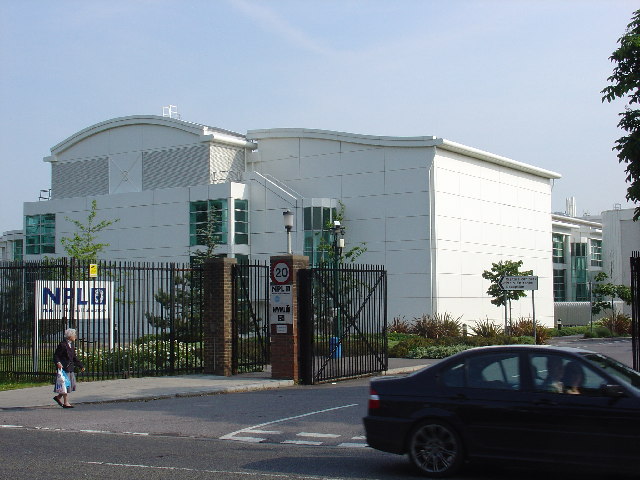
National Physical Laboratory
Laboratory in Teddington, EnglandWikipedia
8
MENTIONS
8
EPISODES
8
PODCASTS
Search complete. 8 mentions across 8 episodes found for "National Physical Laboratory".
Sep 26, 2026

Herman PoppleberryHOST
He's thinking about networks that survive damage where there's no single point of failure.
Herman PoppleberryHOST
Separately, in 1965, Donald Davies at the UK National Physical Laboratory conceives of packet switching.
Herman PoppleberryHOST
He's the one who coins the term packet.
Herman PoppleberryHOST
Independently.

ChrisHOST
So after the war, Alan began turning that idea into reality.
ChrisHOST
In 1945, he joined the National Physical Laboratory, helping design one of the first electronic computers, the ACE, the Automatic Computing Engine.
ChrisHOST
In 1948, before ACE was completed, he moved to Manchester University where he became Deputy Director of the Royal Society Computing Laboratory and helped bring the Manchester Mark I into operation, one of the world's earliest working computers.
GrahamHOST
He wrote the first programming manual for the Mark I and used the machine to explore new ideas in mathematical biology, modelling how the markings on animals or the arrangement of leaves on a stem might emerge from a series of simple rules.

Donald GoldfarbGUEST
You have to take the train into Paddington and you have to go wherever you're going in London.
Donald GoldfarbGUEST
And so Gene was having this thing and I had never met Walter Murray, but we had communicated and he was at National Physical Laboratory.
Donald GoldfarbGUEST
So when he communicated with me, he always wrote it on Her Majesty's stationery.
Donald GoldfarbGUEST
And I thought I was communicating with 007.

Tail DraggerHOST
Wallace spent two years fighting for his idea.
Tail DraggerHOST
He tested scaled models and tanks at the National Physical Laboratory, he wrote reports.
Tail DraggerHOST
He ran calculations.
Tail DraggerHOST
He begged for resources.

Laurel LefkowNARRATOR
A turning point in the story of the automated state had come in 1958 when a team of American researchers and ad men built a machine that they claimed could both predict and influence voting behavior.
Laurel LefkowNARRATOR
That year, a landmark conference on the mechanization of thought processes took place at the National Physical Laboratory in Teddington, near London.
Laurel LefkowNARRATOR
Speakers included French, Israeli, Russian, and Hungarian scientists, and they talked of a future in which computers would one day compose music, resolve legal disputes, control air traffic, conduct surgery, and in the administration of government, replace not only clerks, but executives.
Laurel LefkowNARRATOR
In New York, Edward L. Greenfield, the head of a Madison Avenue advertising firm, drafted a proposal for what would become known as a people machine.

Janet JalilHOST
Next month, a general conference on weights and measures, yes, that is a thing, will consider how to deal with this.
Janet JalilHOST
Dr. Setnam Shimar, the principal scientist for the National Timescale Group at the UK's National Physical Laboratory, explains the problem and a possible solution.
Satnam ChimaSOUNDBITE_SPEAKER
solution.The problem is that whenever we insert these leap seconds to keep atomic time or the time on our, our everyday clocks, in order to keep that aligned with solar time, which is based on the rotation of the Earth, modern technology systems, the timing networks in them can have discrepancies in the way the leap seconds are applied, and this can cause inconsistencies or a system crash.
Satnam ChimaSOUNDBITE_SPEAKER
So this could involve a telecom system or an electrical grid system or a system inside the financial sector, and this is the concern why leap seconds are being considered to be replaced by the leap hour.

Sarah GlanvilleGUEST
And my first question was, was where is everybody else? And I really look to have sort of that diversity of thought, that diversity of skill and that diversity of people very much in my sort of landscape that I like to look towards and look into.
Sarah GlanvilleGUEST
At the National Physical Laboratory, it's been a really fun and exciting change for me.
Sarah GlanvilleGUEST
I'm coming up to my 11th month there which feels like I've blinked but the ways that people work how we integrate how we sort of work across multiple disciplines and make sure everybody gets a say is like a really important component of what I do and be that from you know access to labs all the way through to how people think differently and have a different way that they like to pursue their careers.
Kovida MehraHOST
Thank you, Sarah.