National Museum of the United States Air Force
Museum in Riverside, OhioWikipedia
69
MENTIONS
42
EPISODES
11
PODCASTS
Search complete. 69 mentions across 42 episodes found for "National Museum of the United States Air Force".
Sep 21, 2026

Todd HolstHOST
If not, it should be.
Todd HolstHOST
I'm telling you, I think it should be over at the Air Force Museum.
IanPANELIST
I saw one.
IanPANELIST
I pulled up the original post on Facebook about it.
Todd HolstHOST
You know, we don't put any effort into parade floats.
Todd HolstHOST
But I'm glad to see that these guys did.
Todd HolstHOST
But, you know, they've got the Star Wars TIE fighter and the X-Wing fighter over at the Air Force Museum.
Todd HolstHOST
This should be there.

Tail DraggerHOST
Restoration starts that didn't finish, debates about where she properly belonged, the kind of community drama that tends to surround objects that people love but don't quite know how to care for.
Tail DraggerHOST
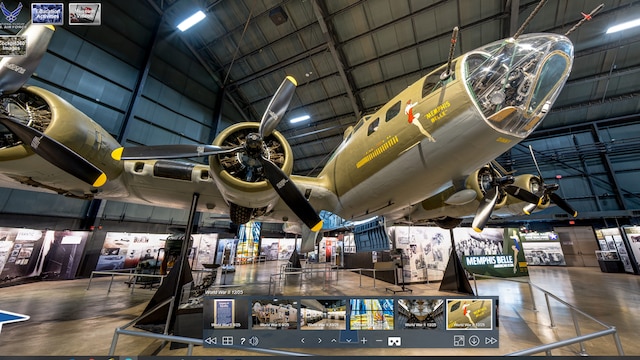
In 2005, the National Museum of the United States Air Force at Wright-Patterson Air Force Base near Dayton, Ohio, took possession of the airplane.
Tail DraggerHOST
They moved her to Dayton, and a team of museum professionals and skilled volunteers began what turned into a 13-year restoration project.
Tail DraggerHOST
13 years.
Tail DraggerHOST
The plexiglass was replaced.
Tail DraggerHOST
The guns, non-functional but period-correct in appearance, were properly positioned.
Tail DraggerHOST
And on May 17, 2018, exactly 75 years to the day after that last mission to Wilhelmshaven, the Memphis Belle was unveiled in the World War II gallery of the National Museum of the United States Air Force.
Tail DraggerHOST
Several members of the original crew lived to see it.
Tail DraggerHOST
He was 74 years old.
Tail DraggerHOST
The meteor is preserved at the National Museum of the United States Air Force in Dayton, Ohio.
Tail DraggerHOST
If you find yourself in Dayton, go see it.
Tail DraggerHOST
It's worth standing in front of for a while.
Tail DraggerHOST
And then he got in the airplane and proved it was true every single time.
Tail DraggerHOST
He was right about all of it.
Tail DraggerHOST
Thanks to the National Air and Space Museum and the historical collections at the National Museum of the United States Air Force for the material behind today's show.
Tail DraggerHOST
More at RadioHanger.com. I'm Tail Dragger.
Tail DraggerHOST
That's Frank Luke, the Arizona Balloon Buster.
Tail DraggerHOST
Tonight's story draws from the historical records preserved by the National Museum of the United States Air Force, the Medal of Honor archives, and the firsthand accounts compiled in the histories of the First Pursuit Group.
Tail DraggerHOST
You can find us at RadioHanger.com. I'm Tail Dragger, fly safe, and if you ever find yourself over the front at low altitude with the flak coming up, remember the kid from Phoenix who made it look easy.
Tail DraggerHOST
Sometimes that's the real story.
Tail DraggerHOST
Primary sources today include Roger Freeman's The Mighty Eighth, Robert S. Johnson's memoir Thunderbolt, Francis Gabreski's Gabby, A Fighter Pilot's Life, and records held by the National Museum of the United States Air Force.
Tail DraggerHOST
More history at RadioHanger.com. Until next time, keep the blue side up.
Tail DraggerHOST
He poured the iced tea and he went home.
Tail DraggerHOST
Sources for today's segment include Phil Handelman's biography of Hoover, contemporaneous reporting in Aviation Week and Space Technology, and the collections at the National Museum of the United States Air Force.
Tail DraggerHOST
More at RadioHangar.com. See you in the hangar.

Aaron BurnsGUEST
So we play a lot of songs from the era, a lot of music from the era.
Aaron BurnsGUEST
And then we worked with all of their consultants from the Air Force, from the Air Force Museum.
Aaron BurnsGUEST
to help make sure that we got all the details right and portrayed everything accurately.
Aaron BurnsGUEST
And now they're getting behind the film and helping us to celebrate the service and sacrifice that all those airmen have given for our country.
Tail DraggerHOST
Walk into Hangar 3 at the National Museum of the United States Air Force at Wright-Patterson in Dayton, Ohio, and you'll find her toward the back.
Tail DraggerHOST
Silver fuselage, four big Wright-duplex cyclone radials, a blunt nose with a glass bombardier's position pointing straight at you.
Tail DraggerHOST
The placard on the floor reads, Boxcar.
8 MINS LATER
Tail DraggerHOST
She was transferred to what was then the Air Force Museum at Wright-Patterson and put under a proper roof.
Tail DraggerHOST
A full restoration followed.
Tail DraggerHOST
Today, she stands in the World War II Gallery of the National Museum of the United States Air Force, restored to her August 9th appearance, the marking she wore that morning.
Tail DraggerHOST
And the museum itself, I'll say this every time I mention it, is free.
Tail DraggerHOST
The National Museum of the United States Air Force, Dayton, Ohio, four connected hangars, over 350 aircraft and spacecraft, including presidential transports, experimental aircraft, nuclear delivery systems, and pieces of history you simply cannot find anywhere else.
Tail DraggerHOST
a test pilot named Harker writing a memo, and everything changed.
Tail DraggerHOST
Sources for today's segment include Roger Freeman's The Mighty Eighth, the Air Force Historical Research Agency, and the collections at the National Museum of the United States Air Force in Dayton.
Tail DraggerHOST
More episodes of The Hanger are at RadioHanger.com. I'm Tail Dragger.
Tail DraggerHOST
Keep the shiny side up.

Don MastersonHOST
On the night of March 9th and 10th, 1945, American bombers attacked Tokyo with incendiaries.
Don MastersonHOST
The National Museum of the United States Air Force describes a low-altitude night raid and destruction across nearly 16 square miles.
Don MastersonHOST
The Smithsonian estimates that close to 100,000 people were killed.
Don MastersonHOST
Those deaths belonged to an actual attack, carried out with conventional weapons.
32 more episodes mention National Museum of the United States Air Force.
Create an account to see the whole feed, search across every transcript, and follow the entities you care about.