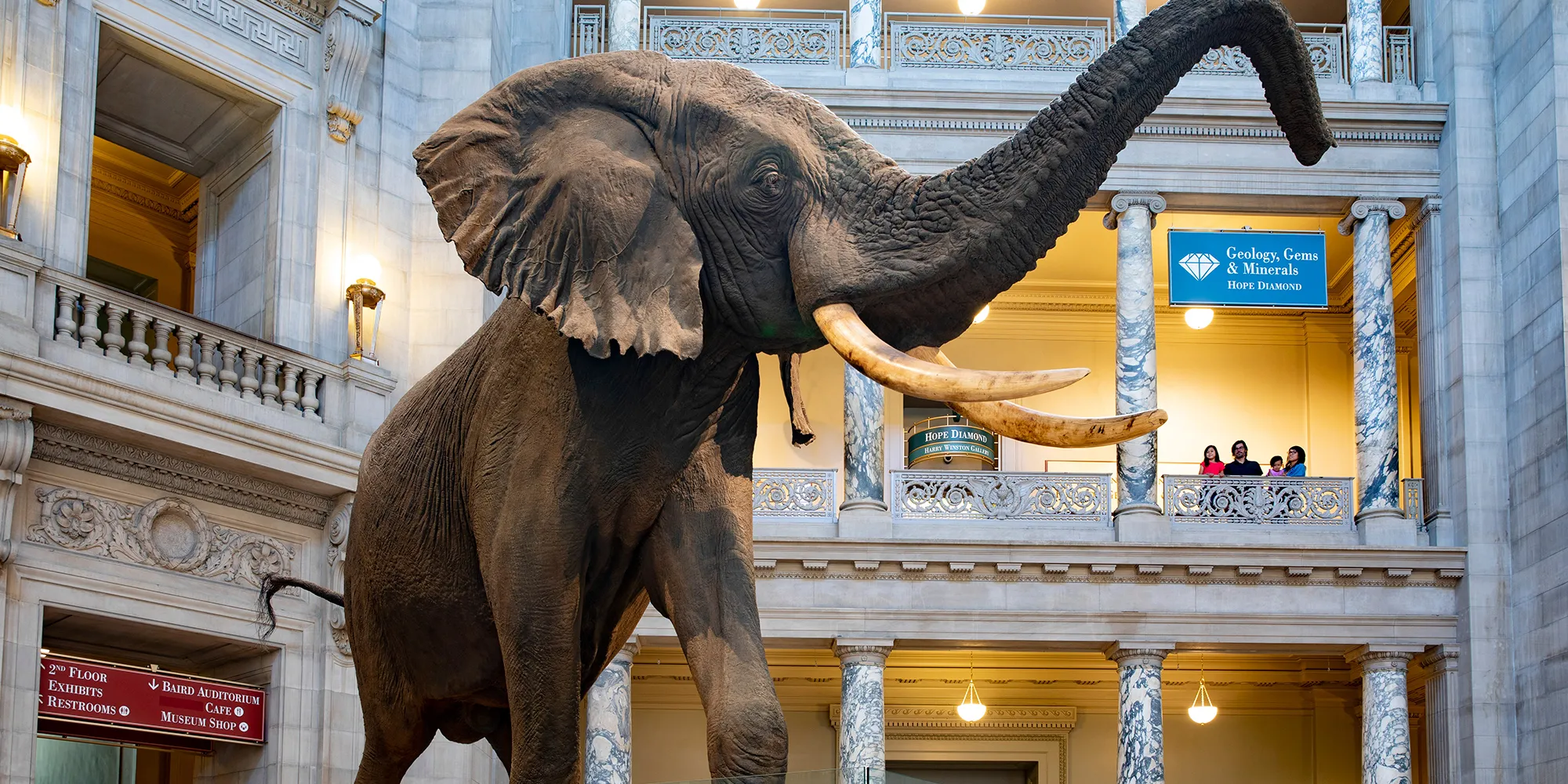
National Museum of Natural History
Natural history museum in Washington, D.C., United StatesWikipedia
15
MENTIONS
14
EPISODES
14
PODCASTS
Search complete. 15 mentions across 14 episodes found for "National Museum of Natural History".
Sep 17, 2026

Rob MullenGUEST
Robert Bateman had a big exhibition at the National Museum of National History, which is the Smithsonian's Natural History Museum, it's the largest by a factor of four in the world.
Rob MullenGUEST
The American Museum in New York, which is, I'd say, a little more famous, is one-fourth the size of the National Museum of Natural History.
Rob MullenGUEST
So this is a massive museum right on the mall there in Washington, D.C. And our original focus was an exhibition there.
Rob MullenGUEST
We got it approved and then the director was, had his head chopped off and went rolling down the hall and some big political scandal.

Larry KudlowHOST
And when the U.S. or the Saudis or somebody is just going to take them out.
Larry KudlowHOST
And President Trump wants a 30-foot statue of George Washington out in front of the Smithsonian Museum of Natural History.
Larry KudlowHOST
Imagine that, folks.
Larry KudlowHOST
A museum that's actually about American history, including George.

Lindsay GrahamHOST
But the diamond will never be returned to France.
Lindsay GrahamHOST
Instead, it will eventually be donated to the Smithsonian National Museum of Natural History in Washington, DC.
Lindsay GrahamHOST
It remains on display there to this day, and each year, millions of visitors come to admire its beauty, just as the thief Paul Miéte once did when he was planning an extraordinary heist that began on September 11th, 1792.
Lindsay GrahamHOST
[instrumental music plays] Next on History Daily, September 14th, 1812.

Don MurphyHOST
Dale received his PhD in comparative biochemistry from Iowa State University and worked in the pharmaceutical industry for many years.
Don MurphyHOST
However, the rest and best of the story comes after Dale retired and began volunteering for the National Museum of Natural History at the Smithsonian in Washington, D.C.
Don MurphyHOST
There he worked for the past 15 years curating the fossil insect collections.
Don MurphyHOST
He initiated the Kishine formation fossil insect collection project and has been responsible for all field work and curation of the collection and interaction with and reports to the U.S. Forest Service.

TerryNARRATOR
You're listening to a reading of articles and features from Scientific American magazine on the Niagara Frontier radio reading service.
TerryNARRATOR
In 2024, evolutionary geneticist Moreno Maillard and his colleagues published a major study of ancient DNA from the island, using remains from 15 individuals held in the National Museum of Natural History in Paris.
TerryNARRATOR
Radiocarbon dating showed that the remains were from a range of times between 1670 and 1950. all dated to after the supposed 1600s collapse.
TerryNARRATOR
Some also dated to after European contact.

Ben SuttonGUEST
I mean, it's interesting.
Ben SuttonGUEST
Three weeks after the July 4th report sort of taking issue with all these various things at the Smithsonian National History Museum, Trump issues this executive order ordering the National Park Service which manages the National Mall, you know, which is the green space that many of the Smithsonian's museums face onto, instructing the National Park Service to erect signage that people would essentially have to pass by in order to enter the museum, you know, warning them that like there could be misleading information inside.
Ben SuttonGUEST
To my knowledge, I haven't triple-checked recently, but as of a couple weeks ago, at least one person who lives in Washington DC confirmed that there had been no signage erected yet.
Ben SuttonGUEST
Obviously that could change at any time.

Mike HenleyGUEST
There are several amazing documentaries that highlight reefs.
Mike HenleyGUEST
And of course, the Smithsonian Natural History Museum's website, ocean.si.edu, is a great resource, as well as NOAA.
Mike HenleyGUEST
NOAA has great coral reef educational materials as well.
Robert CarpenterHOST
We'll put some

CovinoHOST
You know, national museums, uh, have articles on it.
CovinoHOST
The Smithsonian, uh, Smithsonian National Museum, they have more sources, stories behind it, and who owned it.
CovinoHOST
Um, yeah, just look it up if you wanna learn more.
CovinoHOST
Also, if you don't have Spotify or Apple Podcasts or wherever you get your streaming service, you could always join our website, mysteriesandbeyond.com, where we have our most recent episode on there and five of our previous episodes on there as well.

speaker_4NARRATOR
The Hope Diamond.
speaker_4NARRATOR
Smithsonian National Museum of Natural History, Washington, D.C. You've probably seen it.
speaker_4NARRATOR
45.52 carats of deep blue diamond.
speaker_4NARRATOR
Worth probably $250 million.

Richie HodelGUEST
So it's certainly wasn't for the money.
Richie HodelGUEST
Um, but I got into it, I think, with my, uh, postdoc supervisor at the, uh, National Museum of Natural History, Jun Wen, um, who's been studying it a bit for quite a while, among other groups in the Rosaceae.
Richie HodelGUEST
Um, and we really started to figure out that it's a really cool system for understanding, um, not just the evolution of this specific group, but how plant groups might evolve, um, on our planet as it changes, especially with respect to climatic and environmental changes over time.
MattHOST
Hmm.
4 more episodes mention National Museum of Natural History.
Create an account to see the whole feed, search across every transcript, and follow the entities you care about.