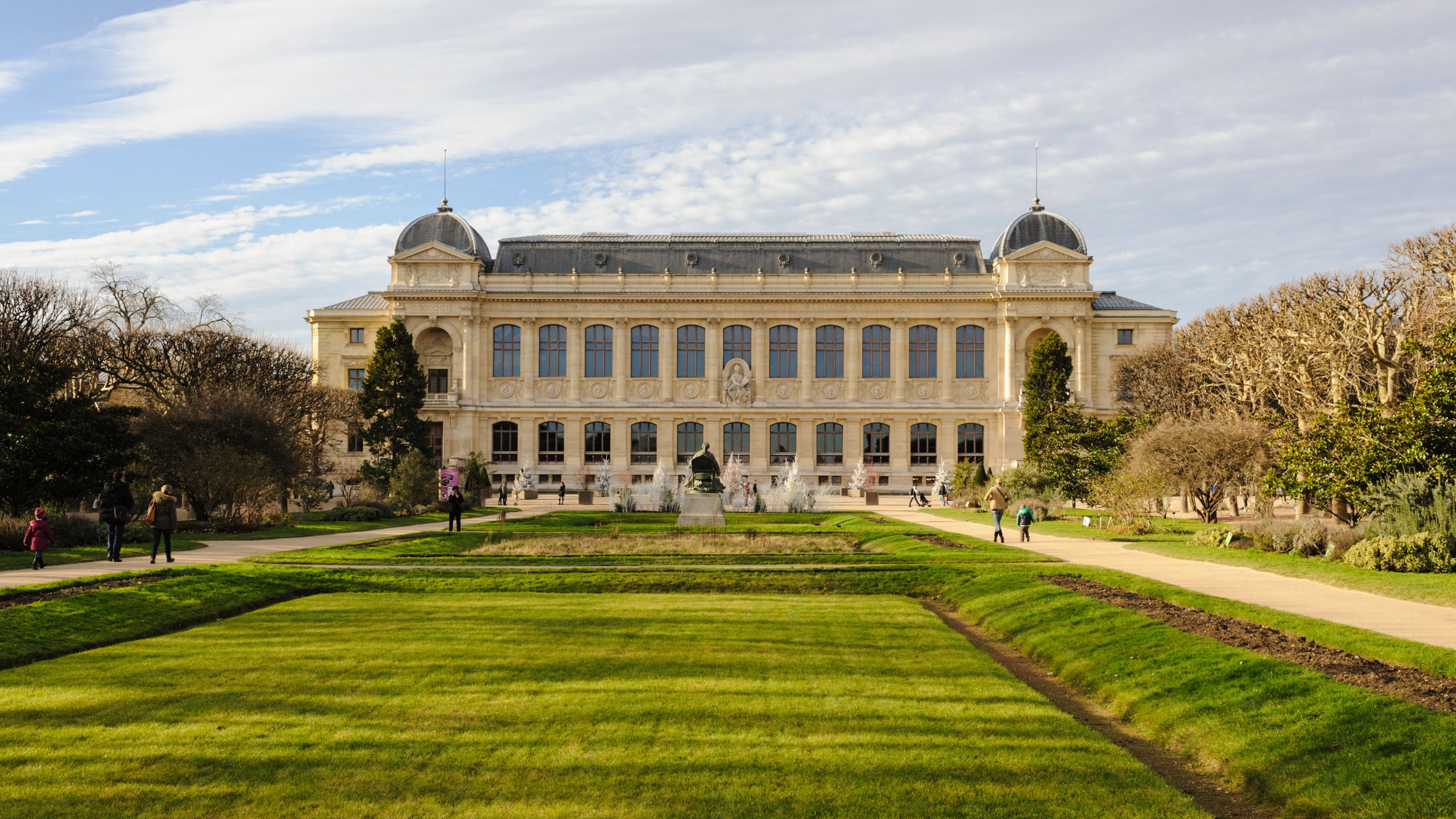
National Museum of Natural History
Natural history museum in Paris, FranceWikipedia
7
MENTIONS
6
EPISODES
6
PODCASTS
Search complete. 7 mentions across 6 episodes found for "National Museum of Natural History".
Sep 28, 2026

Jeff LarsonHOST
He prepared the skins and bones, shipped them to Paris, and the Paris museum got...
Jeff LarsonHOST
It, it's called the Museum National d'Histoire Naturelle in Paris.
Jeff LarsonHOST
But the whole world's like, "Oh, wow, there's another type of bear," and this is, like, the last bear to be documented worldwide, right?
Mike SmithHOST
Yeah.

Evan ShinnersHOST
In this balloon, no source of heat was taken up, so that the air inside rapidly cooled and the balloon soon descended.
Evan ShinnersHOST
The news of the experiment at Annonay attracted so much attention at Paris that Barthelemy Fougeray de Saint-Fond, 1741 to 1819, afterward professor of geology at the Musee d'Histoire Naturelle, set on foot a subscription for paying the expense of repeating the experiment.
Evan ShinnersHOST
The balloon was constructed by two brothers of the name of Robert under the superintendence of the physicist J.A.C. Charles.
Evan ShinnersHOST
The first suggestion was to copy the process of Montgolfier, but Charles proposed the application of hydrogen gas, which was adopted.

Kat HopeHOST
Music Violinist, composer, zoo musicologist and author Dr Hollis Taylor performs recompositions of avian songs on violin alongside her environmental field recordings and reimagines the pied butcherbird repertoire for other human instruments and voices.
Kat HopeHOST
Dr. Taylor has held research appointments at the Sydney Conservatorium of Music, the Institute for Advanced Study in Berlin, the Museum of Natural History in Paris, the University of Technology Sydney and Macquarie University.
Kat HopeHOST
She jointly received the 2025 Richard Gill Award for Distinguished Services to Australian Music with John Rose.
Kat HopeHOST
In addition to her CD, Absolute Bird, she is an author of three books, is birdsong music, post-impressions, and most recently, music from another species, Australian birdsong transcriptions.

speaker_2NARRATOR
Brigitte Senou is a specialist in fossil morphology, or the study of the shape of ancient skeletons.
speaker_2NARRATOR
She and Martin are based here at the French National Museum of Natural History, one of the oldest museums of its type in the world.
speaker_2NARRATOR
By finding such significant bones, they are on the brink of a revolutionary and controversial new theory of how we came to be.
Brigitte SenutGUEST
It's not an easy position, but don't forget that science don't proceed or don't get better with established ideas.
30 MINS LATER
speaker_2NARRATOR
It is likely then that Aurorin touganensis was a creature that is ancestral to each and every one of the six billion modern humans on the planet today.
speaker_2NARRATOR
Say hello to your grandparent.
speaker_2NARRATOR
With the discovery of Millennium Man, scientists from the French National Museum of Natural History can at last get a glimpse of the species from which we are all likely to have descended.
Martin PickfordGUEST
It's about the size of a chimp, a modern chimp.

speaker_15NARRATOR
work of the Curies, discovery of radium, enormous energy, various uses.
speaker_15NARRATOR
Early in 1896, just a few months after Roentgen had startled the scientific world by the announcement of the discovery of the X-rays, Professor Henri Becquerel of the Natural History Museum in Paris announced another discovery.
speaker_15NARRATOR
which if not as mysterious was more puzzling and still continues a puzzle to a great degree to the present time studying the action of the salts of a rare and very heavy mineral called uranium becquerel observed that their substances give off an invisible radiation which like the roentgen rays traverse metals and other bodies opaque to light as well as glass and other transparent substances like most of the great discoveries it was the result of an accident becquerel had no idea of such radiations had never thought of their possibility the early days of the roentgen rays there were many facts which suggested that phosphorescence had something to do with the production of these rays it then occurred to several french physicists that x-rays might be produced if phosphorescent substances were exposed to sunlight becquerel began to experiment with a view to testing this supposition he placed uranium on a photographic plate which had first been wrapped in black paper in order to screen it from the light after this plate had remained in the bright sunlight for several hours it was removed from the paper covering and developed a slight trace of photographic action was found at those parts of the plate directly beneath the uranium just as becquerel had expected from this it appeared evident that rays of some kind were being produced that were capable of passing through black paper since the x-rays were the only ones known to possess the power to penetrate opaque substances it seemed as though the problem of producing x-rays by sunlight was solved
Tyler ReddickADVERTISER
Tyler Reddick here from 2311 Racing.

JohnHOST
It's now called this smooth thing with strange feet.
JohnHOST
Fun fact, by the way, that original specimen that was described, it was housed in the Museum of Natural History in Paris when it was described.
JohnHOST
By 1964, it was missing.
JohnHOST
So the original specimen that it was described from isn't there anymore.