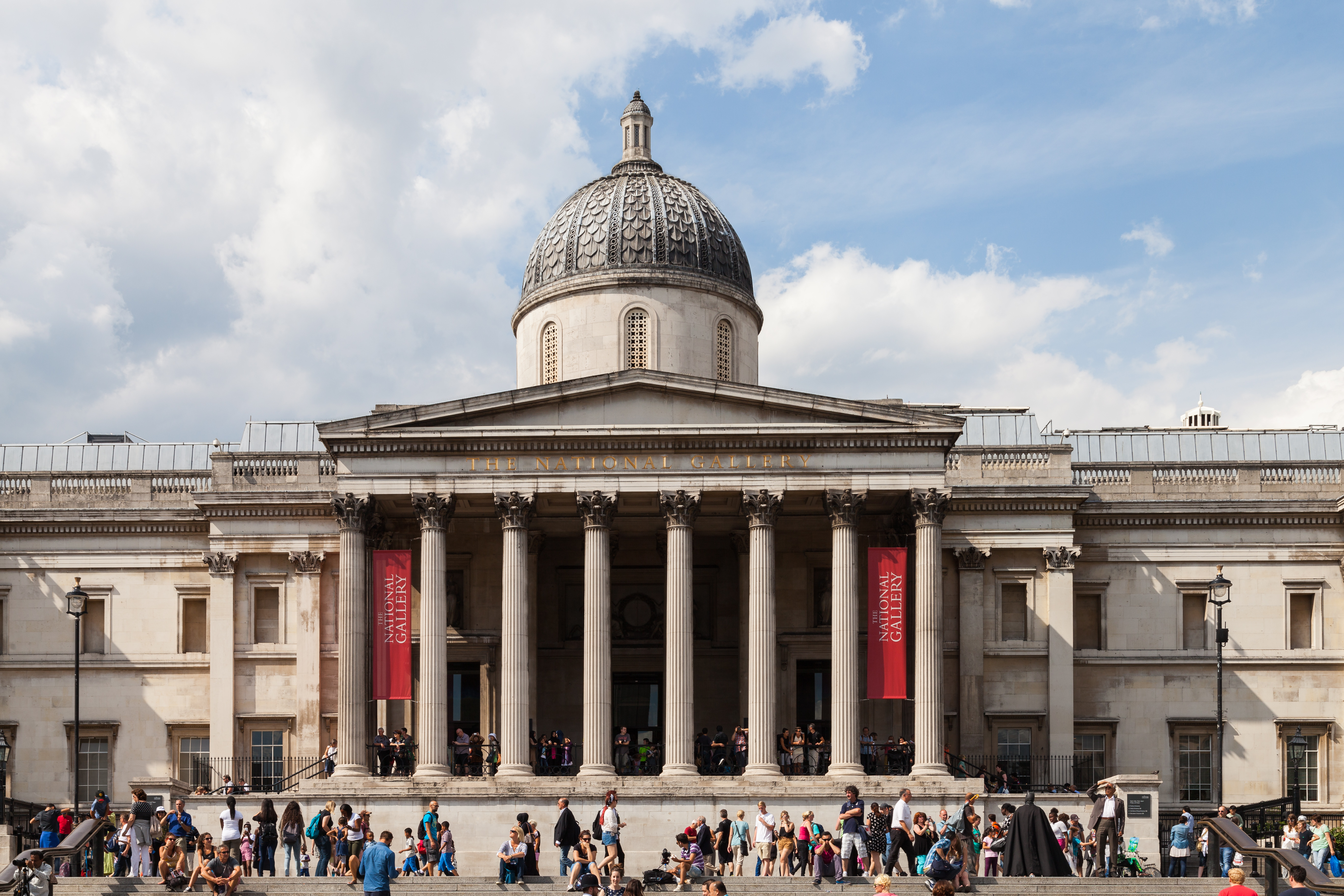
National Gallery
Museum in London, EnglandWikipedia
191
MENTIONS
90
EPISODES
82
PODCASTS
Search complete. 191 mentions across 90 episodes found for "National Gallery".
Oct 29, 2026

Bill NighyHOST
I'm Backing Britain was scrawled across this person's bulging backside.
Bill NighyHOST
Above him, on the steps of the National Gallery, were the peripatetic folk with the new ancient faces, Jesus boots, caftans, sporadic bursts of song, or tinkling breaking a tranquilized hush.
Bill NighyHOST
Alexander went in.
Bill NighyHOST
She was not there, as he might have known.
Bill NighyHOST
which had been removed for the performance, so he was left to sit on a bench contemplating an alternative Gloriana, rattled, white-leaded, bestriding the counties of England in thunderstorm and sun, painted an inch-thick horsehair topped and hennaed, heavy with quilted silk propped and constricted by whalebone.
Bill NighyHOST
The crowd flowed between him and the paintings.
Bill NighyHOST
It seemed to have overflowed from the steps of the National Gallery, variously uniformed, uniformly various.
Bill NighyHOST
Grimy, thonged feet under silky, fluffy, matted beards over sari and saffron robe.

Robyn DavidsonHOST
And it just sort of stays with you.
Matt StephensGUEST
Yeah, I think there's a lot of paintings that I like and I wouldn't want to choose my favourite, but I think one of the most impactive paintings is in the National Gallery.
Matt StephensGUEST
It's enormous.
Matt StephensGUEST
It's very famous.

Evie HatchHOST
Maybe a couple of artists get to do a residency or something, but to have a full studio is unreal.
Evie HatchHOST
Imagine having that in the National Gallery or something.
Louise ReynoldsHOST
so good wouldn't it yeah so were they friends or were they rivals we haven't even talked about the rivalry
Evie HatchHOST
there's so much interesting stuff to talk about it's not that yeah yeah the rivalry between them is completely artificial basically there was a man called i hope that's right we'll take it yeah Something like that.
Louise ReynoldsHOST
And was there a perceived hierarchy between, as in, you know, oil painting, why imagine oil painting being the top of the tree and pastel painting or pastel drawing maybe a little bit lower than oil painting? Oil painting in European art is always kind of...
Evie HatchHOST
yeah for a while for a long time still is i would argue yes oh my gosh absolutely in the market yeah yeah
Louise ReynoldsHOST
absolutely so labiglia's self-portrait oh you know what i love vigi lebrun's self-portrait the one that's in the national gallery with the straw hat and it's after a um it's after a rubens portrait which is also called it's called a woman with a straw hat although in the rubens portrait she's not actually wearing a straw hat So I think that the title of the work, which was given afterwards, is a little bit sloppy.
Louise ReynoldsHOST
Someone wasn't looking properly.

CocoHOST
true.
CocoHOST
I did do my show at the Edinburgh Fringe in a bin bag when I left my dress at the National Gallery.
CocoHOST
Oh, yeah, you did.
CocoHOST
Yes.

Maddie Rose HillsHOST
The names of paints are so familiar in the world of traditional art materials, but what do they actually mean? Where do they come from and what can they reveal about the history of colour? Evie is a pigment specialist and art historian who writes and presents the hugely popular Jackson's Art Supplies pigment stories.
Maddie Rose HillsHOST
She also lectures and has talked for the National Gallery and Dulwich Picture Gallery on colour and pigments.
Maddie Rose HillsHOST
Yes, this is a conversation about colour names, but it's really about so much more.
Maddie Rose HillsHOST
It's about people, mysteries, accidental discoveries, feuds, poetry and secret recipes.
8 MINS LATER
Evie HatchGUEST
really, like, it was really, really lovely.
Evie HatchGUEST
Yeah.
Evie HatchGUEST
And I have also done various work with the National Gallery, Dulwich Picture Gallery, which has been...
Evie HatchGUEST
So cool.

Oliviero ToscaniGUEST
Where there was power, there is art.
Brian RoseHOST
Yeah, there's a National Gallery here in London.
Brian RoseHOST
And you can go and see every painting.
Brian RoseHOST
And then you can go and research each painting.

Tom AllenHOST
But it's often geared towards the shop.
Tom AllenHOST
I fancy going to the Tate or the National Gallery or the National Portrait Gallery and seeing like a talk or a guide where I have something explained to me because I don't know much about art, but I like it.
Suzi RuffellHOST
Do you know what you should do, Tom? What? Come down to Brighton, go to the Royal Pavilion.
Tom AllenHOST
That sounds like a nice day out.

SteveHOST
These conclusions were reached independently by two archaeologists.
SteveHOST
Recent excavations in Covent Garden adjoining have uncovered an extensive Anglo-Saxon settlement covering about 150 acres, stretching from the present-day National Gallery site in the west to Aldwych in the east.
SteveHOST
As the presumed focus of the city, London Borough was moved back within the old Roman wars.
SteveHOST
The old settlement of London Vic gained the name of Eald Vic, Old Port Eald and the softer form of Vic transposed to Old and Witch in Middle English The street was created in the early 20th century in a project that saw a new street layout destroying Wych Street, which was full of overhangs and projections, and the construction of Australia House and Bush House .

Jon RichardsonHOST
I had a moral dilemma on my hands.
Jon RichardsonHOST
I wanted a cup of tea, preferably with milk in it, but I knew that to move the bottle and wreck the web, I'd feel like I was cluster bombing the National Gallery.
Jon RichardsonHOST
So in an act of pure altruism and human kindness, I left the milk bottle where it was and I used the back door instead, completely forgetting that other people also work in my office.
Jon RichardsonHOST
And moments later, I watched a grinning colleague walk through the door, triumphantly holding the bottle of milk and saying...

Tom OvertonGUEST
I think the most formative thing about that period, I mean, there are so many things, but if she's talking about someone's sort of teens and twenties book, a real sort of strong line was, and if we think about how different it is to have someone getting to that point in their life would experience trying to start life as an artist or painter now.
Tom OvertonGUEST
It was just immediately after the Second World War and there was a sense in the country and more broadly of... kind of state funding for the arts and there being that sort of you know despite living in an entirely sort of shattered continental world that was kind of massively indebted in all sorts of ways that there were you know there was a newly founded arts council alongside you know an NHS and a but also kind of nuclear weapons research campaign but the sense that John started life well he was an art student and then he was called at the military service and then he was did his short period of military service and then became an art student again and that was funded with an ex-serviceman's grant so he had it wasn't an enormous amount of money but he could start out like that and then when he started making money separate to that it was on the bbc the sort of predecessor of the bbc world service um and so that was also another state funded thing and he was this was the time of the um the festival of britain and so the sense of what uh art being produced on behalf of uh in a kind of democratic way on behalf of the people and the idea that the patron of the future was uh was the state or was that the people who had voted who had voted for that government um was i think struck him particularly powerfully because he around this time he met a uh a hungarian jewish um emigre called uh frederick antole who in some ways becomes the subject of his first book his first novel sorry um who who um wrote about uh the renaissance and about how patronage worked in say renaissance florence no he wasn't you know sort of uh early modern florence and how their artists had been considered um kind of craft people who worked to a commission and their sort of individual hand was in how they served that commission that He, John, sort of would have first seen in these paintings when they came one by one as part of the National Gallery, as part of the Picture of the Month thing during the war, alongside works made by the War Artists Advisory Committee.
Tom OvertonGUEST
So suddenly the sense that people were making work to commission again rather than as an art for art, in the sense of art for art's sake or their personal kind of whims.
Tom OvertonGUEST
So I think that was probably the most formative thing.
18 MINS LATER
Tom OvertonGUEST
Yeah, just as a sort of, uh, nice piece of trivia saying ken clark not vmp uh funnily enough uh ken ken clark's son alan clark uh who wrote a book about the first world war is actually in the the footnotes of g so there's a there's a both kenneth clark's into the story but um ways of seeing i mean there's so many sort of potential angles there i mean ways of seeing comes out of a sort of
Omari EdwardsHOST
it it
Tom OvertonGUEST
that very complicated relationship between Kenneth Clark as in the National Gallery, Kenneth Clark, Lord Clark of Culture, Clark, because he is a really formative figure in a different sort of way for John in that he sets the sort of artistic culture because he's obviously a bit older and he's quite established by the time John's coming up as an art student.
Tom OvertonGUEST
He sets the artistic culture into which John becomes a... uh an adult um who is looking at art and you know to the extent that when he's when john is trying to make his way as a painter he's clark he's writing to saying would you come and see my exhibition i could do with your um you know your sort of uh uh, you giving my career a boost.
80 more episodes mention National Gallery.
Create an account to see the whole feed, search across every transcript, and follow the entities you care about.