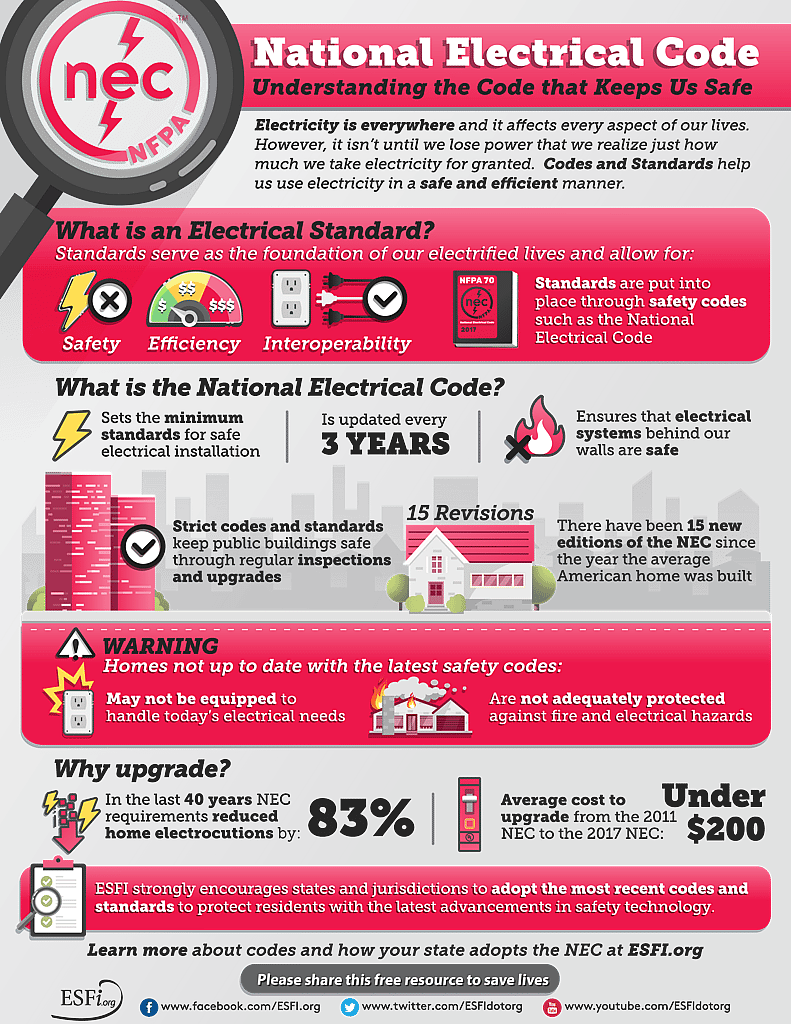
National Electrical Code

National Electrical Code

Search complete. 99 mentions across 38 episodes found for "National Electrical Code".

Nov 23, 2026

Ellen ParsonHOST
1:46
And today I'll be speaking with Paul Abernathy,
Paul AbernathyGUEST
1:49
one of our new NEC code experts.
Ellen ParsonHOST
1:53
We're thrilled to have him with us and we're going to be picking his brain on everything code related a little bit, you know, farther down the line, we're going to be talking about specific code revisions for the 2026 NEC.
Ellen ParsonHOST
2:05
But for now, we're starting it off with getting to know Paul.
Ellen ParsonHOST
2:08
Also, really diving into the inspector, electrical contractor, electrician relationship.

15 MINS LATER

Ellen ParsonHOST
17:37
So thanks for your time today, Paul, for sharing your insights from the field and knowledge with us.
Ellen ParsonHOST
17:42
That's it for today's Code Conversation.
Ellen ParsonHOST
17:44
Please let me know if you have any pressing NEC podcast topics you'd like to listen to in the future.
Sean WhiteHOST
59:35
Thanks for listening to Sean White's Solar and Energy Storage Podcast.
Sean WhiteHOST
59:39
To learn more, go to SolarSP.com. And also, if you want to learn about the National Electrical Code, you can check out my NEC classes with Bill Brooks on the 2026 National Electrical Code.
Sean WhiteHOST
59:55
We have a 15-hour PV National Electrical Code class and a 15-hour TV.
Sean WhiteHOST
1:00:01
energy storage, national electrical code class.
Sean WhiteHOST
1:00:04
They also include a little bit of building and fire codes so you can get all your NABCEP credits and get recertified.
Sean WhiteHOST
1:00:11
So check it out.

Unknown podcast

Solar Charge Controllers Explained: PWM vs MPPT, Safety, and Off‑Grid Prep

Nov 21 · 2 Mentions

speaker_1UNKNOWN
2:22
Think of it as a reckless bartender pouring too much drink into one glass.
speaker_1UNKNOWN
2:28
On the safety side, both types often include overvoltage and overcurrent protection, but you still need to wire them according to NEC 690.31. Use proper conduit, fuses rated for PV use, and keep cable sizes big enough for the panel's short circuit current.
speaker_1UNKNOWN
2:50
If you ignore those wiring rules, you could end up with a fire hazard that's harder to spot than your neighbor's new solar roof because it will be hidden inside the attic.
speaker_1UNKNOWN
3:03
And don't forget the anti-IS landing feature on inverters.
speaker_1UNKNOWN
3:15
Otherwise, you could feed a surge back into an already compromised network.
speaker_1UNKNOWN
3:21
In practice, most small off-grid setups keep it simple.
speaker_1UNKNOWN
3:26
one PWM controller per battery bank and a 12 volt or 24 volt battery because that's what the NEC allows for residential installations without a permit.
speaker_1UNKNOWN
3:38
But if you're aiming to power a whole cabin on 48 volts then you need to double check that your controller's maximum input voltage matches the panel array and that your battery bank is sized to handle the surge load when you first start charging after a long night of no sun.

Unknown podcast

Survivalist Preppers Uncover the Hidden Heroes of Water Lines

Nov 21 · 1 Mention

speaker_1UNKNOWN
9:13
As the copper wires warm up, insulation degrades, resistance increases, voltage drops, and a spark can pop at the plug or socket.
speaker_1UNKNOWN
9:25
That's why the National Electrical Code recommends you never exceed eighty percent of a cord's amp rating for continuous use.
speaker_1UNKNOWN
9:35
So what does that look like in practice? First, pick the right gauge.
speaker_1UNKNOWN
9:40
Use a twelve AWG cord for anything over ten amps, ten AWG for up to fifteen amps, and never go above eighteen AWG for heavy loads.

Unknown podcast

Family Emergency Drills 101: Why Your Smoke Alarms, Communication Plan, and Smart Home Hub Matter

Nov 21 · 1 Mention

speaker_1UNKNOWN
3:54
The space is too small, the ventilation isn't up to snuff, and the building's shared systems can't handle an extra combustion source.
speaker_1UNKNOWN
4:04
Now, the National Electrical Code actually gives us a framework for battery-based backup that does not involve combustion, like those whole-house UPS units.
speaker_1UNKNOWN
4:17
But they still require proper enclosure, labeling, and a disconnect switch within easy reach of the unit.
speaker_1UNKNOWN
4:26
Many owners skip the disconnect, thinking it's a nice-to-have, and end up with a fire hazard when the battery overheats.

Unknown podcast

Dental Injuries on the Road – Survival Prep for Tooth Trauma

Nov 21 · 1 Mention

speaker_1UNKNOWN
9:35
I can't stress how critical the wiring and grid interconnection code are.
speaker_1UNKNOWN
9:40
You could have the best turbine in the world, but if you don't run the cable through a conduit that meets NFPA 70, you might be looking at a fire hazard or a legal nightmare when the inspector comes knocking.
speaker_1UNKNOWN
9:57
Short circuits aren't just inconvenient, they can vaporize your whole system.
speaker_1UNKNOWN
10:04
So what's the practical takeaway? Do a site survey.

Unknown podcast

Battery Prep 101: Keep Your Power Packs Ready When the Grid Fails

Nov 20 · 1 Mention

speaker_1UNKNOWN
5:50
And let's not forget the wiring code.
speaker_1UNKNOWN
5:53
The National Electrical Code requires conduit for any new branch circuit in a shared service.
speaker_1UNKNOWN
6:01
That means drilling into walls that belong to other units.
speaker_1UNKNOWN
6:05
Something no tenant can legally do without the landlord's explicit consent.

Unknown podcast

Mental Health Check‑In: Building a Realistic, Respectful System for Long-Term Preparedness

Nov 18 · 1 Mention

speaker_1UNKNOWN
11:29
If there are any signs of electrical fault, a fire alarm going off, or your neighbors start complaining about power quality issues, that's a red flag that you're dealing with more than just a DIY project.
speaker_1UNKNOWN
11:45
In those cases, a licensed contractor can assess whether your system meets the National Electrical Code and local interconnection standards.
speaker_1UNKNOWN
11:56
So to wrap this up, know the legal landscape, respect the physical limits of your roof or yard, get professional help for permits and safety checks, document every step, and stay in communication with your HOA.
speaker_1UNKNOWN
12:14
If you keep these steps in mind, you can enjoy clean energy without turning your neighborhood into a battleground.

Unknown podcast

Aging Off‑Grid: Mobility, Maintenance, and Backup Power in the Long Haul

Nov 18 · 1 Mention

speaker_1UNKNOWN
7:19
So what does that mean for folks who need backup power? The smartest move is to focus on battery storage that meets the building's electrical code, a UPS, or a home battery system that plugs into your main panel, not an external generator.
speaker_1UNKNOWN
7:38
You can also look at solar with a compliant inverter and battery bank that sits in your garage but stays within the 600-volt rating limits set by the National Electrical Code.
speaker_1UNKNOWN
7:53
And if you're in a condo, talk to your board about adding a small diesel tank in a dedicated storage room.
speaker_1UNKNOWN
8:01
It's a long shot.

Unknown podcast

Generator Safety 101: Why You Must Never Run It Inside

Nov 18 · 1 Mention

speaker_1UNKNOWN
2:36
Keeping the generator's exhaust vent pointed away from windows isn't just paperwork.
speaker_1UNKNOWN
2:43
It's a design requirement in the National Electrical Code and the OSHA 1910.269 Safety Standard for Portable Generators.
speaker_1UNKNOWN
2:54
If you ignore those codes and install a transfer switch without proper grounding, you're setting up a situation where the generator could backfeed into your panel, potentially arcing through your wiring while CO is leaking in.
speaker_1UNKNOWN
3:12
The immediate risk is obvious.

28 more episodes mention National Electrical Code.

Create an account to see the whole feed, search across every transcript, and follow the entities you care about.

We value your privacy

We use cookies to understand how you use our platform and to improve your experience. Click “Accept All” to consent, or “Decline non-essential” to opt out of non-essential cookies. Read our Privacy Policy.