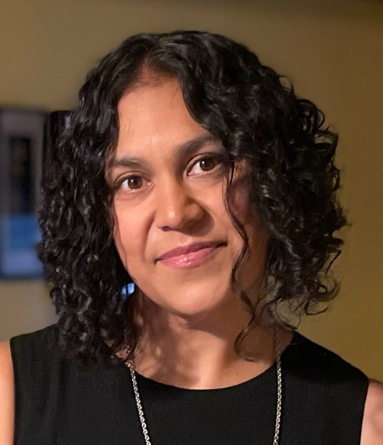
Natasha Ramlall
Embodied integration coach and somatic practitioner, founder of Humanist Coaching, specializing in identity rupture and trauma-informed mind-body work.
4
APPEARANCES
4
PODCASTS
Sep 16, 2026

JennyHOST
ask you if you could talk more about like, how does a person start to nurture self-trust? Um, I guess it is, you just measured the soul connection too, but what does that look like?

Natasha RamlallGUEST
Yeah, I think the soul connection is really helpful when we're struggling because it's always incredibly difficult to come into self-trust.
Natasha RamlallGUEST
Um, But I think that really the pathway back to self-trust is through the body.
Natasha RamlallGUEST
Because as I mentioned before, mistrust, if we're talking about what can't be trusted, that is the stories that we're telling ourselves, that we're living through conceptually in our head.
ChrisHOST
How does it give it


Dave RobertsHOST
What services do you provide to the women that request them? And how does what you do differ from other coaching approaches?
Natasha RamlallGUEST
So the women that are generally attracted to the work that I offer tend to be like me, which means that they have spent a lot of their time up in their thinking mind and sort of living life from that survival state of thinking our way through and really feeling as though we're If we make all of the right choices, we will somehow be able to control the outcomes of our life.
Natasha RamlallGUEST
And so when something happens, and I call this an identity rupture of sorts, maybe a career collapse or a health diagnosis or a significant relationship ending, maybe divorce, or just sort of reaching that midlife point where all of a sudden you're stopping and you're looking at your life and you're wondering why it doesn't feel like a good match.
Natasha RamlallGUEST
Those points along the journey are where that illusion of control kind of bursts.
26 MINS LATER
Dave RobertsHOST
How has his book influenced or provided context to your work as an embodied integration coach?

MargieHOST
So- I'm curious from your point of view, as people are navigating this experience of getting to know themselves better and becoming, um, a more authentic version of themselves, do we have to wait to find our new tribe until we're sort of done with this process? Or do we continue to kind of fake one mask while inside we're doing work? Like, how does, how do you, how do you navigate that in the middle of just real life?
Natasha RamlallGUEST
To be honest, I don't, I don't tend to feel that there is a linear path, and I don't tend to feel that there is a, an exact way for every person in the same way that it will unfold.
Natasha RamlallGUEST
But what I can say is that if we are doing the work of reaching deeper self-understanding and self-love, which I think is actually at the heart of, of everything we're doing, for me, the ultimate goal is coming back to self-love, and maybe we can talk about that a little bit, um, later.
Natasha RamlallGUEST
But in order to do that, I think we have to get really honest about our relationships.
Natasha RamlallGUEST
And so, you know, those friendships that we have always... alcohol has always been a big part, I don't necessarily think that the friendship itself, um, needs to be, uh, um...
Natasha RamlallGUEST
We don't need to necessarily get rid of all our friendships is what I'm trying to say.
MargieHOST
... and yet, um, this is, this is the expectations?


Natasha RamlallGUEST
yeah it's um embodied integration is really looking at how generally in the culture that we live in in the ways we've been conditioned and likely out of you know the the protective mechanisms that drive us in our life we've kind of fractured these different parts of our human experience and then we've over-prioritized particular parts.
Natasha RamlallGUEST
So especially for high-functioning, hyper-capable women, we are up in our heads and we are living primarily from the stories that we are understanding at a cognitive level.
Natasha RamlallGUEST
And we're relying on our brain to make meaning of our existence, which is you know, that's biologically and it's primal.
Natasha RamlallGUEST
But the problem is that we have overvalued that way of understanding ourselves and understanding our life at the expense of not understanding what it feels like to be in our body, to be connected to the messages coming from our body, from, you know, nurturing our intuition and and for trusting in that.
Natasha RamlallGUEST
And without those two pieces working together, we're really not living in the full expression of our humanness.
13 MINS LATER