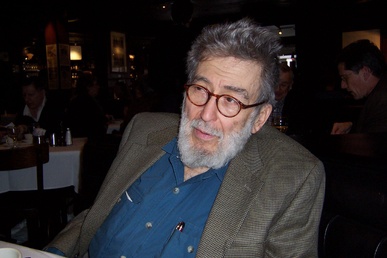
Nat Hentoff
American historian and novelistWikipedia
13
MENTIONS
10
EPISODES
9
PODCASTS
Search complete. 13 mentions across 10 episodes found for "Nat Hentoff".
Sep 26, 2026

Jon PodhoretzHOST
Also, you're not allowed to call anybody a girl anymore, except if you title a show Girls, which I don't think you could even do today, called Girls Girls, named Jessie Hentoff.
Jon PodhoretzHOST
And what was interesting about Jessie Hentoff is that her father, she's a clown, and her father was Nat Hentoff.
Jon PodhoretzHOST
And Nat Hentoff was...
Jon PodhoretzHOST
One of the more famous counterculture journalists of the 20th century was a columnist with the Village Voice, who was also one of the foremost jazz critics of the 20th century and was a First Amendment absolutist, wrote this brilliant column.
Jon PodhoretzHOST
crazy column for the for the for the village voice uh and then became the most heterodox person who ever lived because he was a man on the left who was anti-abortion uh and uh and so he was a very um unique figure uh in american intellectual and public life and his daughter jesse uh was a clown it's it's still a clown it's still one of america's premier academic grounds And I mean that literally not, uh, I, she was very bubbly actually.

Jon PodhoretzHOST
named Jesse Hentoff.
Jon PodhoretzHOST
And what was interesting about Jesse Hentoff is that her father, she's a clown, and her father was Nat Hentoff.
Jon PodhoretzHOST
And Nat Hentoff was one of the more famous counterculture journalists of the 20th century, was a columnist with the Village Voice, who was also one of the foremost jazz critics of the 20th century and wrote, was a First Amendment absolutist, wrote this brilliant crazy column for the Village Voice, and then became the most heterodox person who ever lived because he was a man on the left who was anti-abortion.
Jon PodhoretzHOST
And so he was a very unique figure in American intellectual and public life.

speaker_0NARRATOR
And Clemens finds little literal use of rags in the music, though Coltrane kept returning to Indian ideas about music acting on the listener and on the world.
speaker_0NARRATOR
He told Nat Hentoff he had been studying approaches to music, as in India, where particular sounds and scales are meant to produce particular emotions.
speaker_0NARRATOR
In an interview published in 1963, he told Jean Clousey and Michel Delorme that he wished he could find a way to make it rain when he wanted, or play a song that would cure a sick friend or bring a broke one money, and admitted he did not know which pieces would do it or how to learn them.
speaker_0NARRATOR
The wish reminds me of the old stories of the great Mian Tansen singing Raag Deepak and setting the lamps alight and of Bhimsen Joshi singing Raag Megh Malhar to invoke the torrential Mumbai monsoon.

Ashley KahnGUEST
And in reading, one learns, you know, the craft.
Ashley KahnGUEST
So there's as much Graham Greene, you know, I hope, in my writing as there is, you know, the music, you know, critics and journalists that spoke to me like a Nat Hentoff in the jazz world.
Ashley KahnGUEST
or Lester Bangs, and then later David Frick and Anthony de Curtis, you know, and people like that.
Ashley KahnGUEST
John Pirellis at the New York Times, who were able to, within a very limited, you know, 250 words, 500 words, get the details right and get the relevant information across.

John MorrisonHOST
Tony Williams is playing the drums.
John MorrisonHOST
Nat Hentoff or Amiri Baraka.
John MorrisonHOST
wrote these beautiful liner notes on the back of this record that i'm sampling that's talking about the history and the culture and the sociological and political context with this in which this music was made i'm learning so much history through sampling a prompt it gives you none of that You know what I'm saying? A prompt is just, oh, give me something about, you know, give me a Neil Soul beat that's up-tempo.
John MorrisonHOST
You know what I'm saying? It's divorcing the process from the history.

Chris GregoryHOST
He played sets in several London folk clubs and made the acquaintance of a number of young folk singers, notably the great Martin Carthy, one of the leading lights of the British folk revival.
Chris GregoryHOST
Carthy had the distinction of getting a mention on Nat Hentoff's sleeve notes for Dylan's breakthrough album Freewheeling two years before the release of his own first album.
Chris GregoryHOST
He's credited there as teaching Dylan the melody of the traditional song Lord Franklin, on which Dylan based Bob Dylan's Dream.
Chris GregoryHOST
Carthy devoted his entire career to traditional folk music.

Nish KumarGUEST
I always talk about this piece 'cause I think it's so good.
Nish KumarGUEST
In The Observer in, uh, 2001, there's a piece written by Sean O'Hagan about Bob Dylan that I think is the, my favorite piece of writing about him, and it quotes him saying to Nat Hentoff in Playboy in the mid-'60s, "It's not about breaking rules.
Nish KumarGUEST
There are no rules.
Nish KumarGUEST
Don't you understand?" And it's like he ...

ChrisHOST
And recorded October 5th, 1962 at Van Gelder Studio, Inglewood Cliffs, New Jersey, of course.
ChrisHOST
And Nat Hentoff with our original liner notes.
ChrisHOST
Cover photo and design by Reed Miles.
ChrisHOST
The model on the cover is Ruth Mason.
17 MINS LATER
ChrisHOST
Because the feeling is so right, I expect that this is one bossa nova album that will be played just for pleasure long after The bossa nova fashion has subsided.
ChrisHOST
What makes the album durable, in short, is Ike's own durability as a lyrical, blues-rooted, directly emotional improviser who neither wastes notes nor wants for passion.
ChrisHOST
Nat Hentoff.
ChrisHOST
Amazing liner notes.
ChrisHOST
And I mentioned Rudy Van Gelder.
ChrisHOST
We got the original liner notes from Nat Hentoff.
ChrisHOST
And yeah, let's get into it.
ChrisHOST
Episode 132, Lee Morgan's leeway.
22 MINS LATER
ChrisHOST
Most important is the fact that he loves his instrument and he loves to play.
ChrisHOST
And that's why playing is so alive, so spontaneous, and so constantly searching.
ChrisHOST
Nat Hentoff.
ChrisHOST
Love the liner notes.

Boris KozlovGUEST
Uh, it was kind of both ways.
Boris KozlovGUEST
She was involved in, uh, but she wasn't involved-- It, it, it was not often that she would ask like, "Can you guys play this or that?" Or, "Somebody is coming from the press and wants to hear that." Or, you know, like, "Nat Hentoff is coming and he wants to hear a particular piece."
Jay SweetHOST
Mm.
Boris KozlovGUEST
Uh, it was rare.