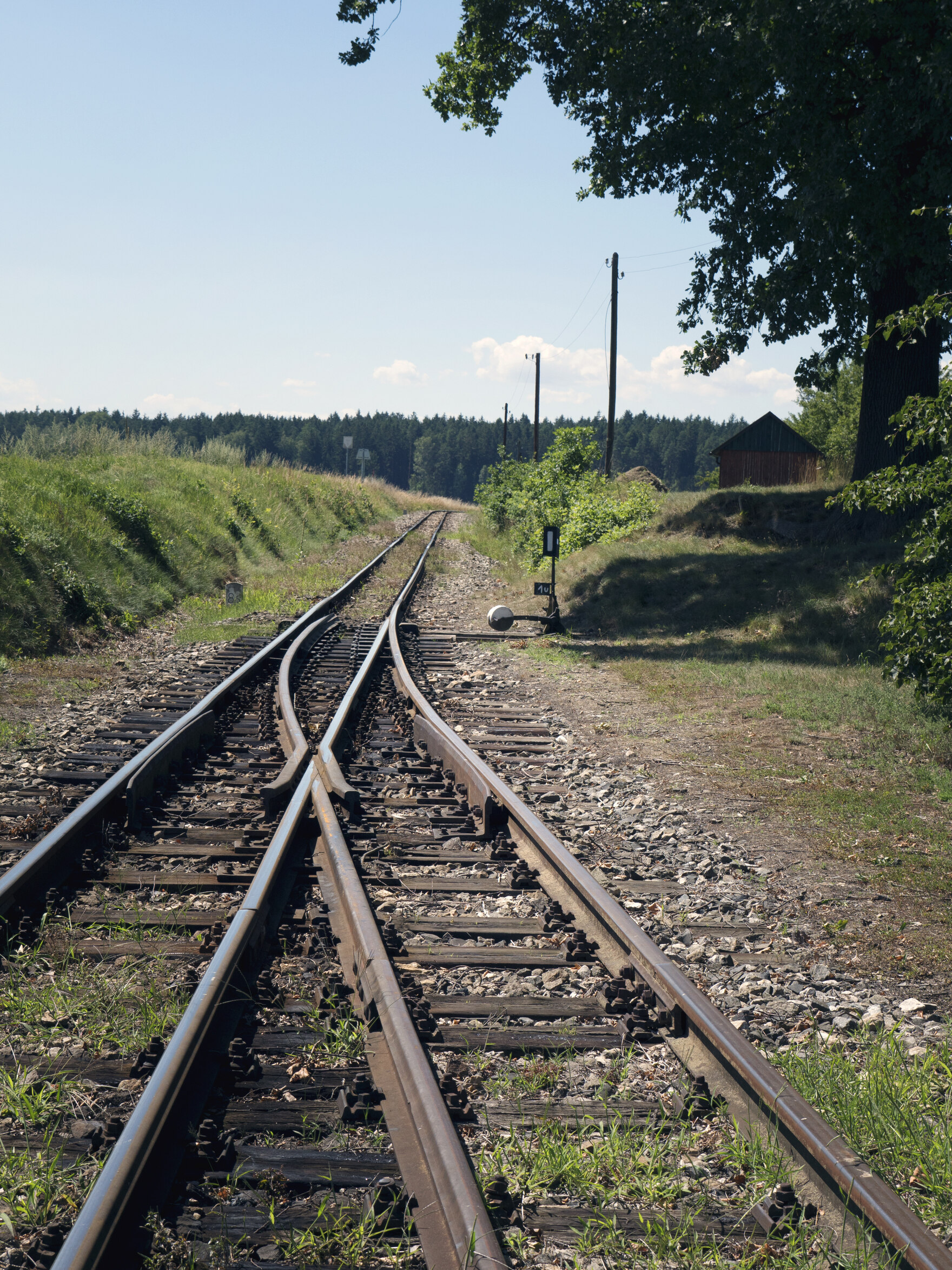
narrow-gauge railway
Track gaugeWikipedia
41
MENTIONS
2
EPISODES
2
PODCASTS
Search complete. 41 mentions across 2 episodes found for "narrow-gauge railway".
Sep 14, 2026

SamHOST
Mm-hmm.
TomHOST
For the standard gauge and the narrow gauge section now.
SamHOST
Mm-hmm.
TomHOST
I have built the harbor walls, which was a case of 3D print, designing and printing in sections.
14 MINS LATER
TomHOST
I like 009.
SamHOST
Really like it.
SamHOST
I think 009, there's, there's loads of reasons that we're gonna be talking about in this current segment, and if you are not a 009-er or you're not someone who's sta- statistically into narrow gauge, we're...
SamHOST
I think we've been quite-

speaker_10NARRATOR
they also precluded the construction of any solid masonry substructure for the turn-table either upon the quay or projected into the river to meet these several conditions the bridge has been designed in the form of a three span bridge that is to say it is only supported by the two abutments two intermediate piers each consisting of a pair of cast-iron cylinders or columns as shown by the dotted circles upon the general plan the central opening is that which serves for the passage of vessels the swing bridge extends over two openings or from the north abutment to the southern pier its centre of revolution being situated over the centre of the northern span and revolves upon a turn-table which is carried upon a lower platform or frame of girders extending across the northern span of the bridge the southern opening is spanned by an ordinary pair of lattice girders in line with the girders and superstructure of the swing bridge we propose at an early date to publish further details of this bridge and the hydraulic machinery by which it is worked we present a perspective view of the bridge as seen from the entrance to the exhibition building which is situated in close proximity to the southern end of the bridge and of section nine
Bryce CriseNARRATOR
PORTABLE RAILWAYS footnote paper read before the institution of mechanical engineers by m de cauville ayne of petit bourg seine en oise france narrow-gauge railways have been known for a very long time in great britain the most familiar lines of this description are in wales and it is enough to instance the festiniog railway two feet gauge which has been used for the carriage of passengers and goods for nearly half a century the prosperous condition of this railway which has been so successfully improved by mr james spooner and his son mr charles spooner affords sufficient proof that narrow-gauge railways are not only of great utility but may be also very remunerative in wales the first narrow-gauge railway dates from eighteen thirty two it was constructed merely for the carriage of slates from festiniog to port matic and some years later another was built from the slate quarries at penryn to the port of bangor as the tract of country traversed by the railways became richer by degrees the idea was conceived of substituting locomotives for horses and of adapting the line to the carriage of goods of all sorts and finally of passengers also but these railways although very economical are at the same time very complicated in construction their arrangements are based upon the same principles as railways of the ordinary gauge and are not by any means capable of being adapted to agriculture to public works or to any other purpose where the tracks are constantly liable to removal these permanent narrow-gauge lines the laying of which demands the service of engineers and the maintenance of which entails considerable expense suggested to m de colville agne farmer and distiller at petit bourg near paris the idea of forming a system of railways composed entirely of metal and capable of being readily laid cultivating one of the largest farms in the neighborhood of paris he contemplated at first nothing further than a farm railroad and he contrived an extremely portable plant adapted for clearing the land of beetroot for spreading manure and for other needs of his farm from the beginning in his first railroads the use of timber materials was rigidly rejected by him and all parts whether the straight or curved rails crossings turntables etc were formed of a single piece and did not require any special workmen to lay them down By degrees he developed his system and erected special workshops for the construction of his portable plant, making use of his farm and some quarries of which he is possessed in the neighborhood as experimental areas.
Bryce CriseNARRATOR
At the present time the system of portable railways serves all the purposes of agriculture, of commerce, of manufactures, and even those of war.
Bryce CriseNARRATOR
Within so limited a space it would be impossible to give a detailed description of the rails and fastenings used in all these different modes of application.
14 MINS LATER
Bryce CriseNARRATOR
A complete equipage, capable of carrying guns weighing from three to nine tons, is composed of trucks with two or three axles, each being fitted with a pivot support, by means of which it is made possible to turn the trucks with the heaviest pieces of ordnance on turntables and to push them forward without going off the rails at the curves.
Bryce CriseNARRATOR
The trucks which have been adopted for the service of the new forts in Paris are drawn by six men, three of whom are stationed at each end of the gun, and these are capable of moving with the greatest ease, guns weighing nine tons.
Bryce CriseNARRATOR
The narrow-gauge railway was tested during the war in Tunis, more than in any preceding campaign, and the military authorities decided, after peace had been restored in that country, to continue maintaining the narrow-gauge railways permanently.
Bryce CriseNARRATOR
This is a satisfactory proof of their having rendered good service.