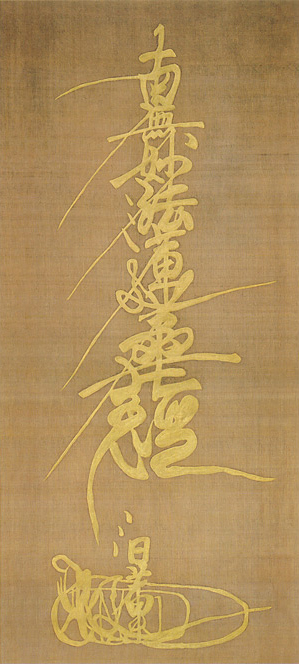
Namu Myōhō Renge Kyō
55
MENTIONS
26
EPISODES
22
PODCASTS
Search complete. 55 mentions across 26 episodes found for "Namu Myōhō Renge Kyō".
Sep 20, 2026

speaker_0NARRATOR
Each and every one of you should be certain deep in your heart that sacrificing your life for Lotus Sutra is like exchanging rocks for gold, or dung for rice.
speaker_0NARRATOR
Now, at the beginning of the Latter Day of the Law, I, Nichiren, am the first to embark on propagating throughout Jambudvipa the five characters of Myoho-renge-kyo, which are the heart of the Lotus Sutra and the eye of all Buddhas.
speaker_0NARRATOR
During the 2220 or more years since the Buddha's passing, not even Mahakashyapa, Ananda, Asvaghosa, Nagarjuna, Nanyue, Tiantai, Miaolo, or Dengyo has propagated them.
speaker_0NARRATOR
My disciples, form your ranks and follow me, and surpass even Mahakashyapa and Ananda, Tiantai or Dengyo.
19 MINS LATER
speaker_0NARRATOR
I felt like Li Ling, who was imprisoned in a rocky cave in the land of the northern barbarians, or the Tripitaka master Faxiang, who was branded on the face and exiled to the area south of the Yangtze by Emperor Hui Zong.
speaker_0NARRATOR
Nevertheless, King Susudan received severe training under the sheer Asita to obtain the blessings of the Lotus Sutra, and even though Bodhisattva Never Disparaging was beaten by the staves of arrogant monks and others, he achieved honor as votary of the one vehicle.
speaker_0NARRATOR
Therefore, nothing is more joyful to me than to have been born in the latter day of the law and to suffer persecutions because I propagate the five characters of Myoho-renge-kyo.
speaker_0NARRATOR
For more than 2,200 years after the passing of the Buddha, no one, not even the great teacher T'ien-t'ai Chih-cheh, experienced the truth of the passage in the sutra that says, "It," the Lotus Sutra, "will face much hostility in the world and be difficult to believe." Only I have fulfilled the prophecy from the sutra, "Again and again we will be banished." The Buddha says, in reference to those who listen to one verse or one phrase of the Lotus Sutra of the Wonderful Law, that, "I will bestow on all of them a prophecy that they will attain supreme, perfect enlightenment." Thus, there can be no doubt that I will reach supreme, perfect enlightenment.

Mark HerrickHOST
My own practice, and the practice of the community I teach, moves between silence and voice.
Mark HerrickHOST
a period of silent calming, a period of chanting Namu Myoho Renge Kyo, a period of settled contemplation.
Mark HerrickHOST
Silent sitting is an act of being, and chanting is an act of doing, and each is stronger with the other.
Mark HerrickHOST
The Western meditation movement focused on the silent practices and left the vocal ones behind.
Mark HerrickHOST
When the sitting turns difficult, chanting is what he prescribed, and it's something we can offer the student when they need it.
Mark HerrickHOST
Not as a consolation, and not as a lesser path, but because the voice can carry what the mind has lost hold of.
Mark HerrickHOST
Namu myoho renge kyo.
Mark HerrickHOST
Namu myoho renge kyo.

Susie WuGUEST
That...
Susie WuGUEST
I speak either, sometimes it's chanting, Nam-myoho-renge-kyo, and you can feel the profile.
Susie WuGUEST
It's very different, and I demonstrate that too.
Susie WuGUEST
So that picture that you showed is in Ellicottville, like their town square.

Isobel MahonGUEST
I do.
Isobel MahonGUEST
I do, I chant Nam Myoho Renge Kyo.
Isobel MahonGUEST
And I, I do sit there s- sometimes, and, and I plan out my next day or that m- for that morning, I plan out the day and what, what it's gonna be.
Isobel MahonGUEST
And so it'd, it'd be amazing when you ...

Machan TaylorGUEST
So he and his wife And I think there were a couple of other people that were there and they just sat in the room with them and they had pillows, you know, meditation pillows that scattered about the room and they started chanting.
Machan TaylorGUEST
Nam-myoho-renge-kyo is the chant.
Machan TaylorGUEST
And it was so magical and so moving.
Machan TaylorGUEST
And I remember my whole body started to buzz from the sound.

KenichiHOST
But the first point, you know, basically this series is to go over the Buddhist perspective of like good health and good life.
KenichiHOST
And, uh, the point one was to chant vigorously, chant Nam-myoho-renge-kyo, and to do gongyo, which is a portion, reading a portion of the sutra.
KenichiHOST
So it's kind of funny, like you wanna know the Buddhist perspective of good health, point one, use Buddhism.
KenichiHOST
Just chant and ch- ch- use the pr- use our Buddhist practice.
10 MINS LATER
KenichiHOST
Um, it's not like, doesn't have to work as hard.
KenichiHOST
So those are all like the whatever, you know, like those are like some physical benefits to it.
KenichiHOST
But I was thinking about it, you know, uh, based on our conversation last week where Shota really shared the first point about doing a vigorous, uh, gongyo and chanting Nam-myoho-renge-kyo every morning to really start the day off.
KenichiHOST
You know, I don't know about you guys, but like when I wake up, even off good rest, I don't always like feel like a Buddha.

Cassidy BradfordHOST
It's okay for it to change, but our dreams give us a destination, a direction to move in.
Cassidy BradfordHOST
Each day, we chant Nam-myoho-renge-kyo toward our goals, big and small.
Cassidy BradfordHOST
Regardless of their size, it's important that they be clear.
Cassidy BradfordHOST
The Buddhist philosopher Daisaku Ikeda said, An arrow will not hit the target unless we take proper aim.
Cassidy BradfordHOST
We can chant to help us clarify our goals.
Cassidy BradfordHOST
Some of us may be swayed by what others think or doubt ourselves.
Cassidy BradfordHOST
As we chant Nam-myoho-renge-kyo, we tap into our inner wisdom, courage, and compassion.
Cassidy BradfordHOST
That helps us see our true self.

Dave GebroHOST
Now, that strain of Buddhism, what is it that separates that from other paths?
David FreibergGUEST
We chant Nam-myoho-renge-kyo, and we don't have any priests.
David FreibergGUEST
We were actually part of the Nichiren Shoshu.
David FreibergGUEST
Nichiren Daishonin was the monk in the 13th century who started this Buddhism, and it went through all kinds of changes.

speaker_3NARRATOR
Nearly two hundred and fifty years ago the daughter of a rich merchant of the city of the shoguns, while visiting some temple festival, perceived in the crowd a young samurai of remarkable beauty.
speaker_3NARRATOR
and immediately fell in love with him unhappily for her he disappeared in the press before she could learn through her attendants who he was or whence he had come but his image remained vivid in her memory even to the least detail of his costume the holiday attire then worn by samurai youths was scarcely less brilliant than that of young girls and the upper dress of this handsome stranger had seemed wonderfully beautiful to the enamoured maiden she fancied that by wearing a robe of like quality and colour bearing the same crest she might be able to attract his notice on some future occasion accordingly she had such a robe made with very long sleeves according to the fashion of the period and she prized it greatly she wore it whenever she went out and when at home she would suspend it in her room and try to imagine the form of her unknown beloved within it Sometimes she would pass hours before it, dreaming and weeping by turns, and she would pray to the gods and the Buddhas that she might win the young man's affection, often repeating the invocation of the Nichiren sect, Nam-myoho-renge-kyo.
speaker_3NARRATOR
But she never saw the youth again, and she pined with longing for him, and sickened and died, and was buried.
speaker_3NARRATOR
after her burial the long-sleeved robe that she had so much prized was given to the buddhist temple of which her family were parishioners it is an old custom to thus dispose of the garments of the dead the priest was able to sell the robe at a good price for it was a costly silk and bore no trace of the tears that had fallen upon it It was bought by a girl of about the same age as the dead lady.
speaker_3NARRATOR
Nevertheless he ventured to sell the luckless garment once more.
speaker_3NARRATOR
Once more it was purchased by a girl and once more worn, and the wearer pined and died, and the robe was given a fourth time to the temple, Then the priest felt sure that there was some evil influence at work, and he told his acolytes to make a fire in the temple court and to burn the robe.
speaker_3NARRATOR
So they made a fire into which the robe was thrown, but as the silk began to burn there suddenly appeared upon it dazzling characters of flame, the characters of the invocation Nam-myoho-renge-kyo, and these one by one leaped like great sparks to the temple roof, and the temple took fire.
speaker_3NARRATOR
Embers from the burning temple presently dropped upon neighboring roofs, and the whole street was soon ablaze.

Jeanette PradoHOST
For those of you that are new here, I practice Nichiren Daishonin's Buddhism.
Jeanette PradoHOST
I chant Nam Myoho Renge Kyo.
Jeanette PradoHOST
This is a beautiful mantra to help elevate your life and help you to shift your life in a beautiful direction.
Jeanette PradoHOST
If this is something that you're interested in starting, you literally just say the words you can start today.
Jeanette PradoHOST
If you want to say it three times with me, Nam Myoho Renge Kyo.
Jeanette PradoHOST
Nam Myoho Renge Kyo.
Jeanette PradoHOST
Do you feel that? One more time.
Jeanette PradoHOST
But yeah, I've been chanting this for 20 years.
16 more episodes mention Namu Myōhō Renge Kyō.
Create an account to see the whole feed, search across every transcript, and follow the entities you care about.