Named-entity recognition
18
MENTIONS
5
EPISODES
5
PODCASTS
Search complete. 18 mentions across 5 episodes found for "Named-entity recognition".
Nov 3, 2026

Christopher ManningHOST
I'm going to introduce a simple NLP task and a simple form of classifier that we can use for it.
Christopher ManningHOST
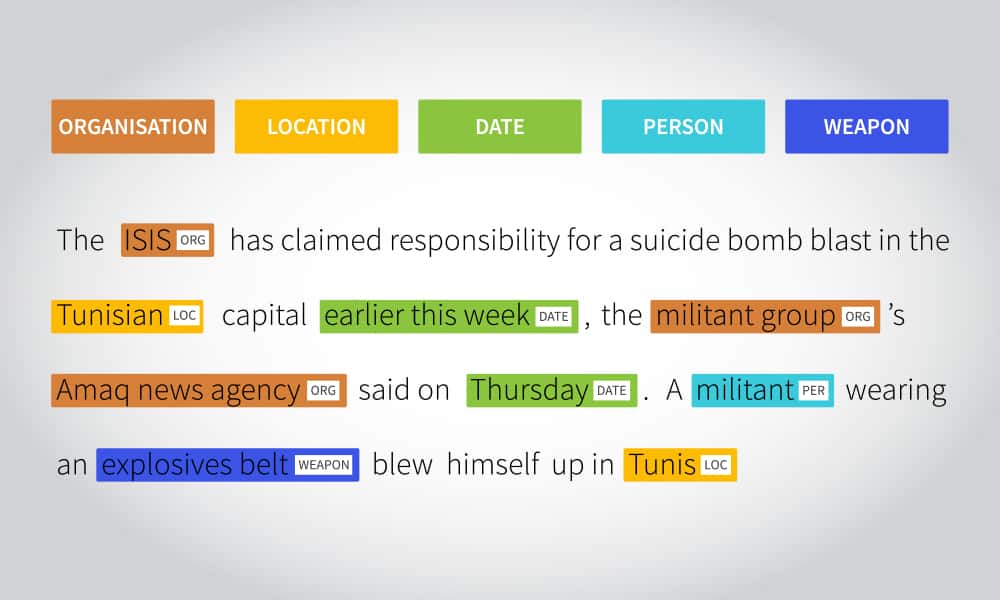
So the task of named entity recognition is a very common basic NLP task.
Christopher ManningHOST
And the goal of this is you're looking through pieces of text and you're wanting to label by labeling the words, which words belong to entity categories like persons, locations, products, dates, times, etc.
Christopher ManningHOST
So for this piece of text, last night Paris Hilton wowed in a sequined gown, Samuel Quinn was arrested in the Hilton Hotel in Paris in April 1989, that some words are being labeled as named entities as shown.
Christopher ManningHOST
These two sentences don't actually belong together in the same article, but I chose those two sentences to illustrate the basic point that it's not that you can just do this task by using a dictionary.
Christopher ManningHOST
Yes, a dictionary is helpful to know that Paris can possibly be a location, but Paris can also be a person name.
Christopher ManningHOST
So you have to use context to get named entity recognition right.
Christopher ManningHOST
OK, well, how might we do that with a neural network? There are much more advanced ways of doing this, but a simple yet already pretty good way of doing named entity recognition with a simple neural net is to say, well, what we're going to do is use the word vectors that we've learned about.

Steven RenwickGUEST
And we have people coming to us asking for all these things, but ultimately what they're being is entity resolution.
Steven RenwickGUEST
And then where you potentially get the confusion is often with named entity recognition.
Steven RenwickGUEST
So, you know, kind of classic NLP stuff where you have a passage of unstructured data and you are trying to identify what is this passage of data about? Like who is the person that was referred to in this passage and what are the relationships they have with other people? things which are in this unstructured data.
Steven RenwickGUEST
Ultimately, it all comes down to an entity.
Tobias MaceyHOST
because i've also seen entities be something that is more of an idea so for instance i've been experimenting with doing some entity extraction for some of my podcast transcripts and one of the values or one of the concepts that i want to extract for being able to provide as a linkage across different episodes is what is the topic or what is the idea that was discussed in the context of this episode and where else was that discussed in a similar way
Steven RenwickGUEST
yeah i mean you could you could certainly almost consider any way of classifying um something could be an entity so that could be that could be the categories and then you're trying to um link everything which is related to that category into one entity um as it turns out there's a there's a million different ways to kind of skin the data cats
Tobias MaceyHOST
and as i've been digging into this field over the past years there are also other neighboring terms that come up so you mentioned named entity recognition which is also sometimes referred to as entity extraction there is entity resolution which is what we're focusing broadly on today and then there's entity disambiguation which is in some ways i've seen disjoint from resolution Although I imagine that there's a decent amount of overlap there.
Tobias MaceyHOST
And I'm wondering if you can provide some of the color that you've had to address in terms of customer education over the years.

speaker_0NARRATOR
We've applied some regex-based guardrails to ensure that occurrences of such words when used as regular English words rather than as entity mentions are not extracted.
speaker_0NARRATOR
This can be alleviated by using context-aware parsing offered by LLMs or out-of-the-box NER models from NLP libraries.
speaker_0NARRATOR
Thank you for listening to this Hackanoon story read by artificial intelligence.
speaker_0NARRATOR
Visit hackanoon.com to read, write, learn, and publish.