Naegleria
5
MENTIONS
3
EPISODES
3
PODCASTS
Search complete. 5 mentions across 3 episodes found for "Naegleria".
Sep 26, 2026

BrewHOST
It was named after Malcolm Fowler, an Australian pathologist who authored the original series of case reports in the British Medical Journal in 1965.
BrewHOST
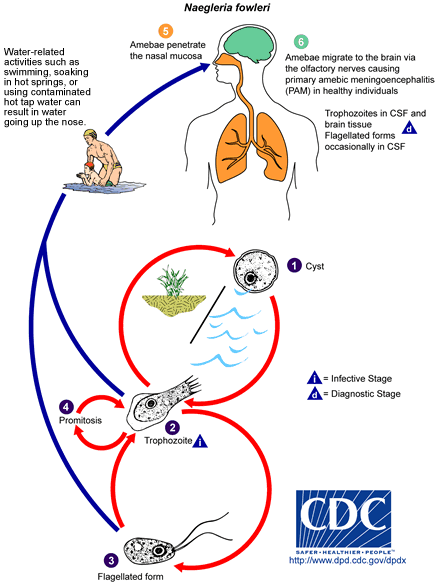
Also, it should be said that there are a number of species of Negleria, but only the Fowlery species causes PAM.
BrewHOST
While it was first identified in Australia, scientists believe that it evolved in the United States.
BrewHOST
In fact, most cases of PAM happen in the southern or southwestern states, with over half of them in Texas and Florida alone.

RobertHOST
Well, Hey everybody, this is Robert and welcome to this live stream I'm doing today.
RobertHOST
And, um, I'm going to be talking about a very serious pathogen and what we know so far this year in 2026 about Naegleria fowleri in 2026.
RobertHOST
And I'm going to go over the different countries that have reported cases and, uh, just talk about that a little bit.
RobertHOST
now i want to go ahead and start in the united states and there have been at least two confirmed cases of naglaria fowleri the cause of primary amoebic meningoencephalitis or pam that had been reported in the u.s in 2026 and the first one was in mid-august when the louisiana department of health reported a confirmed niglaria fowleri infection in an eight-year-old girl who did pass away.
RobertHOST
Now, while the public health investigation does not conclusively determine where the teen was exposed, the findings suggest that a water feature located at a community-based organization in Durham, North Carolina, was the most likely source.
RobertHOST
The teen was reported to have contact with water from the water feature during the likely exposure period, including splashing water on the face.
RobertHOST
Now this water feature was closed by the Durham County Department of Health on August 28th and subsequently tested positive for Naegleria fowleri by the CDC.
RobertHOST
And as of September 15th, it is still closed to the public.

Cindy BayCORRESPONDENT
The water feature at El Futuro remains closed after an investigation linked a teen's death from a brain-eating amoeba to the site.
Cindy BayCORRESPONDENT
Investigators found non-viable Naegleria fowleri DNA, meaning the amoeba had been there at some point.
Cindy BayCORRESPONDENT
A North Carolina teenager died on August 31st.
Cindy BayCORRESPONDENT
Officials tested potential exposure sites, including this Durham water feature, where the report says the teen, identified by his mom as Moises Ponce Mendoza, splashed water on his face.