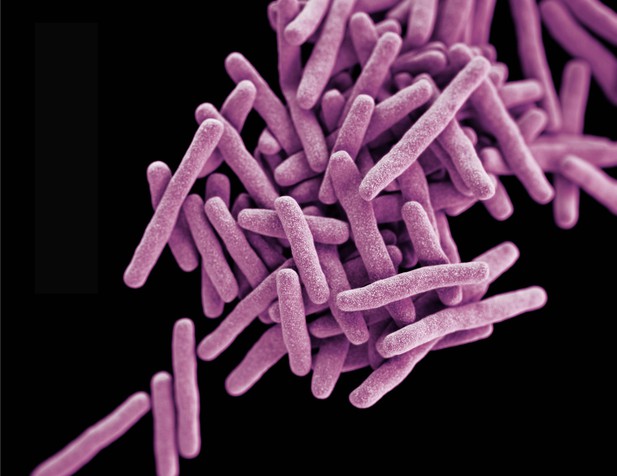
Mycobacterium
BacteriaWikipedia
18
MENTIONS
8
EPISODES
8
PODCASTS
Search complete. 18 mentions across 8 episodes found for "Mycobacterium".
Sep 21, 2026

John GreenHOST
Much of the strangeness here is related to the bacterium itself.
John GreenHOST
Mycobacterium tuberculosis has an unusually fatty, thick cell wall, which makes it difficult for infection-fighting cells to destroy the bacteria.
John GreenHOST
So instead, the bacteria is surrounded, first by one white blood cell, and then by many, which creates this ball of calcifying tissue called a tubercle.
John GreenHOST
As long as these vaguely spherical tubercles hold the bacteria within them, active disease never develops.
John GreenHOST
But if the bacteria escapes and the immune system isn't strong enough to surround all the new bacteria with tubercles, the body can slowly be overwhelmed by infection, eventually leading to death.
John GreenHOST
Now because it takes so long to build the complicated fortress of its cell wall, Mycobacterium tuberculosis has an incredibly slow growth rate compared to other bacteria.
John GreenHOST
Like in laboratory environments, E. coli divides and doubles about once every 20 minutes.
John GreenHOST
Mycobacterium tuberculosis divides about once per day.

Ian GarnerGUEST
We did give that information over to that farm, and they were tested separately for the gold standard test for Yonis, and it didn't reach that clinical level, but they could see elevated levels of the toxin.
Ian GarnerGUEST
was it? Mycobacteria.
Sarah BoltHOST
Mycobacteria,
Ian GarnerGUEST
yeah.
Ian GarnerGUEST
So they could see elevated levels, but it didn't reach the threshold to classify it as something.

speaker_9SOUNDBITE_SPEAKER
And they found that I had...
speaker_9SOUNDBITE_SPEAKER
Mycobacterium avian complex, chronic bronchitis, chronic sinusitis.
speaker_9SOUNDBITE_SPEAKER
I
speaker_17SOUNDBITE_SPEAKER
actually got sick last year from constant cough.

Simon WhistlerHOST
Today we know it as tuberculosis, the deadliest disease to ever crawl the earth.
Simon WhistlerHOST
The main responsible pathogen of tuberculosis, or TB, is the Mycobacterium tuberculosis.
Simon WhistlerHOST
This microorganism has accompanied humans throughout every stage of our history, during which time it may have killed more people than any other living being.
Simon WhistlerHOST
Before we get into the history of this disease, let's quickly profile it.
speaker_1ADVERTISER
causing
Simon WhistlerHOST
miliary tuberculosis, tuberculosis meningitis, or other variants of the disease, such as Pott's disease, which causes spinal deformity.
Simon WhistlerHOST
In all cases, the ruthless bacilli of the Mycobacterium genus will set to work, causing a process called caseation from the Latin word for cheese.
Simon WhistlerHOST
What happens is the invaders will destroy healthy tissue, leaving in their place a thick, cheesy substance.

Yuan ZhaoHOST
What we have shown is that immunosenescence compromises MTB clearance in the lungs when standard anti-TB therapy is given.
Yuan ZhaoHOST
Our work combines TB infection model with immunological and proteomic analysis to link age-associated immune alterations to delayed Mycobacterial clearance.
Ranjan Kumar NandaGUEST
Tuberculosis still remains a global challenge and currently there is a significant increase in the aged population globally and as expected immunosenescence in aged subjects leads to a compromised immune function.
Ranjan Kumar NandaGUEST
like higher inflammation level and then the clearance there will be a compromised protective immune response and that leads to functional impairment.

Peter MazzoneHOST
These results show that antifungal treatment is associated with lower 60-day mortality in patients with COVID-19-associated pulmonary aspergillosis.
Peter MazzoneHOST
Completing this section is a report of phylogenomic and clinical perspectives of an East Asia-specific cluster of Mycobacterium massiliens.
Peter MazzoneHOST
Our COPD section is next.
Peter MazzoneHOST
The association of mild or one moderate COPD exacerbation with prognosis is unknown.

speaker_0HOST
And she was on a grueling multi-month regimen of heavy V antibiotics, imipenem and amikacin, just to stop the necrosis.
speaker_0HOST
So when the pathology team finally cultured the tissue to see what was doing this, they identified a pathogen called Mycobacterium shalona.
speaker_1HOST
Right, Mycobacterium shaloni.
speaker_1HOST
It's a non-tuberculous mycobacteria, and it is the exact reason aesthetic clinics hand you that terrifying list of restrictions.
speaker_0HOST
It's that dangerous.

Nayan PatelGUEST
So they took the blood in a test tube.
Nayan PatelGUEST
They infected the blood with Mycobacterium avium infection.
Nayan PatelGUEST
Now, Mycobacterium has no, has no cure right now, right? And so the only hope we have is that, hey, if your, if, if your own immune system gets stronger, it'll kind of brings it, brings it to check.
Nayan PatelGUEST
And so what there was, what they saw was they infected the blood, uh, the, uh, the test tube with, uh, uh, uh, with this infection, and they were measuring all the s- 30 patients.
Nayan PatelGUEST
50 of them were taking glutathione, and 15 were taking placebo.
Nayan PatelGUEST
No, no medicine whatsoever.
Nayan PatelGUEST
The people that were taking glutathione, they saw a reduction on the Mycobacterium load.
Nayan PatelGUEST
I said, "Hey, what's going on over here?" Then they, then they measured the blood for all the samples.