Mycenae
Archaeological site in GreeceWikipedia
232
MENTIONS
58
EPISODES
55
PODCASTS
Search complete. 232 mentions across 58 episodes found for "Mycenae".
Nov 2, 2026

speaker_0NARRATOR
Heracles was the greatest of all the Greek heroes.
speaker_0NARRATOR
He was the son of Zeus and of a mortal woman named Alcmene, a princess of the royal house of Mycenae.
speaker_0NARRATOR
who lived in the city of Thebes.
speaker_0NARRATOR
And from the very beginning of his life, he was hated by Zeus' wife, the goddess Hera, who resented every child her husband fathered with another.
speaker_0NARRATOR
In a fit of madness sent by the goddess, he killed his own wife and children.
speaker_0NARRATOR
And when he came to his senses and learned what he had done, he went to the oracle of Apollo at Delphi to ask how he could be purified.
speaker_0NARRATOR
The oracle told him to go to Tiryns, near Mycenae, and to serve its king, Eurystheus, for twelve years, and to perform whatever labours the king set him.
speaker_0NARRATOR
These were the famous labours of Heracles, usually counted as twelve.

Tristan HughesHOST
Thanks to Homer's epic, the Iliad, their leader Agamemnon became a legend.
Tristan HughesHOST
But was he real? Who were these Mycenaeans? Where did they come from? And why did they disappear? Today, I'm pleased to welcome Dr.
Tristan HughesHOST
Steve Kershaw to lift the veil on the mystery of the Mycenaeans in Bronze Age Greece.
Tristan HughesHOST
I'm Tristan Hughes.
Tristan HughesHOST
Welcome to the Ancients.
Steve KershawGUEST
And you think it takes you straight back to Aeschylus' plays there, where the beacon fires bring the message of the fall of Troy at the start of that mighty play, the Agamemnon, and the watchman sees it and all the horror is then
Tristan HughesHOST
unleashed.
Tristan HughesHOST
And so today we're talking about the Bronze Age people that are known as the Mycenaeans.

Alejandro DolinaHOST
Este, que tiene varios ciclos, tiene el ciclo de las hazañas, pero tiene un montón de otras historias que se entrelazan.
Alejandro DolinaHOST
Casi no, no, no hay otro personaje mitológico que tenga tantas leyendas anexas, ¿no? Y hoy vamos a terminar la historia de las doce hazañas de Heracles que le fueron encargadas por su enemigo, el rey Euristeo de Micenas.
Patricio BartonHOST
Mmm.
Alejandro DolinaHOST
Que en realidad lo que quería era que Heracles muriera.
17 MINS LATER
Alejandro DolinaHOST
«Lleváselo.
Alejandro DolinaHOST
Pero haceme un favor, dice, ayudame, me voy a poner una almohada.
Alejandro DolinaHOST
Sostenemela un cachito la, la bóveda, que me pongo una almohada acá en el hombro y después andá vos a, a Micenas a llevarle las manzanas a Euristeo».
Patricio BartonHOST
Mmm.

Ivonne de JesúsNARRATOR
Nuestro viaje recorrerá sus regiones más fascinantes, desde la Argólida y Arcadia hasta Laconia y Mesenia.
Ivonne de JesúsNARRATOR
Y aparecen dos fotografías, una de una pintura hecha sobre un fresco, parece, "La dama de Micenas", fresco del siglo XIII antes de Cristo, que podría representar a una deidad.
Ivonne de JesúsNARRATOR
Y se alcanza a ver lo que parece, eh, el perfil de un rostro, eh, y que una persona que está sosteniendo algo en la mano tiene una vestidura en color amarillo, naranja y blanco.
Ivonne de JesúsNARRATOR
Y la siguiente fotografía es de Delfos, el Tholos, templo de planta circular del santuario de Atenea.
Ivonne de JesúsNARRATOR
Y en la foto se alcanza a ver un mar azul completamente calmado, una formación rocosa en medio y un bosque lleno de árboles, así como pequeñas casas pintadas de blanco con techos naranjas, algunos, eh, con puertas y ventanas pintadas en color azul.
Ivonne de JesúsNARRATOR
Algunas, eh, están hechas de color piedra, eh, y se alcanza a ver un pequeño barco en lo que parece ser un muelle.
Ivonne de JesúsNARRATOR
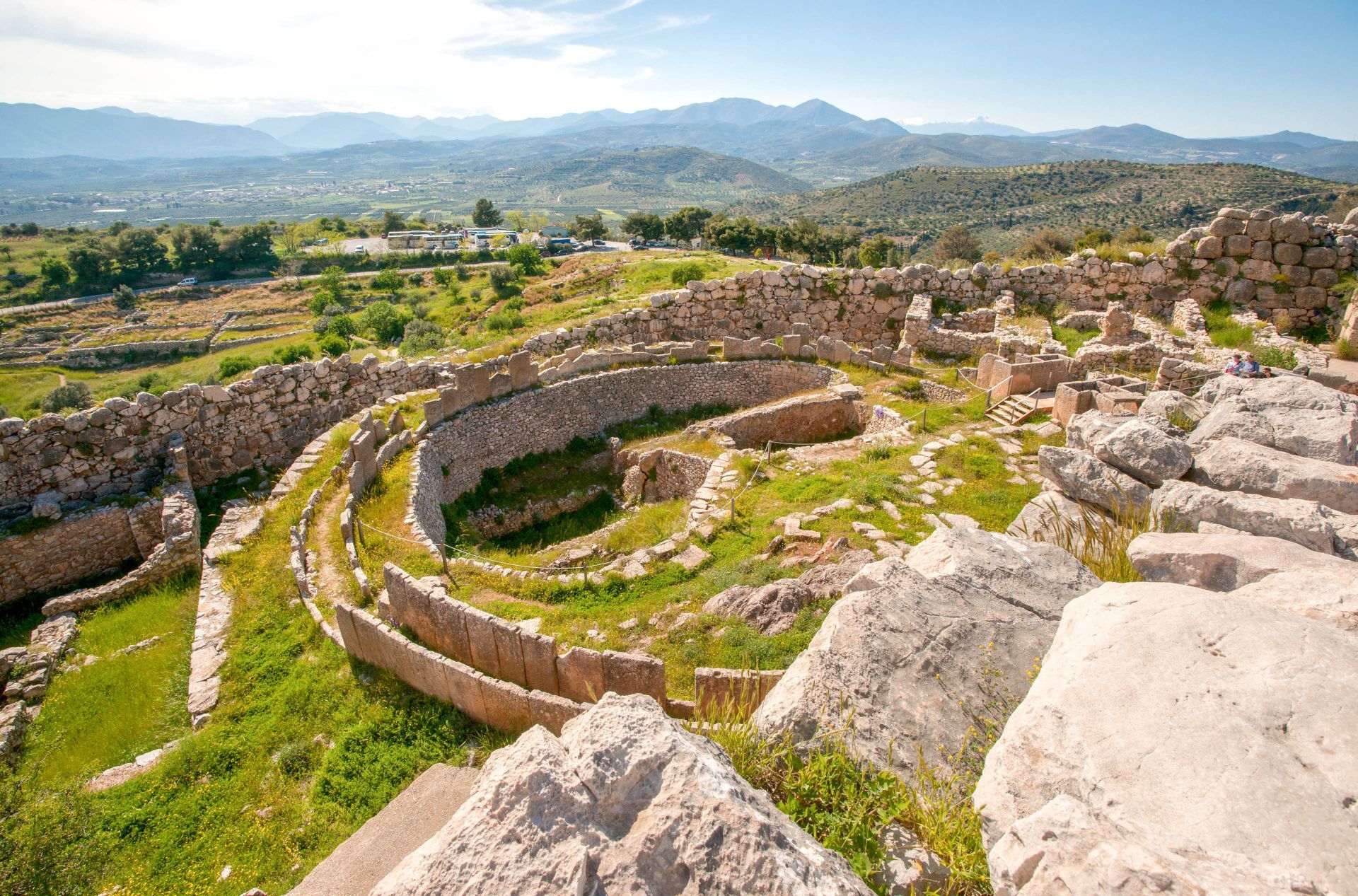
Micenas, la legendaria patria de Agamenón, se yer-- se yergue sobre un cerro protegido por murallas levantadas hace más de tres mil trescientos años.
Ivonne de JesúsNARRATOR
La desmesura de sus bloques de piedra alimentó la creencia de que habían sido colocados por cíclopes.

LiamHOST
We might have some distant memories of this collapse, but we have no great histories attesting to the kind of transformation that we know happened through archaeology.
LiamHOST
In the late 12th century, historian Eric Klein decisively dates this to 1177 BC, you see a broad systems collapse across the eastern Mediterranean, in which the great Hittite empire collapses altogether, as we discussed in our previous episode, in which the great Mycenaean palaces, like that at Mycenae itself, are wholly abandoned.
LiamHOST
and in which the Egyptian empire, which had previously stretched up into the modern day lands of, you know, Lebanon, Israel, Palestine, suddenly recedes back to the Egyptian heartland.
LiamHOST
This Bronze Age collapse was also associated with a decrease in trade, a decrease in the standard of living, probably had some connection with natural crises such as earthquakes and drought, but broadly speaking, led to a less interconnected, less literate, and less prosperous society.
LiamHOST
We see the symbolic slaughter of the goddess Athena, which seems to usher in the destruction of all literate civilization.
LiamHOST
Near the end of the film, Odysseus, played by Matt Damon, tells his son Telemachus, played by Tom Holland, that our stories must be sung, not spoken, as writing is rapidly disappearing.
LiamHOST
Indeed, the Bronze Age Linear B writing system of Mycenaean Greece did disappear after the Bronze Age Collapse, being replaced by the phonetic alphabet introduced, of course, by the Phoenicians.
LiamHOST
Nolan's interpretation of the Greeks as the Sea Peoples squares the circle of how Greek-speaking peoples appear to have been involved not only in destructive acts across the Mediterranean, but also in the destruction of their own civilization.

Josh JohnsonHOST
where there's all these Canaanite cities that appear to be destroyed in some fashion or another.
Josh JohnsonHOST
And then there's also the Greek mainland or the Peloponnese, where you have these places like Knossos and Pylos and Mycenae that are destroyed.
Josh JohnsonHOST
What happened? Well, in this episode, we're going to try and figure that out.
Josh JohnsonHOST
Historian Robert Drew narrates the century-long period of unrest that we call the Late Bronze Age Collapse.
5 MINS LATER
Josh JohnsonHOST
Maybe it truly is a natural disaster of some kind.
Josh JohnsonHOST
But that's just one part of this geopolitical world that exists, the Assyrians and Babylonians.
Josh JohnsonHOST
There's also, there's Crete, there's Mycenae, there's the Egyptians and the Hittites and the Mitanni, and the Egyptians and the Hittites sort of define this other portion of the geopolitical world, mostly through a singular instant called the Zananza Affair.
Josh JohnsonHOST
So we've talked about geopolitical things being, you know, mostly stable, and that's probably a simplistic way of looking at it.

Emily PillingerGUEST
but also herds of goats and choirs of children occupying spaces.
Emily PillingerGUEST
He did it in Mycenae.
Emily PillingerGUEST
He did it in Persepolis.
Emily PillingerGUEST
He did these inhabitations of significant ancient spaces using very high-tech elements or the most high-tech that were existent at that time.

Dan JonesGUEST
Big high one, basically, Charlotte.
Dan JonesGUEST
So, I mean, the walls are the sort of the elemental bit, aren't they, of castles? If we trace the origins of castles and fortifications way, way, way back, I mean, through the Iron Age with hill forts, back through the Bronze Age with the fortified citadels, you know, I mentioned Troy already, but think of Mycenae.
Dan JonesGUEST
We could go back a bit further and think of the walls of Jericho, you know, these fortified cities of the Neolithic into the Bronze Age.
Dan JonesGUEST
You can go as far back as the last Ice Age and see that the archaeology on the first sort of settlements where nomadic hunter-gatherers might stay for a season when they were chasing mammoths around, Europe.
speaker_7ADVERTISER
But the walls are the starting point.
Dan JonesGUEST
So I've got a soft spot.
Dan JonesGUEST
I won't keep harping on about the Bronze Age, but I've got a soft spot for the Mycenaean walls, the Cyclopean walls, the idea that in the Bronze Age, these walls built of these huge blocks of stone were so improbably large for their time that they could only have been built by the Cyclopes, the demigods.
Dan JonesGUEST
However, I think this castle needs to be fit for purpose.

ExpatriateNARRATOR
Exit.
ExpatriateNARRATOR
The chorus of old men of Mycenae enter, each leaning on a staff.
ExpatriateNARRATOR
During their song, Clytemnestra appears in the background, kindling the altars.
ExpatriateNARRATOR
Chorus.

Suprada UrvalNARRATOR
Birds make fair distribution of their food.
Suprada UrvalNARRATOR
Ulysses hastens back to the rocks of his Ithaca as eagerly as Agamemnon speeds to the kingly walls of Mycenae.
Suprada UrvalNARRATOR
For no man loves his native land because it is great.
Suprada UrvalNARRATOR
He loves it because it is his own.
48 more episodes mention Mycenae.
Create an account to see the whole feed, search across every transcript, and follow the entities you care about.