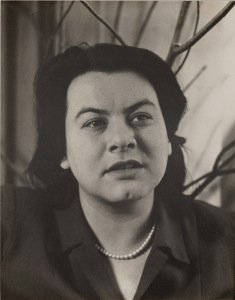
Muriel Rukeyser
American poet and essayistWikipedia
25
MENTIONS
12
EPISODES
11
PODCASTS
Search complete. 25 mentions across 12 episodes found for "Muriel Rukeyser".
Oct 15, 2026

Alexis MadrigalHOST
Do you want to talk to us a little bit about where you encountered the poem, what it's about, and then we're going to have you read it for us.
Elizabeth AlexanderGUEST
Yes, that poem is by the very, very great, the very mighty Muriel Rukeyser, a person who was mighty through the word, poetry, memoir, nonfiction, plays.
Elizabeth AlexanderGUEST
She wrote all kinds of things, but also mighty in her humanity and in the ways that she wanted always to stand alongside people whose experiences were not necessarily her own experiences.
Elizabeth AlexanderGUEST
and to bear witness, especially to injustice.
Elizabeth AlexanderGUEST
And Dr. Martin Luther King is putting together in his speeches the connections between racial discrimination and and economic exploitation and the war.
Elizabeth AlexanderGUEST
Muhammad Ali is boldly refusing military service and stripped of his heavyweight championship, which was an extraordinary act, a public act of courage.
Elizabeth AlexanderGUEST
So Muriel Rukeyser writes this poem that I'm about to read to you.
Elizabeth AlexanderGUEST
And I've always known it, but I think that in the last several years.

Elizabeth AlexanderGUEST
And so that's what brought the threads of the book together and occasioned it coming out in this form.
Callie CrossleyHOST
And of course, what a startling way to open with a poem from Muriel Rukeyser from 1967.
Callie CrossleyHOST
If you'd said nothing about it, you know, the, the time, I would have read it, as I'm sure many will read, as though it, she just wrote it last week.
Callie CrossleyHOST
It sounds like today.
Elizabeth AlexanderGUEST
Absolutely.
Elizabeth AlexanderGUEST
I mean, Muriel Rukeyser is my...
Elizabeth AlexanderGUEST
There are many guiding lights in this book, but she opens and closes the circle of this book.
Elizabeth AlexanderGUEST
She was a Jewish feminist, radical poet, biographer, memoirist, theorist, reader, witness bearer, who in the early 1930s, when she was at Vassar College, 19 years old, she left college to go to Alabama to bear witness and write about the Scottsboro Boys trial.

Jack PetrankerGUEST
You know, there was a poet, the name just escapes me right now, it'll come to me, but she wrote a poem in which there's a line that says, the universe is made of stories.
Jack PetrankerGUEST
And Muriel Rukeyser, that's her name.
Jack PetrankerGUEST
And I think that if you take that seriously, and I do, because that is something that I've explored in my own practice and and have thought about quite a bit, if you take that seriously, that really becomes a basis for creating a greater sense of community with other people, because you have your story and I have my story.
Jack PetrankerGUEST
That doesn't necessarily lead to relativism, because I continue to maintain my story.

Hallerin Hilton HillHOST
Storytelling is the core of humanity.
Hallerin Hilton HillHOST
If you think about it, I think it was the author Muriel Rukeyser who said the universe is not made of atoms, it's made of stories.
Hallerin Hilton HillHOST
A story in its simplest form is just a sequence of what happened.
Hallerin Hilton HillHOST
It's a documentation of what happened.

Audrey MolloyGUEST
They're versions of truth.
Audrey MolloyGUEST
So I know there's another poet, Muriel Rukeyser, who has a line in one of her poems, what would happen if one woman told the truth about her life? The world would split open.
Audrey MolloyGUEST
And I just thought, well, do we want it to split open? That's like, it's like a bomb.
Audrey MolloyGUEST
You know, the truth is a dangerous thing.
Audrey MolloyGUEST
Whether it's the lyrics of songs or whether it's Emily Dickinson or whether it's writing my own work, it's helped me to do those things.
Katherine PetruccelliHOST
I want to go back for sure to this idea of the status of women in the 21st century.
Katherine PetruccelliHOST
And I also have in my head, you brought up Rukeyser, Muriel Rukeyser, and I'm thinking of her poem, Waiting for Icarus.
Katherine PetruccelliHOST
I'll put it in the show notes, but it's brilliant.

Brian LehrerHOST
You agreed to read something because there's so much writing in this book that, as I said in the break leading up to this segment, is things that you consider among the most profound things you've ever read.
Brian LehrerHOST
And one of them at the start of the book was something written by Muriel Rukeyser in 1967.
Brian LehrerHOST
It's just called Poem, but in parentheses, I lived in the first century of world wars.
Brian LehrerHOST
Do you want to dive in or do you want to set it up?
Elizabeth AlexanderGUEST
We would try by any means to reach the limits of ourselves, to reach beyond ourselves, to let go the means to wake.
Elizabeth AlexanderGUEST
I lived in the first century of these wars.
Elizabeth AlexanderGUEST
The great Muriel Rukeyser.
Brian LehrerHOST
That's the first poem you write about in the book.

Aaron SmithHOST
June Jordan and Audre Lorde are both from Harlem.
Aaron SmithHOST
James Merrill, Merwin, Howard Nemiroff, Michael Palmer, and Muriel Rukeyser are all born in New York City.
Aaron SmithHOST
And Delmore Schwartz is in Brooklyn.
Aaron SmithHOST
And Richard Wilbur is New York City.

Anne FernaldGUEST
The rebel is... someone who rails against the injustices that she faces.
Anne FernaldGUEST
And what interested me about the two rebels I write about, Vera Brittain, whom I've talked about a little bit already, and Muriel Rukeyser, the American poet, is both the rebellions they fight for and the moments where they're conventional.
Anne FernaldGUEST
So if you're a Britain one and they're the only two mothers in the book.
Anne FernaldGUEST
So that struck me as very surprising, right? Because I think the stereotype of the rebel is really a kind of untouchable Joan of Arc, you know, a formidable, um, hatchet-faced woman.
Anne FernaldGUEST
And what interests me about The Rebel is this idea that courage is a decision you have to make many times over, right? And that you're constantly reminding yourself.
Anne FernaldGUEST
And so Muriel Rukeyser was a queer woman.
Anne FernaldGUEST
She had affairs with men and women.
Anne FernaldGUEST
She had a child.

Vijay PrashadGUEST
Yeah, so firstly, that's a really interesting way to put it.
Vijay PrashadGUEST
I would say that I don't I feel, you know, the great American poet, communist poet, actually, Muriel Rukeyser wrote a poem where the line is, you know, basically communists are aliens from the future, you know, exiles from the future.
Vijay PrashadGUEST
Sorry, exiles from the future.
Vijay PrashadGUEST
I love that line.

Laura DavisHOST
Pause for Peace.
Laura DavisHOST
Poem, I Lived in the First Century of World Wars, featuring a poem by Muriel Rukeyser.
Laura DavisHOST
I hope you enjoy this midweek pause for peace.
Laura DavisHOST
Each Wednesday, I pair an image with a poem, a little something for your heart and your nervous system.
Laura DavisHOST
This Muriel Rukeyser poem, long one of my favorites, first published in 1968, shows how things haven't really changed at all.
Laura DavisHOST
Poem, I Lived in the First Century of World Wars by Muriel Rukeyser.
Laura DavisHOST
I lived in the first century of world wars.
Laura DavisHOST
Most mornings I would be more or less insane.
2 more episodes mention Muriel Rukeyser.
Create an account to see the whole feed, search across every transcript, and follow the entities you care about.