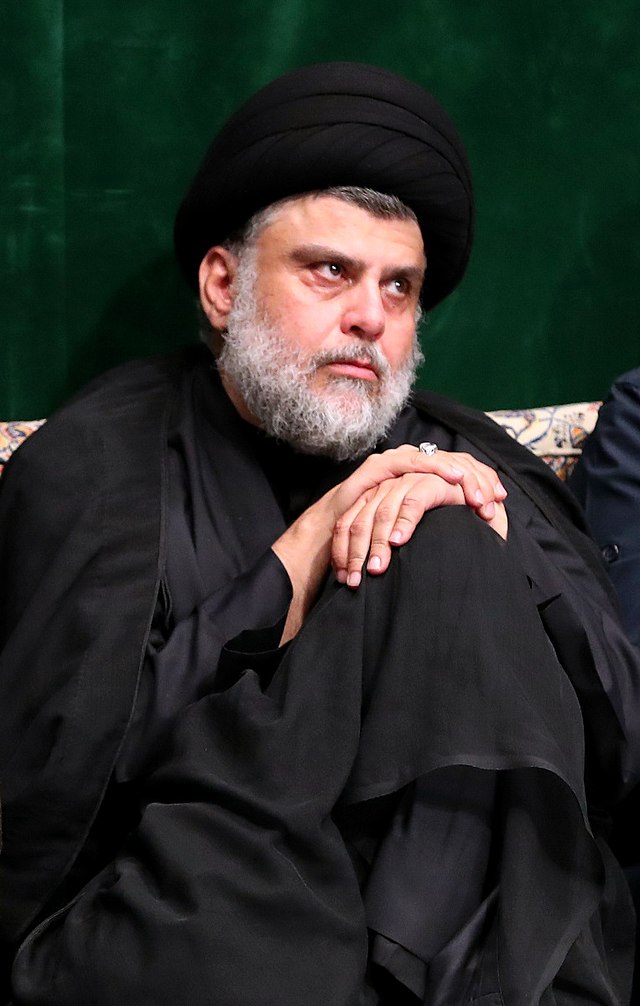
Muqtada al-Sadr
Iraqi cleric and politicianWikipedia
20
MENTIONS
12
EPISODES
12
PODCASTS
Search complete. 20 mentions across 12 episodes found for "Muqtada al-Sadr".
Oct 8, 2026

Inna RudovGUEST
Because in a way he's, um, he, uh...
Inna RudovGUEST
he studied under Mohammed Sadeq as-Sadr, under Moqtada al-Sadr's father, and if you look at the, um, ideological orientation of the group or of, uh, of his movement is very much Sadrist.
Inna RudovGUEST
Sadrist meaning adopting the, the beliefs, the teachings of Mohammed Sadeq as-Sadr, not being a follower of, of, of Moqtada al-Sadr.
Inna RudovGUEST
And, uh, what, what was, uh, striking with him now to, to bring more of a, of a fresh context, uh, December after the latest round of elections, he gave this, uh, electoral, uh, victory speech after his movement, uh, won 27 seats.
Inna RudovGUEST
And he said, "Yes, I mean, w- we as Muqawama, we as resistance, we have to be the one who lead by example when it comes to bringing the weapons in the hands of the state." And before you now start cheering and saying, "Here, like this revolutionary now developed into pragmatic actor," he also added the context.

Mike RosolGUEST
So Jaish-el-Mahdi, Mahdi Militia,
Charlie FaintHOST
the organization headed up by Muqtada al-Sadr, that was a pretty competent force.
Charlie FaintHOST
Yes.
Charlie FaintHOST
If I remember correctly, that is the force that, when the violence broke out so badly in Sadr City, that was kind of behind all that.

Stanly JohnyGUEST
Broadly speaking, you can divide the PMFs into three categories.
Stanly JohnyGUEST
Organizations that maintained close ties with Iran and organizations that stayed steadfastly loyal to the Grand Ayatollah Ali Sustani and organizations that were linked to Muqtada al-Sadr.
Sharmada VenkatasubramanianHOST
After years of being caught in between the US and Iran, what do the Iraqis actually want?
Stanly JohnyGUEST
When you look at it, yes, the target assassinations weaken militias, but it doesn't destroy militias.
17 MINS LATER
Sharmada VenkatasubramanianHOST
Right.
Stanly JohnyGUEST
So there were originally there were seven militias including Katai Bhasbullah and Mujabah, AAH and others and the Sadarists.
Stanly JohnyGUEST
So Sadarists are basically they belong to the movement of Muqtada al-Sadr who's also a very influential cleric in Iraq.
Stanly JohnyGUEST
Okay.

Brian StahlHOST
And in your experience, because you talked about al-Qaeda in Iraq, you talked about different Shia groups.
Brian StahlHOST
So there's the Jaysh al-Mahdi with Muqtada al-Sadr.
Brian StahlHOST
There's the Bata Brigades with Iran.
Brian StahlHOST
There's a whole bunch of other groups.

Renad MansourGUEST
And this, this is where the challenge lies.
Renad MansourGUEST
The Iraqi government will try, can try to go after these groups, but if you remember during the Civil War many years ago, the Iraqi government was able to go after Moqtada al-Sadr's Mahdi Army with the support of a hundred thousand plus U.S. troops, and that was still a long and very difficult battle.
Renad MansourGUEST
Is the Iraqi government both capable and then willing to go after these groups? I think most would say no.
Sophia YanHOST
Mm-hmm.

Chris MartensonHOST
Turning to geopolitics on the U.S.
Chris MartensonHOST
Deadline to end a 12-year presence in Iraq, Muqtada al-Sadr demanded American compensation for occupation damages and urged Iraqis to file claims.
Chris MartensonHOST
Troops entered in 2003, left in 2011, and returned in 2014 against the Islamic State.
Chris MartensonHOST
Sadr said Washington and neighbors should stay out of Iraqi affairs and that weapons should come under the state.

Douglas MacgregorGUEST
Remember that when we were going through this thing called the purge, we were fighting large numbers of people, and then all of a sudden, more than 50% of the opposition dropped out.
Douglas MacgregorGUEST
Well, that was Soleimani who went down and got Muqtada al-Sadr, transported him to study theology in, uh, southern Iran, and we benefited enormously from that because that removed large numbers of people that we might have otherwise had to fight.
Douglas MacgregorGUEST
And in addition to the Sunnis that we were fighting, we then drowned most of the opposition in cash.
Douglas MacgregorGUEST
It still cost us 1,000 American lives, more than 1,000 wounded, and of course, now in retrospect, you have to ask the question, "Well, why did we do this? What was the purpose?" I think the real purpose at the time was to convey the impression to the American public that the war in Iraq was over.

Ricky ScaparoHOST
This is what Osama bin Laden did.
Ricky ScaparoHOST
This is what al-Sadr did.
Ricky ScaparoHOST
Al-Sadr, he had the Mahadi army.
Ricky ScaparoHOST
And they had the black flags and then ISIS.

speaker_1HOST
Instead, Iraqi media reported that the date would open a 90-day freeze on militia attacks, with a detailed disarmament timetable due and full completion pushed back to June 30, 2027.
speaker_1HOST
The Sofan Center said the more heavily armed groups, including Khatib Hezbollah, Khatib Syed al-Shahada, and Harakat al-Najaba, had rejected disarming by the announced date without ruling out disarmament eventually, while As-Sab al-Alhaq and followers of the cleric Muqtada al-Sadr had begun folding into state structures.
speaker_1HOST
Before the plan was revised, Iraqi analyst Sajjad Jiyath had predicted that no group would disarm by September 30th.
speaker_1HOST
In the Gulf, the European Union's foreign policy chief, Kaya Khalas, said the bloc was applying for observer status in a Saudi-led maritime defense coalition formed to protect the kingdom's energy exports.

Elfadil IbrahimGUEST
And, uh, that, that legacy continues today.
Scott HortonHOST
So in Iraq war two, David Petraeus turned the biggest militia, the Bada Brigade into the Iraqi army and Muqtada al-Sadr still had his group.
Scott HortonHOST
And there were a couple of smaller militias, but it was really in Iraq war three after Obama built the caliphate for Osama bin Laden.
Scott HortonHOST
Well, for Ayman al-Zawahiri anyway.
Scott HortonHOST
Now there's this entire new set of Shiite militias with, I don't know, 10 different names or whatever that have to be corralled that they're always referred to as Iranian-backed, I think mostly, plausibly so, as we saw from Quds Force and IRGC intervention in Iraq War III there against ISIS.
Scott HortonHOST
So that makes sense.
Scott HortonHOST
I did read a thing a few weeks ago that said that Muqtada al-Sadr has given in, and he already told his Mahdi army to join the army, although I don't know if that actually happened or not.
Scott HortonHOST
And then you say in here, a Saba al-Haq, which I know is a very important Shiite militia, that they have agreed to either lay down their arms or join the military or both, one or the other, or something like that, but then...
2 more episodes mention Muqtada al-Sadr.
Create an account to see the whole feed, search across every transcript, and follow the entities you care about.