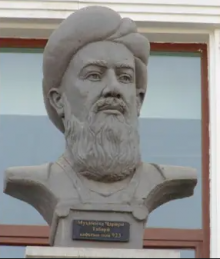
Muhammad ibn Jarir al-Tabari
PolymathWikipedia
63
MENTIONS
48
EPISODES
24
PODCASTS
Search complete. 63 mentions across 48 episodes found for "Muhammad ibn Jarir al-Tabari".
Sep 21, 2026

Ahmed KhalilHOST
As-Sakran passed away in Mecca before the migration of the Messenger of Allah to Medina, and then the Messenger of Allah succeeded him with his wife Sa'dah, meaning he married Sa'dah after the passing away of As-Sakran ibn Amr.
Ahmed KhalilHOST
Muhammad ibn Jarir al-Tabari, in his book, he says, it's called History of Prophets and Kings, he says her husband before the Prophet was As-Sakran ibn Amr.
Ahmed KhalilHOST
As-Sakran was one of the immigrants to Abyssinia, where he converted to Christianity and died.
Ahmed KhalilHOST
and the message of Allah married her while he was in Mecca.

Bilal AssadHOST
No scholar, no jurist, no imam in the history of Islamic history opposed these three examples and these three appointments of these women.
Bilal AssadHOST
And finally, the great Imam Ibn Jarir Al-Tabari.
Bilal AssadHOST
Who's heard of great Imam Ibn Jarir Al-Tabari? Good.
Bilal AssadHOST
You guys, if you wanna learn knowledge, he is one of the master jurists and one of the greatest judges in the history of Islam.
Bilal AssadHOST
One of the elite ones.
Bilal AssadHOST
The great classical scholar and judge, Al-Imam Ibn Jarir Al-Tabari, ruled that a qualified woman can be appointed as a Supreme Judge in all cases without exception because the criteria are knowledge and competence, which are not restricted by gender.
Bilal AssadHOST
This is his analysis.
Bilal AssadHOST
The fourth evidence, none other than Sayyida Ummul Mu'minin, mother of believers, Aisha Radiallahu Anha.

Belal AssaadHOST
No scholar, no jurist, no imam in the history of Islamic history opposed these three examples and these three appointments of these women.
Belal AssaadHOST
And finally, the great Imam Ibn Jarir al-Tabari.
Belal AssaadHOST
Who's heard of great Imam Ibn Jarir al-Tabari? Good.
Belal AssaadHOST
You guys, if you wanna learn knowledge, he is one of the master jurists and one of the greatest judges in the history of Islam, one of the elite ones.
Belal AssaadHOST
The great classical scholar and judge, Al-Imam Ibn Jarir al-Tabari, ruled that a qualified woman can be appointed as a supreme judge in all cases without exception because the criteria are knowledge and competence, which are not restricted by gender.
Belal AssaadHOST
This is his analysis.
Belal AssaadHOST
The fourth evidence, none other than Sayyida Ummu'l-Mu'minin, mother of believers, Aisha Radi Allahu Anha.
7 MINS LATER
Belal AssaadHOST
Therefore, she could hold high-level administrative, executive, and governmental leadership roles, but not absolute supreme khalifa and judicial roles involving criminal corporal punishment and retribution laws.

Ali Al-BarghouthiHOST
So because you did not eat and then you start eating, that's a break.
Ali Al-BarghouthiHOST
That's why it's called iftar, right? Now what is Badi'u Samawati Wal Ard or Badi' means? So Tabari says, when Allah says Badi'u Samawati Wal Ard, it means that Allah originated them.
Ali Al-BarghouthiHOST
He did that, created them from nothing, from no previous example, no previous pattern.
Ali Al-BarghouthiHOST
And remember when we said last time that when humans wanna be creative and they create something, they innovate something, they always have to depend on a previous example.

Jake BrancatellaGUEST
No, it doesn't say that.
Jake BrancatellaGUEST
But if you want to go to the Tafsir, if you go to Al-Tabari, and I will admit that there's, like most verses, there's always different explanations of what actually happened.
Jake BrancatellaGUEST
The relied upon opinion from Al-Tabari is that this was specifically talking about an incident that took place between a Jew, a Jew who was involved in the story, and a Muslim.
Jake BrancatellaGUEST
And he was saying that they needed to accept his ruling.
Jake BrancatellaGUEST
So there was a Jew actually involved in the story.
Jake BrancatellaGUEST
but if you look at if you looked at the tafsir of ibn kathir he brings the two together and he actually says that includes both of them because he takes it to be a general command that it's not meant to be although because this happens right although there we believe that there are reasons for revelations for certain verses just because it happened in a specific context doesn't mean that then more broadly it doesn't have application to other people involved for example even if it happened between two Muslims let's say for the sake of argument that doesn't mean that it was only for those two Muslims It refers and includes all the Muslims.
Jake BrancatellaGUEST
So what Ibn Kathir does, if my memory serves me correct, and I'm happy to be corrected on it, what Ibn Kathir does is he brings, I think, both opinions, and then he explains how one doesn't necessarily contradict the other, that they can be referring to both.
Jake BrancatellaGUEST
But Al-Tabari brings the two views and he favors that the specific reason for the revelation in the beginning was the matter that included the Jew.

Earl FontenelleHOST
In the cases of both of his main Abrahamic competitors then, I take it that Abdul Malik was saying, there's a new religion in town, it's in charge, and its name is Islam.
Earl FontenelleHOST
Many historical sources later, such as At-Tabari's important chronicle, tell us a lot about the behavior of the third Amir al-Mu'minin, Omar, when he entered Jerusalem after the city's largely bloodless conquest by the Arab forces.
Earl FontenelleHOST
So the Arabs have taken Jerusalem.
Earl FontenelleHOST
Omar, the commander, is led into this town.

Muhammed AliHOST
What Christians do is intentionally avoid the context and the interpretation of the scholars of Islam that were there 1,200 years ago.
Muhammed AliHOST
If you open Al-Tabari, which lived 1,200 years ago, he wasn't my friend that was texting on Instagram, he will tell you these verses are talking about the chronological order.
Muhammed AliHOST
Allah first revealed the Torah and told the people to follow the Torah.
Muhammed AliHOST
He revealed the Gospel and told the people that time, follow the Gospel.
Bilal AssadHOST
Number four, and this is the last reason, forgive me if I say it straight out, sex workers.
Bilal AssadHOST
Secular history and traditional text commentary, such as Imam al-Tabarani or Imam al-Tabari and Imam al-Qurtubi noted that hypervisible, dramatic, artificial modifications were predominantly the practice of sex workers and promiscuous women.
Bilal AssadHOST
In secular history, these types of workers were one of them and elitist hierarchical discrimination among the wealthy aristocrats like the caste systems.
Bilal AssadHOST
They're the ones who used to thin out their eyebrow and tattoo and wear human hair extensions.

Murtaza KhanHOST
Angels turned around and said, Are you going to place on the earth one who spills blood, creates corruption? Why did the angels pose this question to Allah ? Why did they ask this question? Why are you placing upon the earth This human being who's going to create facade and corruption and spill blood.
Murtaza KhanHOST
Imam Tabari begins to have a discussion about it.
Murtaza KhanHOST
Prior the jinn existed upon the earth, saw what the jinn were doing.
Murtaza KhanHOST
All the angels had this farasa, they had this insight.
Ali Al-BarghouthiHOST
So what is then the meaning of القريب that Allah عز و جل is close? So we will talk first of all about the general meaning and then we will break it down into the more specific meanings.
Ali Al-BarghouthiHOST
The general meaning of الطبري said when Allah عز و جل said about himself إنه سميع قريب that Allah is سميع.
Ali Al-BarghouthiHOST
hearing, qareeb, close.
Ali Al-BarghouthiHOST
He says, al-tabari, that Allah is not far, is not distant, so he cannot hear what I'm telling you, or what you are saying, or what others are saying.
38 more episodes mention Muhammad ibn Jarir al-Tabari.
Create an account to see the whole feed, search across every transcript, and follow the entities you care about.