Motivational interviewing
157
MENTIONS
20
EPISODES
19
PODCASTS
Search complete. 157 mentions across 20 episodes found for "Motivational interviewing".
Nov 18, 2026

Eric HelmsHOST
Thank you for that consultation.
Eric HelmsHOST
Thank you for reading Motivational Interviewing at least twice.
Eric HelmsHOST
I actually am not going to hire you.
Eric HelmsHOST
I got this now.

Eric HelmsHOST
Thank you for that consultation.
Eric HelmsHOST
Thank you for reading Motivational Interviewing at least twice.
Eric HelmsHOST
I actually am not going to hire you.
Eric HelmsHOST
I got this now.

Mike LaneHOST
So, you know, we're referring to different aspects of how we were taught or how we taught.
Mike LaneHOST
But there's motivational interviewing as well.
Mike LaneHOST
We have talked about that before.
Mike LaneHOST
Motivational interviewing is such a strong framework for assisting one person to lead the communication with another.
Mike LaneHOST
And they use a process called OARS, O-A-R-S, so O standing for the open-ended style of the conversation.
Mike LaneHOST
dialogue, then the A for the affirmation, and then the R for the responsiveness, and then the S for the summarizing.

Adam GrantGUEST
And then nobody opens their mind.
Adam GrantGUEST
There's a whole psychology of what's called motivational interviewing.
Adam GrantGUEST
Over a thousand experiments have tested it.
Adam GrantGUEST
And basically what motivational interviewing is all about is approaching somebody that you want to change as if you were a neutral interviewer.
Adam GrantGUEST
And your whole goal is to understand their motivations so that you can help them figure out if change would serve them well or not.
Adam GrantGUEST
And so, yeah, what I would normally now do if I remember to do it is say to that person, you know, tell me what are the pros of, you know, following through on this commitment? What are the cons? And, you know, how do you feel about it? And lo and behold, the person is more likely to talk themselves into change as opposed to feeling like, well, I twisted their arm.
6 MINS LATER
Adam GrantGUEST
You tell me, what do you want to push back on?
Lauryn BosstickHOST
Well, it looks like Michael wants to push back on what we were saying earlier.

speaker_3HOST
Or what about a person with opiate use disorder who isn't interested in treatment but is willing to accept a naloxone kit that might reverse an overdose? What's been missing in the treatment of substance use disorders is acknowledging the continuum of progress on the way to abstinence.
speaker_3HOST
In this lesson, you will learn how to clarify your patient's treatment goals and how to guide your patient through five stages of change using various motivational interviewing techniques.
speaker_3HOST
So let's start with treatment goals.
speaker_3HOST
Generally, there are four categories of goals that you will encounter with patients.
6 MINS LATER
speaker_3HOST
Or a person might want to try switching to an electronic cigarette, and this would put them in the use with less harm group.
speaker_3HOST
Or the person might want to quit altogether, and that's the complete abstinence group.
speaker_3HOST
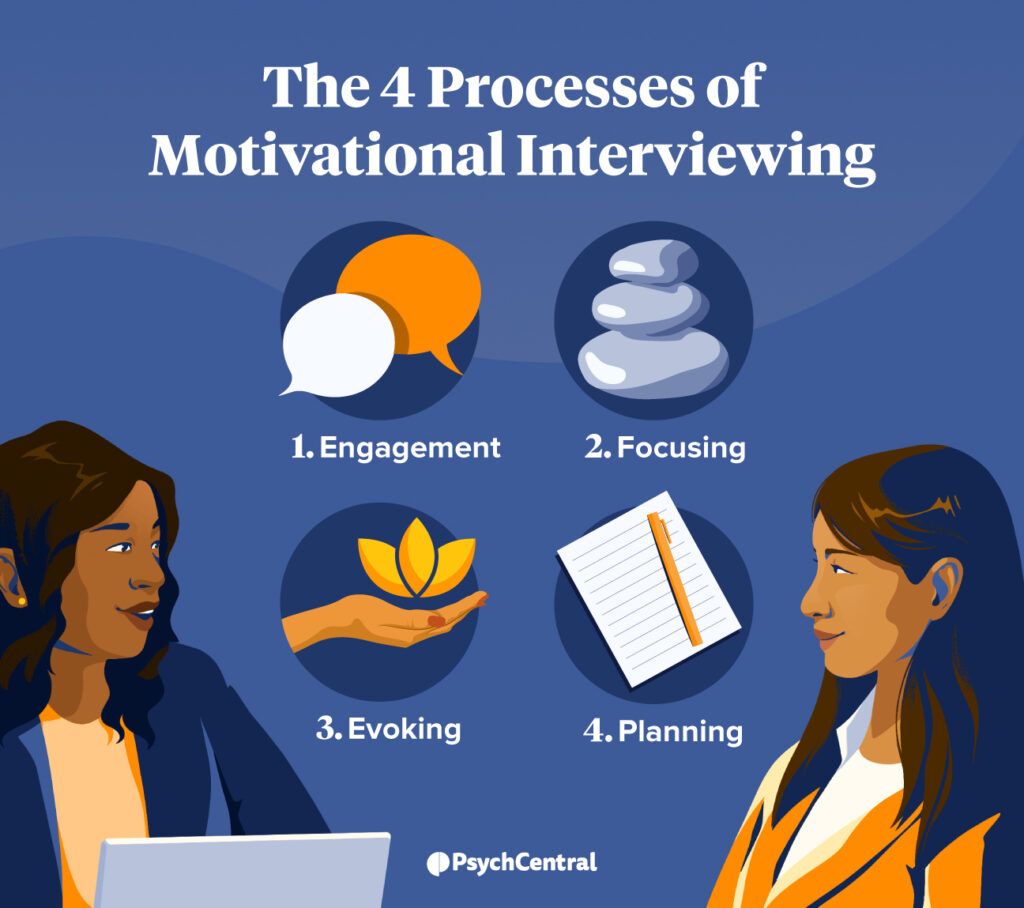
No matter which goal the person chooses, you should utilize the motivational interviewing process of planning for change.
speaker_3HOST
When we help people plan for change, we generally focus on making an action plan, removing barriers to change, and engaging outside support.

Sebastian KaplanHOST
Hello, everyone.
Sebastian KaplanHOST
Welcome to another episode of Talking to Change, a motivational interviewing podcast.
Sebastian KaplanHOST
My name is Sebastian Kaplan, and I'm based in Winston-Salem, North Carolina.
Sebastian KaplanHOST
And as always, I'm joined by my good friend, Glenn Hines from Derry, Northern Ireland.
Glenn HindsHOST
And Tony invited us to go to, I suppose, a very familiar place, but in a deeper way to look at caring and how we as individuals care and how we can care successfully, inverted commas, for others.
Glenn HindsHOST
And what really stood out for me was the The call to recognise I matter too when I'm caring and that for Tony that was most purposely arrived at by connecting to the self at a deeper level and from his perspective using what's called transcendental meditation to fall down into the stillness that he described the ocean and the waves and that from that place we're better equipped to be supportive of other people.
Glenn HindsHOST
What was also interesting as well was just how much of what we explored can be translated into the theory and philosophy that informs our practice of motivational interviewing.
Glenn HindsHOST
Indeed, the best practices across other models and schools of helping.

Sean DeMarco GarciaGUEST
It's a real science.
Sean DeMarco GarciaGUEST
CBT and motivational interviewing.
Sean DeMarco GarciaGUEST
There's so much that's involved that people don't understand.
Sean DeMarco GarciaGUEST
So I'm a huge proponent of it.

Monica GilbertHOST
And that's a useful distinction.
Monica GilbertHOST
A lot of the times people think that just because you're doing motivational interviewing or using motivational interviewing, that you're not allowed to give things.
Monica GilbertHOST
You're not allowed to provide any information.
Monica GilbertHOST
And it's truly not like that.
11 MINS LATER
Monica GilbertHOST
Awkward doesn't mean you're a bad therapist or you're bad at parent training.
Monica GilbertHOST
It may mean you're developing a skill you haven't had enough opportunity to practice.
Monica GilbertHOST
This is one of the reasons I care so much about motivational interviewing.
Monica GilbertHOST
Because MI gives you a framework for engaging parents, identifying shared priorities and values, evoking their own ideas and motivation, and developing a plan together.

Steve VargoHOST
Yeah, and if you want to study something from the outside world, as you called it, I would study psychologists.
Steve VargoHOST
And there's a really interesting book, I don't know if you've read it, it's called Motivational Interviewing, and a lot of the things that you're talking about are straight from...
Steve VargoHOST
the world of psychology and how they work with people.
Steve VargoHOST
It turns out psychology who understand the behaviors of other people and behavior change don't spend a lot of time telling their patients or clients what to do.

Caroline MooreGUEST
And I think that that just highlights that some people are just not ready to make that change yet.
Caroline MooreGUEST
and yeah, you know we talk a lot about motivational interviewing in in in nhs and primary care and and and you know i've done that before and it was it was it was it's great it's always stayed with me that that that session um and but when you start putting it into practice you realize that you build the trust up with your patients much more than you do by like you know imposing something that you you or suggesting something that they're not ready to hear or ready to do yet.
Caroline MooreGUEST
And they'll come back to you when they're ready to change.
Caroline MooreGUEST
And then that change is much more powerful than it would have ever been before.
10 more episodes mention Motivational interviewing.
Create an account to see the whole feed, search across every transcript, and follow the entities you care about.