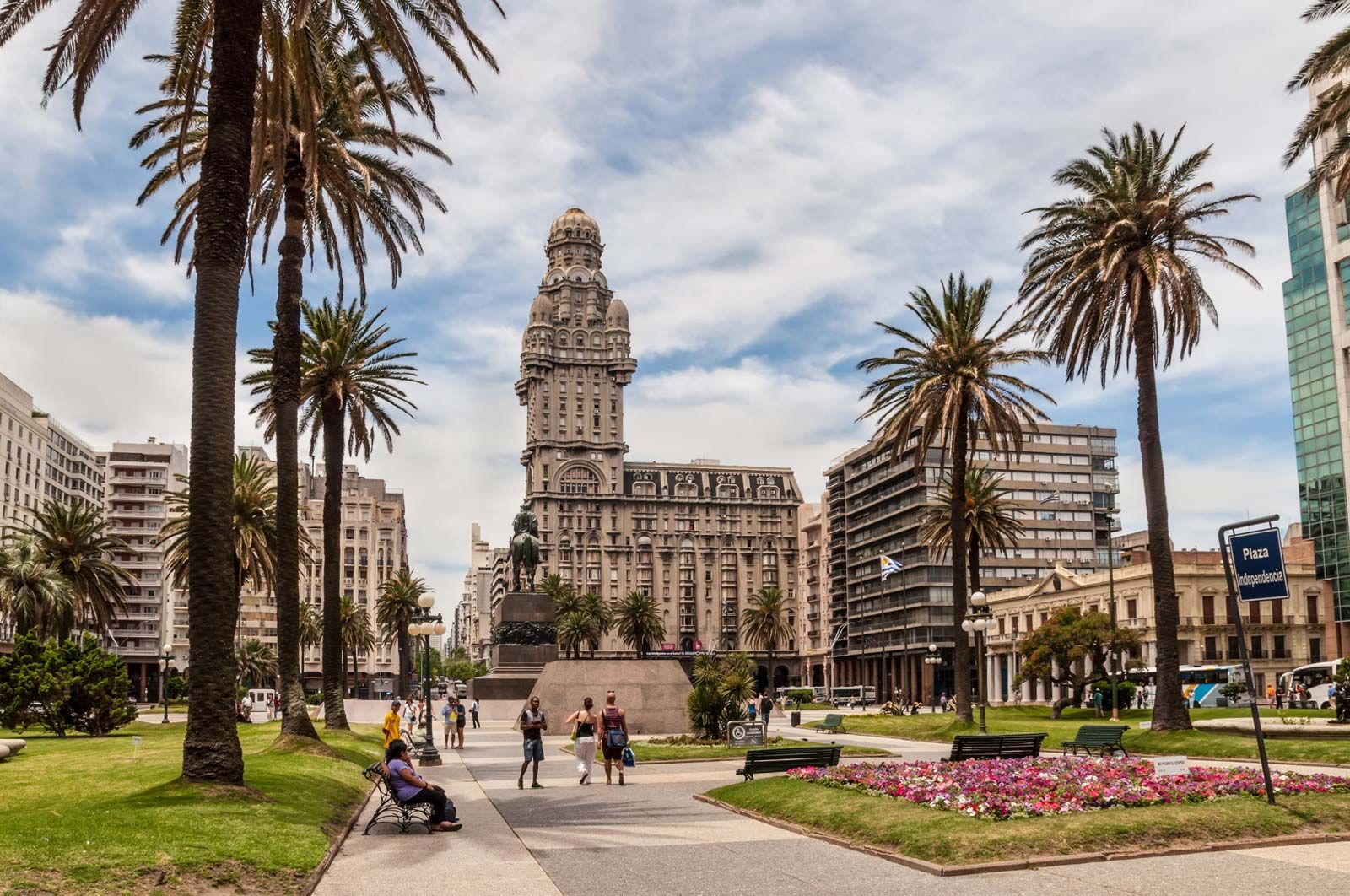
Montevideo
Capital of UruguayWikipedia
181
MENTIONS
106
EPISODES
94
PODCASTS
Search complete. 181 mentions across 106 episodes found for "Montevideo".
Oct 28, 2026

Ronan McMahonHOST
But that growth wasn't spread evenly.
Ronan McMahonHOST
The capital, Montevideo, actually shrank.
Ronan McMahonHOST
It lost about 72,000 people.
Ronan McMahonHOST
Meanwhile, one department on the coast grew by more than a quarter.
6 MINS LATER
Ronan McMahonHOST
Around 25 companies have signed up so far.
Ronan McMahonHOST
Up to 1400 jobs are projected.
Ronan McMahonHOST
Uruguay's president came to open it and he said the country's development has to grow beyond Montevideo.
Ronan McMahonHOST
That's a government saying in public that Punta isn't just a resort anymore.

Patricio BartonHOST
Ehm, aquí hay pedidos.
Patricio BartonHOST
Quiere-- venimos de Montevideo solamente para verlos a ustedes.
Patricio BartonHOST
Quién-- diga dónde están.
speaker_15UNKNOWN
Hombre.

Jani SarajärviHOST
I'm your host, Jani Sarajärvi, and this month's Discus Sao takes us to Uruguay.
Jani SarajärviHOST
My guest is Camilo Esperanza Borde, a coach born in Montevideo who has worked in Spain, Brazil, the United States, New Zealand, Ecuador, England, of course his home country Uruguay, and now with Ilves in Finland.
Jani SarajärviHOST
We talk about Carra Charrua, baby football, Luis Suarez, of course, questions related to Uruguay's football culture.
Jani SarajärviHOST
What a small country with three and a half million people can teach other countries looking for their own voice.
Camilo SperanzaGUEST
And having that curiosity that it's always making me, you know, question things and try to do things in a different way.
Jani SarajärviHOST
Yeah, I think your CV also reflects this kind of curiosity.
Jani SarajärviHOST
You have been in different places in the United States, in many different Barca academies, in Ecuador, in Waikiki City and Independiente, Valladolid, Watford, Liverpool, Montevideo, and now in Finland.
Jani SarajärviHOST
So you have been in different places, and that's kind of a little bit like a non-linear path.

Jonathan FadugbaHOST
For those who kind of don't know too much about you in that sense or are new to the Finnish League, because we haven't really covered the Finnish League in general, but we started to talk about it a little bit more since my trip.
Jonathan FadugbaHOST
Obviously, you are a Uruguayan coach born in Montevideo, I understand.
Jonathan FadugbaHOST
And you've coached around the world, to be honest, in many different countries and places.
Jonathan FadugbaHOST
As mentioned, when we put out the post about this, your previous role before this was Liverpool Montevideo.
Jonathan FadugbaHOST
And also you've also had experience in the championship with Watford, of course, as assistant manager there.
Jonathan FadugbaHOST
So you have a very kind of broad experience as a coach.

Patricia IrelandGUEST
I love that feeling.
Patricia IrelandGUEST
I got to go down to Buenos Aires and Rio de Janeiro and Montevideo, Uruguay.
Patricia IrelandGUEST
I mean, I went all over the place.
Patricia IrelandGUEST
There were just so many exciting aspects of the job, not all of them encouraging, but so much to learn.

Gabriel DelacosteGUEST
So this is the floor where Uruguayan politics happens.
Gabriel DelacosteGUEST
This bourgeois republican liberalism is called vachismo after Jose Valle Ordoñez, who was the president at the start of the 20th century that did great reforms and working rights and state intervention in the economy, plenty of things that up to today, if you walk around Montevideo, you will see the consequences, the good consequences of this republican reformism.
Gabriel DelacosteGUEST
So Metol is a bit of a strange figure because he's a Catholic in a non-Catholic country.
Gabriel DelacosteGUEST
And he grows up in in the same places where i where i of which i talked just now in peronism he got raised in the opposition to bachismo in the far right nationalists in uruguay that is the blanco party the the nationalist party here in your way that is an old party that comes from the 19th century civil war which has is very close to the church so he grows up during the second world war He is against the Alice.
5 MINS LATER
Gabriel DelacosteGUEST
Firstly, because of very radical revolutionary movements in the 19th century, and then because of a massive wave of immigration, mostly from Italy and Spain, but also from Germany, France, Jews from Eastern Europe, from the Arab countries.
Gabriel DelacosteGUEST
And there were a lot of socialist anarchists.
Gabriel DelacosteGUEST
Actually, for example, the first international in the 1870s had some militants here in Montevideo that came from Europe.
Gabriel DelacosteGUEST
So in the state formation here, you have And these big capital cities in Uruguay, Montevideo, that were ports, were from where the raw materials from the countryside were exported.

John WatsonVOICE_ACTOR
Is he? Is he? You know he is.
John WatsonVOICE_ACTOR
He was hanged in Montevideo
Sherlock HolmesVOICE_ACTOR
over a year ago.
Sherlock HolmesVOICE_ACTOR
I know that someone was hanged in Montevideo under that name, but I'll stake my reputation that Moriarty is alive and here, now in London.
Sherlock HolmesVOICE_ACTOR
Hello? Yes, but Dr.
Sherlock HolmesVOICE_ACTOR
Watson, wait a minute.
Sherlock HolmesVOICE_ACTOR
Oh, Professor Moriarty.
Sherlock HolmesVOICE_ACTOR
Not that I wish to appear inquisitive, but to what am I indebted for the pleasure of this visit? Scotland Yard would be interested.

Paul MussonHOST
But a change of government in the 1950s sent the country down a socialist path.
Paul MussonHOST
At one point, one-third of the citizens in the country's largest city, Montevideo, worked for the government.
Paul MussonHOST
Hazlitt says that, "...once a subsidy, pension, or benefit payment is extended to any group," It is immediately regarded as a right, and it becomes politically impossible to discontinue or reduce it.
Paul MussonHOST
So by the late 1960s, Uruguay was in severe financial and fiscal distress.

CesarGUEST
So we won 5-3.
CesarGUEST
And now we're qualified to play at the final in Montevideo, in Uruguay.
Ray MundoHOST
Yeah, that's insane, isn't it? And how many times have you won the Copa Libertadores before?
CesarGUEST
We already won three times.
8 MINS LATER
CesarGUEST
The game is going to be on the 28th of November.
CesarGUEST
So I'm going to fly at the 27th, meet my friends there in Porto Alegre.
CesarGUEST
Then it's another 10 hours drive to Montevideo.
Ray MundoHOST
Wow, man.

Paul Rogat LoebGUEST
I remember I was...
Paul Rogat LoebGUEST
We went to Buenos Aires and to Montevideo, Uruguay this year.
Paul Rogat LoebGUEST
And I met a young Russian couple.
Paul Rogat LoebGUEST
And I was sort of guardedly saying, well, what's it like? Because they're from a kind of dictatorship at this point.
96 more episodes mention Montevideo.
Create an account to see the whole feed, search across every transcript, and follow the entities you care about.