Mongol Empire
CountryWikipedia
218
MENTIONS
63
EPISODES
60
PODCASTS
Search complete. 218 mentions across 63 episodes found for "Mongol Empire".
Sep 12, 2026

Fulcrum DjediGUEST
This is, um, where giants would kind of be around.
Fulcrum DjediGUEST
The Mongol Empire, um, dominated a whole load of the Earth.
Fulcrum DjediGUEST
Some, I think some of the biggest, um, portions ever, more than what's been kind of conquered, um, currently by different, um, governments and such.
Fulcrum DjediGUEST
They keep it hidden because of what that civilization brought to the planet.

Benjamin BosterHOST
The Ferghana-Syrdarya Corridor, the Indian and Iranian portions, and the remaining sites in China remain on the tentative lists.
Benjamin BosterHOST
Despite the popular imagination, Silk Road was never a singular east-west trade route that linked China to the Mediterranean, nor was there unrestricted trade before the Mongol Empire.
Benjamin BosterHOST
It was a network of routes.
Benjamin BosterHOST
Even Marco Polo, often linked to the Silk Road, never used the term, despite traveling during a time of Mongol-enabled ease of movement.
Benjamin BosterHOST
The use of the term Silk Road is not without its detractors.
Benjamin BosterHOST
For instance, Warwick Ball contends that the maritime spice trade with India and Arabia was far more consequential for the economy of the Roman Empire than the silk trade with China, which at sea was conducted mostly through India and on land was handled by numerous intermediaries, such as the Sogdians.
Benjamin BosterHOST
Going as far as to call the whole thing a myth of modern academia, Ball argues that there was no coherent overland trade system and no free movement of goods from East Asia to West until the period of the Mongol Empire.
Benjamin BosterHOST
William Dalrymple points out that in pre-modern times, maritime travel cost only a fifth of overland transport and argues for the pre-13th century primacy of an India-dominated Golden Road extending from Rome to Japan.

Jesse KellyHOST
The, the, the Song Dynasty was dying.
Jesse KellyHOST
The Mongolian Empire, the Achaemenid-- They were always dying.
Jesse KellyHOST
We're dying, too.
Jesse KellyHOST
Eventually, there will be things that take us down, wars and famine and debt and disease and then all the other things that take nations down.

speaker_5NARRATOR
Free Tartary.
speaker_5NARRATOR
these weren't unified political entities they were european attempts to label vast territories inhabited by nomadic peoples settled canates and various ethnic groups that didn't fit neatly into european categories of nationhood the actual history of these regions is complicated You had the remnants of the Mongol Empire fragmenting into various Kanatis.
speaker_5NARRATOR
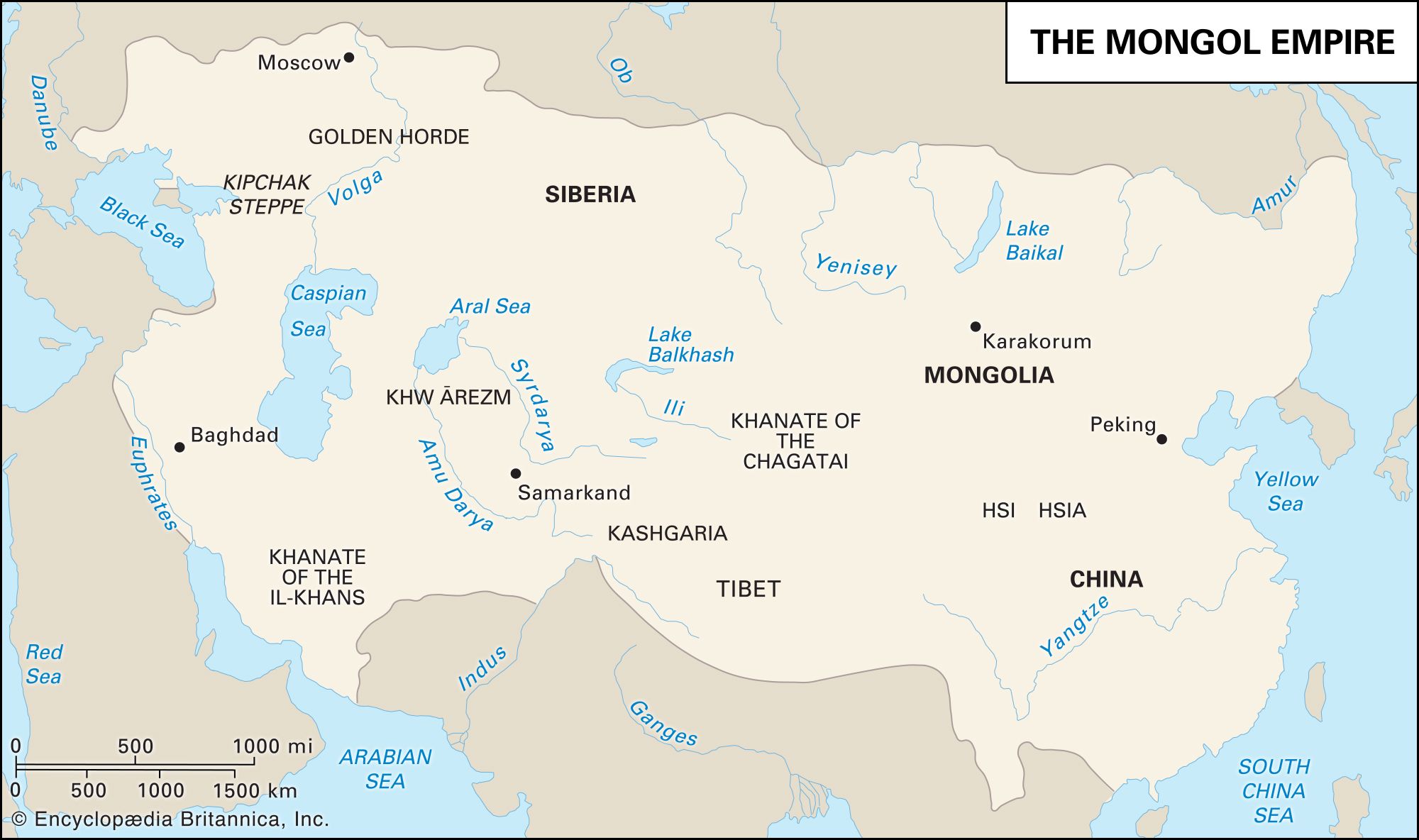
The Golden Horde, the Chagatai Kanati, the Dzungar Kanati.
speaker_5NARRATOR
You had Turkic peoples, indigenous Siberian groups, the expansion of the Russian Empire gradually absorbing these territories.

Addison AndersonNARRATOR
It was the largest contiguous land empire in history, stretching from Korea to Ukraine and from Siberia to Southern China, and was forged on the open plains.
Addison AndersonNARRATOR
In the 12th century CE, before the Mongol Empire formed, the East Asian Steppe was home to scattered groups of Mongol and Turkic pastoral nomads led by khans.
Addison AndersonNARRATOR
The people herded sheep, cattle, yaks, and camels.
Addison AndersonNARRATOR
They lived in felt tents and moved between summer and winter campsites.
Addison AndersonNARRATOR
In the 1230s, Chinggis Khan's sons and daughters conquered the Turks of Central Asia and the Russian princes, then destroyed two European armies in 1241.
Addison AndersonNARRATOR
In the 1250s, the Mongols seized Islamic territory as far as Baghdad, while in the east, their grasp reached Southern China by 1279.
Addison AndersonNARRATOR
Life within the Mongol Empire wasn't just war, pillage, and destruction.
Addison AndersonNARRATOR
Once the Mongols conquered a territory, they left its internal politics alone and used local administrators to govern for them.

William HanHOST
The Song Dynasty still persisted in southern China, while northern China went through a series of regimes, namely the Liao, the Jing, and the Yuan.
William HanHOST
When Guo Shoujing was born in 1231, The Jing Empire still existed in the north, but it was already on the cusp of destruction at the hands of the Mongols.
William HanHOST
Three years later, in 1234, the Jing fell completely, and the Mongol Empire took over.
William HanHOST
Guo Shoujing's father appears to have died young, and he was raised instead by his grandfather, Guo Rong.
William HanHOST
Kublai Khan, though, was not yet the great Khan of the Mongol Empire.
William HanHOST
That title belonged to his brother, Munku.
William HanHOST
Kublai Khan was rather in charge of the Mongols considered the South, which meant Northern China.
William HanHOST
In 1251, Kublai Khan called Liu Bingzhong back into service.

Pamela NagamiNARRATOR
The dukes of the Bavarians were making themselves practically independent.
Pamela NagamiNARRATOR
The situation of the Frankish realm in these later days of the seventh century was becoming like the situation of the Mongol Empire when Clive landed in India.
Pamela NagamiNARRATOR
An old monarchy founded on force, and long held together by fear, but now fast falling into decomposition and ruin through the utter loss of power in its heart.
Pamela NagamiNARRATOR
It will be hardly necessary to waste another word on the nominal occupants of the Frankish throne.

Juan NaulaNARRATOR
Bohemond then faced a run of bad luck, including being captured in battle, losing land to the Byzantine Empire, and Antioch being reduced to the status of a vassal of the Byzantine Empire.
Juan NaulaNARRATOR
But the rulership of Antioch continued to be passed down the Norman line from Bohemond to his nephew Tancred, and then to Tancred's son, Bohemond II, before Antioch became a tributary state of the Mongol Empire in 1260.
Juan NaulaNARRATOR
Back in France, Rollo's descendants survived the turmoil of the period through a mix of old Viking strategies, ruthless military action, and the cunning ability to sense weakness in the enemy.
Juan NaulaNARRATOR
The Normans were masters at taking advantage of the infighting among the Frankish aristocracy, a weakness which had left them unable to combat the Rouen Vikings' growing determination to stay.

Cass MorrisHOST
And I love seeing the big ones like that.
Cass MorrisHOST
I love the spread of the Roman Empire, the Mongol Empire.
Cass MorrisHOST
I love seeing how the big ones operate.
Cass MorrisHOST
But I also love when somebody takes that and smashes it with a hammer, which is how you get medieval Italy and the Holy Roman Empire.

Jason Jay SmartHOST
But it is something that has changed.
Jason Jay SmartHOST
It is not the Mongol Empire, one, but two, there's more information.
Jason Jay SmartHOST
More information is spreading very quickly in society.
Jason Jay SmartHOST
As information is spreading, more people are realizing that what is going on now in Moscow, what is going on inside the Kremlin, is destructive not only to themselves, but to the state.
13 MINS LATER
Chuck PfarrerGUEST
How do you remove the endemic corruption that isn't a bug, but it's a feature, right? How do you retrain a generation of officers to realize that the most important resource they handle are the men and women under their command?
Jason Jay SmartHOST
Absolutely.
Jason Jay SmartHOST
Going back to the Mongol Empire, it really is the same.
Jason Jay SmartHOST
What we see is that I think the Mongols... which very few people studied the Mongols, but they were interesting, is that ultimately, you know, one of the interesting elements about it was that it was all held together by personal loyalty to the supreme leader.
53 more episodes mention Mongol Empire.
Create an account to see the whole feed, search across every transcript, and follow the entities you care about.