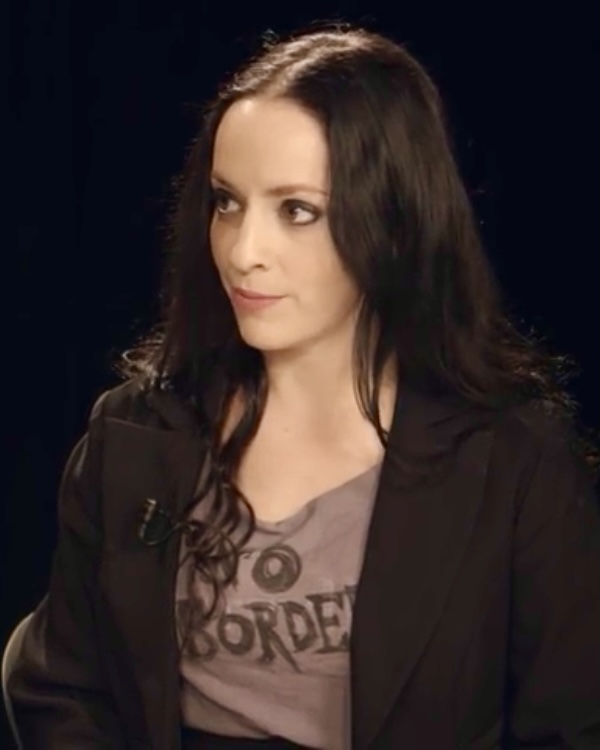
Molly Crabapple
American visual artist and writerWikipedia
35
MENTIONS
23
EPISODES
23
PODCASTS
Search complete. 35 mentions across 23 episodes found for "Molly Crabapple".
Oct 15, 2026

Clara Sherley-AppelHOST
Anyone who has been to any kind of sort of leftist meeting knows that there is always a piece of this in them.
Clara Sherley-AppelHOST
And it reminded me too of, I know you, I know you're a big fan of Molly Crabapple's, uh, Here Where We Live Is Our Country.
Sim KernGUEST
Mm-hmm.
Clara Sherley-AppelHOST
There's a moment in that where she's talking about, I think it might still be about the Vilna Group, and then she's kind of comparing it to all of these, like, basement meetings that she sat in in New York City with, like, interminable stacks and [laughs] uh, being either too hot or too cold, um, and how it is so familiar to, again, to, like, anybody who has ever been in those spaces.

Naomi KleinGUEST
Was largely destroyed in the Second world War, but it was a response to Zionism, and it was the, it was the rejection of the idea that safety lied over there in Palestine because of the rampant violence and antisemitism in Eastern Europe.
Naomi KleinGUEST
And in response to that, the Jewish Labor Bund said, "Here where we live is our country," and that's the title of our friend Molly Crabapple's book, and we have a right to stay, and we have a right to make here better in coalition and in solidarity across faith and, you know, like ethnic lines in the working class.
Naomi KleinGUEST
And so it was a different vision of safety.
Naomi KleinGUEST
It was one rooted in solidarity.

Naomi KleinGUEST
But it was a response to Zionism, and it was the, it was the rejection of the idea that safety lied over there in Palestine because of the rampant violence and antisemitism in Eastern Europe.
Naomi KleinGUEST
And in response to that, the Jewish Labor Bund said, "Here where we live is our country," and that's the title of our friend Molly Crabapple's book.
Naomi KleinGUEST
And we have a right to stay, and we have a right to make here better in coalition and in solidarity across faith and, you know, like ethnic lines in the working class.
Naomi KleinGUEST
And so it was a different vision of safety.

Francesca Root-DodsonHOST
Welcome to Critical Babe Theory, the podcast where we change hearts and minds one liberal at a time.
Francesca Root-DodsonHOST
And today I'm thrilled to have on the show Molly Crabapple in special celebration of our 75th episode.
Francesca Root-DodsonHOST
Molly is the author.
Francesca Root-DodsonHOST
She's also an artist and a journalist, and she's the author of the New York Times bestseller, Here Where We Live Is Our Country, the story of the Jewish Bund, which was a secular socialist revolutionary Jewish group that came to be in the late 1800s in the former Russian Empire and their political arc over the course of from the late 1800s through World War II.
Francesca Root-DodsonHOST
Hi, everyone.
Francesca Root-DodsonHOST
Welcome to Critical Babe Theory.
Francesca Root-DodsonHOST
My name is Francesca, and my guest today is Molly Crabapple, journalist, writer, and artist who wrote this incredible book called Here Where We Live Is Our Country, The Story of the Jewish Bund.
Francesca Root-DodsonHOST
Did I do it right? You got it.

KieranHOST
Uh, there's, um, you know, your book obviously is, uh, v- very detailed about that.
KieranHOST
Uh, Molly Crabapple's written a, a book, uh, about the Bund called, uh, Here Where We Live is Our Country.
KieranHOST
And then there's just a new book out, um, by Benjamin Moser, uh, called Anti-Zionism: A, A Jewish History.
KieranHOST
So there is this, um, quite a swing, uh, perhaps, uh, given impetus by Israel's actions as well.
Tony GreensteinGUEST
Never telling us of course that kibbutzim were established on stolen or Palestinian land or razed Arab villages, that they were Jewish only institutions, and they were an essential part of the apartheid construction of Israel itself, so.
Tony GreensteinGUEST
I mean, Zionism as I say has rewritten not least its own history, but that too is coming under the microscope like it's never before.
Tony GreensteinGUEST
And that, that's not just simply Molly Crabapple and Ben Moses books, but people like Ilan Pappé, the foremost Israeli historian, uh, and his book at the ethnic cleansing of Palestine.
Tony GreensteinGUEST
The work of people like Moshe Machover, for instance.

Arielle AngelHOST
And Tamim Fruchter, who actually organized a kind of letter to the Jewish Book Council for making their Zionist commitments operative and the way that that kind of pushes anti-Zionist novelists and writers out of the community, put it very well, which is just like instead of reckoning, they're digging their heels in.
Arielle AngelHOST
And so many of our Jewish organizations are doing that, and now our Jewish literary organizations are doing that, in spite of the fact that there is an enormous amount of anti-Zionist literature being published that's very interesting, like Molly Crabapple's book about the Bund, for example, which also is a bestseller and having a real cultural moment.
Arielle AngelHOST
So I don't know.
Arielle AngelHOST
I mean, like, I hear what you're saying, Josh, that like the more the merrier.
Josh LambertGUEST
It has to do with what people want to read, what they want to put their money behind, what they're interested in.
Arielle AngelHOST
And the changes, the broad changes in American political life.
Dan SinykinGUEST
I mean, I think we heard this from Molly Crabapple and from Benjamin Moser and from others.
Dan SinykinGUEST
But like, you know, people who've been critical of Zionism for a long time, it felt like a lonely position for a long time in this country.

Faisal Al YafaiHOST
Right.
Rashid KhalidiGUEST
Um, Molly Crabapple's book on the Bund.
Faisal Al YafaiHOST
Precisely.
Faisal Al YafaiHOST
The Bund.

Poulomi SahaMODERATOR
If one step to that was the choice to write together, because I found myself so taken by the idea that there was more than one of you in this book, because the scale of what you take on seems so enormous and at times... impossible, but somehow it felt fortifying to know that it wasn't just me reading, but that there were also the two of you.
Poulomi SahaMODERATOR
And I wonder how much friendship and that really human personal connection was a method and a kind of through line for the book, but also what kind of challenges come up as two people with different perspectives living in two countries with two different voices.
Poulomi SahaMODERATOR
How did you find a common voice? Where did you disagree? If we read close enough, could I find Astra and Naomi? Or did you try to find a third melded voice?
Astra TaylorGUEST
Yeah, I mean, I think it is really... appropriate that this is a co-written book and I think it's something that we both agree like neither of us could have written alone partly because of the the time that we wrote it in but also because it I mean to be really honest it was really hard I mean, there were moments of total despair.
Naomi KleinGUEST
So yeah, I think that we had that compliment.
Naomi KleinGUEST
And for me, as somebody, Astra has co-written before, I haven't.
Naomi KleinGUEST
And it was a challenge for me to sort of lose, like, you know, the eye, you know? But I do feel like we got to something that is more powerful, like the fact that the book really does come from friendship.
Naomi KleinGUEST
And I think people feel that.

Katherine FentonNARRATOR
It was a perfect encapsulation of here-ness, an idea developed by the Jewish Labor Bund, a Yiddish socialist group that was founded in the 19th century and grounded in fierce commitment to place and community not based on bloodlines.
Katherine FentonNARRATOR
Molly Crabapple, a proud New Yorker and artist who recently published a best-selling history of the Bund, made the connection in a piece published in The Guardian.
Katherine FentonNARRATOR
Like New York itself, Mamdani's campaign was multicultural, multiracial, polyglottal, she wrote.
Katherine FentonNARRATOR
When Andrew Cuomo tried to bait him as un-American, he released ads in Spanish and Bangla, Hindi and Arabic.

Katie HalperGUEST
Um, there are actually two books that I recommend right now.
Katie HalperGUEST
Um, one is by Molly Crabapple, it's about the Bund, and one is by, uh, Ben Moser, and it's called, uh, Anti-Zionism: A Jewish History.
Katie HalperGUEST
Uh, and it's basically takes the form of 12 different lives, 12 Jewish lives, 12 Jews who over, in different countries and d- during different t- periods of time, uh, were a- anti-Zionist, 'cause that is a history that people just don't know about.
Katie HalperGUEST
Um- And then the Molly Crabapple book about the Bund, uh, is, is really excellent.
Katie HalperGUEST
The, and I, I highly re- recommend both of them.
Katie HalperGUEST
But, you know, it, what's interesting is that these people get...
13 more episodes mention Molly Crabapple.
Create an account to see the whole feed, search across every transcript, and follow the entities you care about.