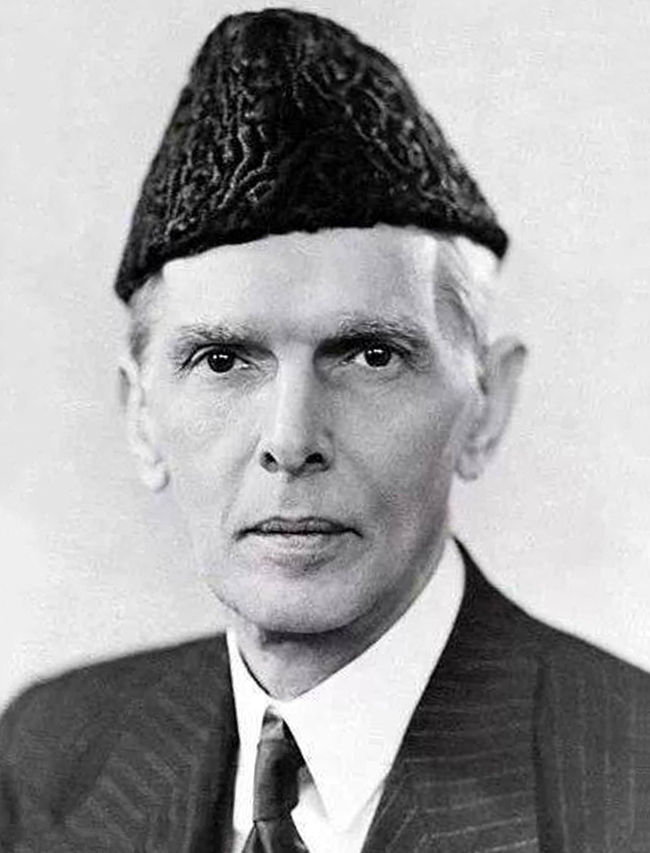
Muhammad Ali Jinnah
Barrister and former Governor-General of PakistanWikipedia
61
MENTIONS
18
EPISODES
17
PODCASTS
Search complete. 61 mentions across 18 episodes found for "Muhammad Ali Jinnah".
Nov 3, 2026

Dinesh D'SouzaGUEST
And Gandhi had envisioned a very different type of India.
Dinesh D'SouzaGUEST
By the way, I don't know if you know this, but the guy who started Pakistan, his name was Muhammad Ali Jinnah.
Dinesh D'SouzaGUEST
This is a guy who was Western educated, secular guy, liked a nice round of scotch.
Dinesh D'SouzaGUEST
He was not some kind of an Islamic fanatic at all.
Dinesh D'SouzaGUEST
But the Muslims came to him and said, you know, we Muslims are not going to be safe in Hindu India.
Dinesh D'SouzaGUEST
And so this guy realized, guess what? If I go to the British and I represent that the Muslims won't be safe, they might give me my own country and I will then become the president of that place.
Dinesh D'SouzaGUEST
So even though Jinnah himself was a little bit more like an Ataturk, he exploited the fears of the Muslims to push the British into partitioning the country.
Dinesh D'SouzaGUEST
And that was the beginning of Pakistan.

Moshe HaberHOST
Well,
speaker_5UNKNOWN
are you on the Israeli side? Are you on the Palestinian side? Or are you on Jinnah's side?
Moshe HaberHOST
Oh my gosh.
DavidUNKNOWN
Yeah.

speaker_0NARRATOR
Now, if there was ever a single act to define colonial stupidity and short-sightedness, it was the Radcliffe Line.
speaker_0NARRATOR
On August 14, 1947, Pakistan was officially formed, with Muhammad Ali Jinnah sworn in as its first Governor General.
speaker_0NARRATOR
This included what we see today as Pakistan, but also an eastern section completely cut off called East Pakistan, which is today Bangladesh.
speaker_0NARRATOR
India had its turn, with Jarrah al-Alneru assuming power as the nation's first Prime Minister.

Kushal MehraHOST
On 7th May 2018 for "The Wire," Sharjeel wrote an op-ed.
Kushal MehraHOST
It was called "It's Time We Absolve Jinnah." And the bo- bottom tagline was, "Partition harmed the Indian Muslims most, but to put, but to put the blame on Jinnah or the Muslim League is not necessarily a correct historical reading." So what he said was, "Jinnah ki toh koi galti nahi thi." Um, and, and you know, I want to read the bit that fascinated me the most.
Kushal MehraHOST
It's called Minority Rights.
Kushal MehraHOST
I want to read this paragraph bit here.
Kushal MehraHOST
Muslims and Hindus were two such vertical divisions among others, as there were other horizontal caste divisions.
Kushal MehraHOST
We were and are still not a nation in the academic sense of Benedict Anderson's imagined communities.
Kushal MehraHOST
Jinnah argued that we would not-- we would be able to become a nation only if we would make the minority community feel secure, and a party which argues on behalf of the minority was a communal party." Wah! Logic dekho.
Kushal MehraHOST
"Congress twisted the meaning of communal and made it into a contemptuous term.

Harsh ManderGUEST
The two people who led the project of political Hinduism and political Islam, somebody called Savarkar was the founder of Hindutva and he was a self-professed atheist.
Harsh ManderGUEST
And Jinnah, who led the creation of a religious-based Pakistan, was not a practicing Muslim most of his life.
Harsh ManderGUEST
And I think...
Harsh ManderGUEST
Yeah, so I think there's a moral out there.

SadhguruHOST
An even more dangerous situation arose in Rajputana, which is roughly what we call Rajasthan today.
SadhguruHOST
The Maharaja of Jodhpur was being courted by Muhammad Ali Jinnah.
SadhguruHOST
Jinnah wanted Hindu majority states to join Pakistan to undermine the very theory on which Pakistan was built.
SadhguruHOST
He handed Maharaja of Jodhpur a blank sheet of paper with his signature at the bottom and said, write your own terms.
SadhguruHOST
That is how desperate Muhammad Ali Jinnah was.
SadhguruHOST
Sardar Patel and VP Menon intervened very quickly with their own counter diplomacy.
SadhguruHOST
They offered Jodhpur concrete things that Jinnah could never deliver.

Shehzad Ghias ShaikhGUEST
Then there can be a lot of decisions on the politics of the Muslim League.
Shehzad Ghias ShaikhGUEST
But it's a fact that either you say because Jinnah and Liaquat Ali Khan passed away quickly, either you say that we didn't have that legacy.
Shehzad Ghias ShaikhGUEST
Jo political vacuum tha uski wajah se bureaucracy aur army, they sort of took control of the country and then this obsession with centralization, centralizing power came, jiski wajah se bhi eventually 1971 hua.
Shehzad Ghias ShaikhGUEST
So if I was to go back to a moment, I would say those early formative years where we sort of lost the idea of what Pakistan should have been, which should have been, in my opinion, independent sovereign states.
Shehzad Ghias ShaikhGUEST
Assalam o Alaikum Wa Alaikum Assalam o Alaikum Wa Alaikum Wa Alaikum Wa Alaikum Wa Alaikum
speaker_7UNKNOWN
Wa Alaikum Wa Alaikum Wa Alaikum Wa Alaikum Wa Alaikum Wa Alaikum Wa Alaikum Wa Alaikum So how do you see Jeddah in the point of view of independence of India?
Shehzad Ghias ShaikhGUEST
I think at this point Quaid-e-Azam Muhammad Ali Jinnah has become a blank state.
Shehzad Ghias ShaikhGUEST
What we don't realize is that Jinnah was not a philosopher.

Viral MistryGUEST
Singh repeatedly uses the pulpit as his vehicle to push his revolutionary agenda, repeatedly calling out the ways of capitalism and how it is harming the people of South Asia.
Viral MistryGUEST
He is visited in jail by numerous prominent leaders, including Jawaharlal Nehru, Subhash Chandra Bose, Muhammad Ali Jinnah, and even Gandhi came to visit him.
Viral MistryGUEST
They defend their ideology in court.
Viral MistryGUEST
They claim, you know, we have every right to partake in this revolutionary struggle because the British government is inherently illegitimate.

Judy TenzingGUEST
This was Lord Wavell.
Judy TenzingGUEST
It was Mahatma Gandhi and Nehru representing, well, Nehru representing the Hindus, Muhammad Ali Jinnah representing the Muslims, and Mahatma Gandhi running backwards and forwards between the three of them trying to get them all to agree to something.
Judy TenzingGUEST
They didn't.
Judy TenzingGUEST
He was terribly frustrated and upset by the whole thing.

Ravi ShankarGUEST
It is not now.
Ravi ShankarGUEST
Jinnah recognized it in 1947.
Ravi ShankarGUEST
That is why, if you go back into the history of India-Pakistan wars, the first lot who came into Kashmir, the raiders, were basically Pashtuns.
Ravi ShankarGUEST
The rest of Pashtuns were pushed by Jinnah into Kashmir for booty and things like that, whatever, right? So that the focus was away from this area and it went into Kashmir.
Ravi ShankarGUEST
Then after the nation settled in whatever fashion they did, say 15-20 years later, the next big war between India and Pakistan happens in 1965.
Ravi ShankarGUEST
In 1965, Ayub Khan repeated the same thing.
8 more episodes mention Muhammad Ali Jinnah.
Create an account to see the whole feed, search across every transcript, and follow the entities you care about.