Moche culture
17
MENTIONS
9
EPISODES
9
PODCASTS
Search complete. 17 mentions across 9 episodes found for "Moche culture".
Oct 26, 2026

Benjamin BosterHOST
ago.
Benjamin BosterHOST
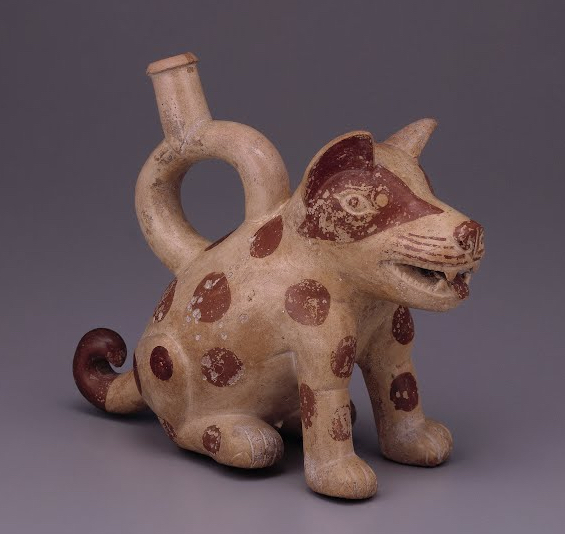
The Moche people of northern Peru often used alpaca images in their art.
Benjamin BosterHOST
Traditionally, alpaca were bred and raised in herds, grazing on the level meadows and escarpments of the Andes, from Ecuador and Peru to western Bolivia and northern Chile, typically at an altitude of 3,500 to 5,000 meters, or 11,000 to 16,000 feet above sea level.
Benjamin BosterHOST
There are no known wild alpacas, and its closest living relative, the vicuña, also native to South

Gary ArndtHOST
The famous Nazca lines would be created over an extended period, roughly spanning the late 1st millennium BC and the first several centuries.
Gary ArndtHOST
Farther north, the Moche culture was beginning to develop.
Gary ArndtHOST
Over the following centuries, Moche societies would construct enormous adobe ceremonial complexes and produce some of the most sophisticated ceramics in the ancient Americas.
Gary ArndtHOST
The Paracas culture, known for its extraordinary textiles and complex funerary practices, was influential in southern coastal Peru around this period as well.
Gary ArndtHOST
In the Andean highlands, farmers cultivated potatoes, quinoa, and other crops that were adopted to mountain environments.

Chris ChristensenHOST
[laughs]
Jorge SalasGUEST
... for at least 4,000 years, locals from t- the Moche Chicama culture were practicing surf on the caballitos de Totora, which is a small reed boat.
Jorge SalasGUEST
And it is here where w- my friends from the Andes are gonna get a little upset, but I believe one of the best, uh, examples of fine Peruvian cuisine has evolved.
Jorge SalasGUEST
So I'm just mentioning that all this, this, this area has a lot.
21 MINS LATER
Jorge SalasGUEST
You know, we did Paracas and, and Nazcas.
Jorge SalasGUEST
W- we did all that.
Jorge SalasGUEST
Now we go to the north and we go into several cultures, the Lambayeques, but the Moche and Mochica cultures.
Jorge SalasGUEST
These are pre-Inca cultures.

speaker_3NARRATOR
The Aztecs connected frogs with Tlaloc, the god of rain and water.
speaker_3NARRATOR
The Moche civilization of ancient Peru depicted frogs frequently in their ceramics, often in association with water and agriculture.
speaker_3NARRATOR
In medieval European folklore, frogs and toads were often associated with witchcraft.
speaker_3NARRATOR
A toad was considered a common familiar for a witch, and toad parts were supposed ingredients in magical potions.

Darcy KopasGUEST
And so it's this golden chain of lineage from, you know, as far as we can map from the Chavin, there's also the Corral culture that they're finding is even possibly older than the Chavin.
Darcy KopasGUEST
And then after the Chavin, you have the Lambayaki and the Mochi and the Chimu and the Wari and the Nazca and the Paracas.
Darcy KopasGUEST
So all these coastal cultures that some, some were in parallel at the same time, but some came after.
Darcy KopasGUEST
And each of the culture would have some form of this Mesa consciousness, right? Mesa technology.

Alan BishopHOST
Farmers left milk offerings for her cats to bless the harvests.
Alan BishopHOST
Or Ai Apaec, a pre-Inca Mochica culture god, which was a shapeshifting creator god depicted with feline fangs and whiskers who possessed strong animal and spiritual powers.
Alan BishopHOST
Or Ovinnik from Slavic folklore, a house and barn spirit that often took the form of a black cat to guard livestock and farm animals.
Alan BishopHOST
And of course, Hecate, a goddess of magic and crossroads who was sometimes said to transform into a cat to escape distress.

speaker_6NARRATOR
Long before the Incas made pilgrimage an instrument of imperial authority, the people of the Andes knew how to gather strangers around a religious center.
speaker_6NARRATOR
Centuries later, between roughly the 1st and 8th centuries CE, the Moche flourished in the coastal valleys of Peru.
speaker_6NARRATOR
They were not necessarily subjects of one united kingdom.
speaker_6NARRATOR
Their settlements appear to have shared artistic practices, beliefs, and commercial connections, while retaining considerable local independence.
speaker_6NARRATOR
Yet, religious leadership could gather resources on an impressive scale.
speaker_6NARRATOR
At the settlement called Moche, laborers erected two enormous ceremonial pyramids, the Huaca del Sol and the Huaca de la Luna.
speaker_6NARRATOR
The former rose approximately 135 feet, or 41 meters.
speaker_6NARRATOR
Similar, though smaller, construction stood in other valleys.

Julia PerratoreGUEST
Well, I think I'm gonna horrify people by betraying my side because, um, I, [laughs] all of my favorite objects of the show tend to be America's objects.
Julia PerratoreGUEST
Uh, but I have many favorites, but, um, I think one object that always stands out to me, and I think Joan can probably guess what I'm gonna say, is a vessel made by the Moche on nor- the north coast of Peru that is a category of hybrid that we do not see a lot of in medieval Europe- Which is a creature that is part human and part plant.
Julia PerratoreGUEST
And, uh-
Matthew GabrieleHOST
Oh
Julia PerratoreGUEST
So maybe Peanut Person.
Julia PerratoreGUEST
It's a small object, so it doesn't have the sort of grandeur and magnificence of the Bat Lord, but it is beyond precious and, uh, amusing and just a, a pleasure to look at.
Julia PerratoreGUEST
I mean, the Moche were wizards when it came to working with clay.
Julia PerratoreGUEST
I mean, I'm, I'm completely converted to, to loving, uh, Moche pottery.

Dave FarinaHOST
The Early Horizon, 2900 to 2200 BP, saw the development and spread of the Chavín civilization, notable for their goldsmithing and metalworking.
Dave FarinaHOST
The Early Intermediate Period saw smaller-scale civilizations such as the Moche and Nazca.
Dave FarinaHOST
The Middle Horizon, 600 to 1000 CE, saw the beginning of powerful states with large areas of influence and control in the Andean region.
Dave FarinaHOST
Specifically, two civilizations came to dominate, Wari and Tiwanaku.