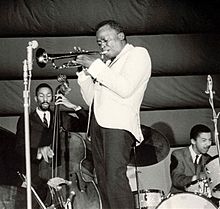
Miles Davis Quintet
BandWikipedia
9
MENTIONS
5
EPISODES
5
PODCASTS
Search complete. 9 mentions across 5 episodes found for "Miles Davis Quintet".
Oct 9, 2026

Hilary MillerHOST
I think that this, uh, circles back to what you were saying earlier.
Hilary MillerHOST
Um, I have this half quote fr- from Wallace Roney, who was trumpeter for the Miles Quintet in '91.
Cody TinsleyHOST
Mm-hmm.
Hilary MillerHOST
And he said, "The meeting of Miles Davis with a prolific composer", and Trane was a good composer too.

Norman GranzSOUNDBITE_SPEAKER
There will be two parts to the concert.
Norman GranzSOUNDBITE_SPEAKER
The first half, the Oscar Peterson Trio, and then Stan Getz Quartet, and after the pausa, the Miles Davis Quintet.
Norman GranzSOUNDBITE_SPEAKER
Now, I would like to introduce the members of the first group, beginning with the drummer, Ed Thigpen.
Norman GranzSOUNDBITE_SPEAKER
[audience applauding] In almost every country where there is an interest in jazz, the fans and the musicians, and even the critics, each year select the best people on the different instruments in jazz, and each year, the best bassist, practically everywhere in the world, is Ray Brown.

Kevin LawrenceHOST
Right now, we're going to feature music from one of the greatest composers in the history of jazz.
Kevin LawrenceHOST
The guy is also an innovator, was a member of the second great Miles Davis Quintet.
Kevin LawrenceHOST
This is the title track of an album that he produced on the Blue Note label called Speak Like a Child, released in 1968.
Kevin LawrenceHOST
Here's Herbie Hancock on Jazz in the AM on K-Jazz on My City, mymusic.com.
speaker_7UNKNOWN
[jazz music]
Kevin LawrenceHOST
[jazz music]And that is music by one of the greatest composers in the history of jazz.
Kevin LawrenceHOST
Member of the second great Miles Davis quintet, one of my favorite jazz bands, Herbie Hancock.
Kevin LawrenceHOST
The title track of a 1968 album, Speak Like a Child.

speaker_0HOST
Those issues got so bad that it finally made him go live with his father for a time in 1953 in order for him to really deal with them.
speaker_0HOST
In 1954, fresh from temporarily dealing with him, Miles moved back to New York City, started working with the Miles Davis Quartet.
speaker_0HOST
And while there, Miles' style switched from bebop to hard bop after having been influenced by pianist Ahmad Jamal.
speaker_0HOST
1956's album Blue Haze and 1957's album Walkin helped to usher in the hard bop era.

speaker_1UNKNOWN
so so
Sid GribetzHOST
Supposed in an old Andy Rousseff composition, already part of the jazz repertory, performed by the Miles Davis Quintet November 16th, 1955 for Prestige Records, and what has come to be known as the quintet that would stay together for more than a year following this recording.
Sid GribetzHOST
John Coltrane on tenor sax, Miles Davis trumpet, Red Garland piano, Paul Chambers bass, and Philly Joe Jones on drums.
Sid GribetzHOST
Good afternoon for those of you just joining us.
Sid GribetzHOST
he had under contract.
Sid GribetzHOST
The albums should be familiar to you.
Sid GribetzHOST
They gave them names starting out with Cooking with the Miles Davis Quintet, Working with the Miles Davis Quintet, Relaxin' with the Miles Davis Quintet, and Steamin' with the Miles Davis Quintet.
Sid GribetzHOST
So those two great recording sessions are in the annals of jazz history.