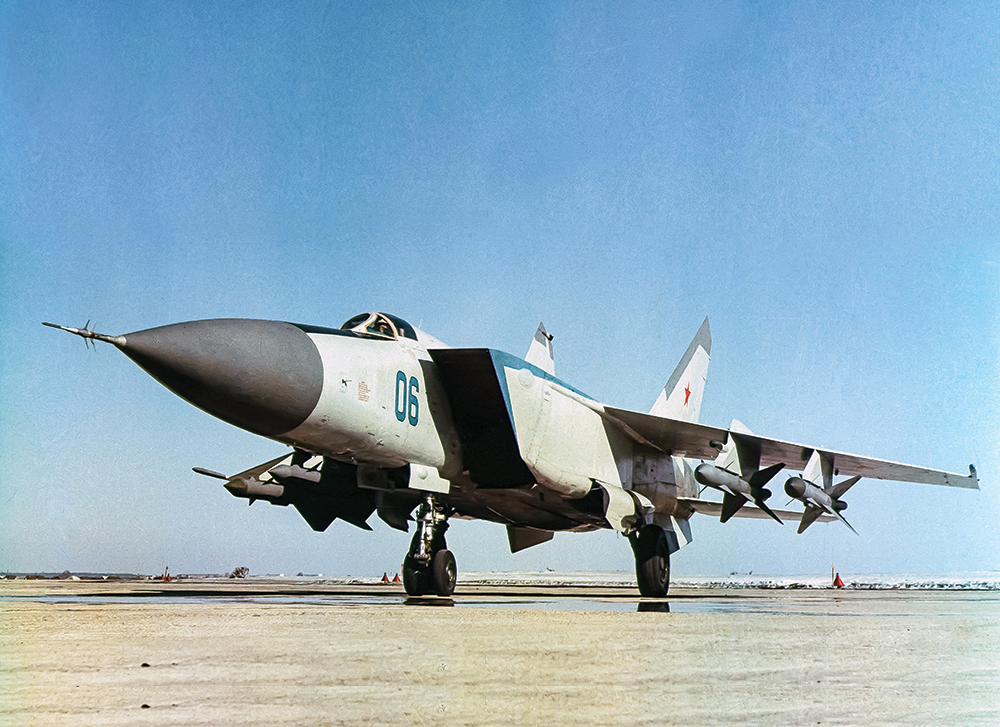
Mikoyan-Gurevich MiG-25
InterceptorWikipedia
33
MENTIONS
8
EPISODES
8
PODCASTS
Search complete. 33 mentions across 8 episodes found for "Mikoyan-Gurevich MiG-25".
Oct 22, 2026

Graham WildGUEST
So you've got to remember that the Russians were afraid of almost everything the Americans were doing.
Graham WildGUEST
So the MiG-25 Foxbat was designed as this kind of super counter to the American aircraft at the time.
Graham WildGUEST
And the Americans then built the F-15.
Graham WildGUEST
And when they got hold of this... apparent russian super aircraft the mig-15 when someone defected i think they flew into japan or into south korea can't remember exactly how they got hold of this mig-15 and when they had a look at this thing they were like oh it's just great at going really fast in a straight line to try and intercept things like the sr-71 but it was not a very good aircraft so this super aircraft the first true air superiority aircraft the americans had with the f-15 was designed to combat this imaginary ghost or this ghoul of a Russian aircraft that just didn't exist.

MikeHOST
Very neat.
Victor EarmalovGUEST
T- tonight is a MiG-25 to 65,000 feet.
MikeHOST
Wow.
MikeHOST
Do you have any aviation regrets? And I mean, let me put it this way, in about '93, I was in Springfield, Illinois, and the guy who ejected out the MiG-29 in Paris-

Barry "Butch" WilmoreGUEST
We'd never done this.
Barry "Butch" WilmoreGUEST
And we went over there and flew the MiG 20- 29, flew the MiG 25.
Barry "Butch" WilmoreGUEST
Um, anyway, long process.
Barry "Butch" WilmoreGUEST
So I was dealing with the State Department, like, every other day for five months.

TonyHOST
After minutes of pursuit, they had no confirmed contact.
TonyHOST
Subsequent analyses by NATO's radar analysts noted that some of those tracks could have been spurious returns caused by temperature inversions over the North Sea or by signal reflections off weather phenomena such as contrails and cloud layers, but they were not able to conclusively attribute the anomalies to known aircraft types like MiG-25s or Dassault Rafales.
TonyHOST
Because the F-16 pilots never recorded a clear image of an object that matched the ground reports, NATO issued a report in early 1991 acknowledging that the incidents remained unidentified and urged Belgium to continue monitoring, yet no further official investigations were pursued at higher levels due to diplomatic concerns about escalating rumors.
TonyHOST
In hindsight, the intercept attempt underscores how quickly high-level military assets can become involved when radar data suggests something beyond standard operational envelopes, and also illustrates why most of these cases remain frustratingly opaque even to the most trained eyes and sensors.

KelliHOST
Some say the craft was intercepted and forced to land in the Soviet Union.
KelliHOST
This theory comes from the thought that a dismantled Mikoyan-Gurevich MiG-25 was included in the cargo on Flight 967.
KelliHOST
In 1967, a Soviet Air Force pilot named Viktor Belenko defected in his MiG-25 to Hokkaido, and was offered asylum by Gerald Ford.
KelliHOST
The fighter jet, MiG-25, became operational in 1970.
KelliHOST
It was the main interceptor and reconnaissance aircraft of the Soviet Union, so they would do anything to keep it out of American hands.
KelliHOST
It is absolutely true that Belenko offered a MiG-25 manual to the US in exchange for citizenship, but there is no proof either he or a decommissioned fighter jet were aboard Flight 967.
KelliHOST
What happened to Varig Flight 967? Did it depressurize and the crew lose consciousness? Was it intercepted by the Soviet Union? What do you think? Thank you for joining me on our adventure through today's mystery.
KelliHOST
The stories that That's Ready Mysterious covers are often stranger than fiction.

Shiv AroorHOST
Hello and welcome to episode 59 of Control All Defense.
Shiv AroorHOST
Now, there are fighter aircraft, there are spy planes, and then there is this absolute monster called the MiG-25 Foxbat.
Shiv AroorHOST
Now, This is an aircraft that was so outrageously fast and powerful that for the longest time, it was born during the Cold War.
Shiv AroorHOST
Most of the world had no idea what this aircraft really was about and what it could do.
Shiv AroorHOST
I was probably the first or if not the first person who isn't from the Air Force to actually see these aircraft up close.
Shiv AroorHOST
But these were incredible machines that the Russians built.
Shiv AroorHOST
And India... for about a quarter century, in almost complete secrecy, operated these tremendous flying machines, the MiG-25 Foxbat.
Shiv AroorHOST
So today on Control All Defense, Vishnu and I are not going to geek about the aircraft between ourselves.

Tom VeltriGUEST
Well, yeah.
Tom VeltriGUEST
The Viggins weren't there for more than, I'd say, five minutes, when a MiG-25, I could...
Tom VeltriGUEST
I could visually identify them.
Tom VeltriGUEST
But when I got to the Pentagon, I was told that they had launched over 20 aircraft at us that day, the Russians, out of different places.

Phil ThompsonHOST
It is 12.50 in the afternoon on the 6th of September 1976.
Phil ThompsonHOST
A Soviet Air Force lieutenant named Viktor Belenko releases the brakes of a MiG-25 interceptor at Sokolovka Air Base in the Soviet Far East, approximately 120 miles northeast of Vladivostok.
Phil ThompsonHOST
The aircraft weighs 22 tons and carries 14 tons of fuel.
Phil ThompsonHOST
It is one of the most secret pieces of military hardware in the world.
Phil ThompsonHOST
The contact on the ground controller's screen disappears.
Phil ThompsonHOST
What followed was one of the most dramatic cases of defection of the Cold War and one of the most consequential technical intelligence windfalls in American history.
Phil ThompsonHOST
For a decade, the MiG-25 Interceptor had been the West's most feared unknown in the Soviet arsenal.
Phil ThompsonHOST
The aircraft was studied for 67 days on Japanese soil before being returned to the Soviet Union in pieces.