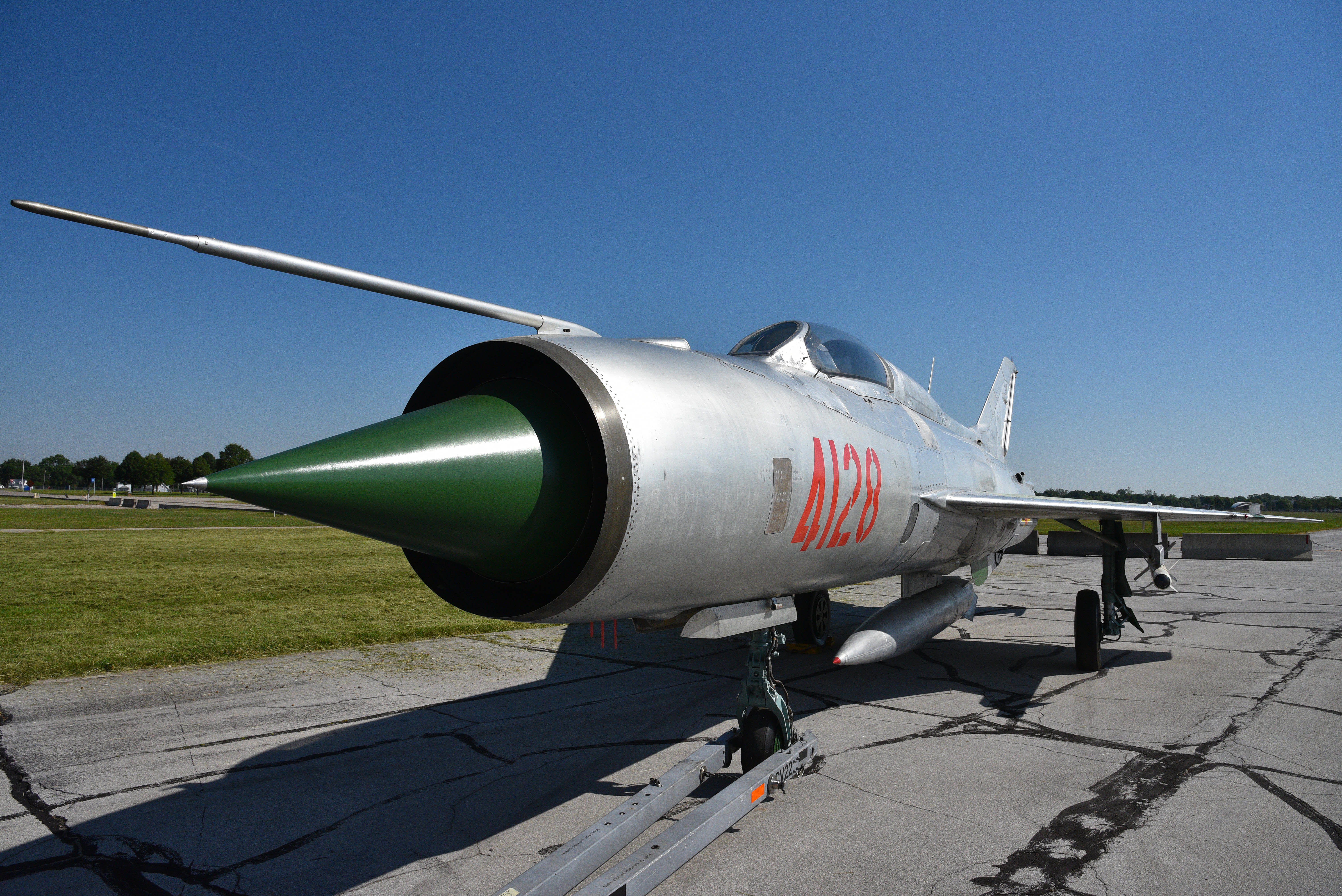
Mikoyan-Gurevich MiG-21
Jet fighterWikipedia
59
MENTIONS
17
EPISODES
15
PODCASTS
Search complete. 59 mentions across 17 episodes found for "Mikoyan-Gurevich MiG-21".
Oct 28, 2026

Shiv AroorHOST
Yeah,
Vishnu SomHOST
but then they didn't really do it, did they? When we were, you know, earlier on in talks with the Americans, you know, they denied us aircraft, which is why we landed up with the MiG-21.
Vishnu SomHOST
Yeah.
Vishnu SomHOST
And we became the MiG-21 Air Force till what last year.
Vishnu SomHOST
Right.
Vishnu SomHOST
And so it's not that then there were other problems.

Tucker HamiltonHOST
Well, he went on to fly F-4s, F-5 Aggressors, and F-15s, while also being handpicked for one of the most secret programs in Air Force history, the 4477th Test and Evaluation Squadron, the Red Eagles.
Tucker HamiltonHOST
There, under the classified program Constant Pig, he strapped into clandestinely acquired Soviet MiG-21s and MiG-23s to learn how to beat them.
Tucker HamiltonHOST
He's one of the only Americans who ever flew those jets, and he's written the story down in a fantastic book, American MiG Pilot, Inside the Top Secret U.S. Air Force Red Eagle's MiG Squadron.
Tucker HamiltonHOST
Get that book wherever books are sold.
Rob ZettelGUEST
Attrition, hard to get in, you name it.
Rob ZettelGUEST
So he said, why don't you think about maybe doing something else as a career? So a little while later, I walk out of his office, and obviously, I didn't listen to authority because 12 years later, I'm selected to be a Red Eagle.
Rob ZettelGUEST
And what was arguably the best-kept secret of the Cold War, an entire squadron of MiGs, MiG-21s, MiG-23s, tucked away 120 miles north-northwest of Nellis, up in the Nevada Ranges at Tonopah Test Range, and we got an entire squadron.
Rob ZettelGUEST
Later, it eventually grew up to 26 MiGs.

Thomas777GUEST
The operation was called Ramon 20 by the Israeli Air Force.
Thomas777GUEST
There was 12 to 14 Soviet MiG-21s and 12 Israeli Mirage 3s and 4 Phantom 2s.
Thomas777GUEST
They...
Thomas777GUEST
Like I said, it was this massive dogfight in the Suez Canal operational area.

ThomasGUEST
The operation was coding Ramon 20 by the Israeli Air Force.
ThomasGUEST
There was 12 to 14 Soviet MiG-21s and 12 Israeli Mirage 3s and F-4 Phantom 2s.
ThomasGUEST
Like I said, it was this massive dogfight in the Suez Canal operational area.
ThomasGUEST
Five Soviet aircraft went down.

speaker_1SOUNDBITE_SPEAKER
So there I was, crossing the pond, and you could see that I wasn't exactly fond.
C.J. HeatleyGUEST
So there I was, sitting in a MiG-21, doing my engine run-ups, looking around Groom Lake, Area 51, and I looked to my 10 o'clock, and there's the weirdest shaped thing I'd ever seen.
C.J. HeatleyGUEST
Had no idea if it was an aircraft or a vehicle.
C.J. HeatleyGUEST
It was a weird color, too.

ScudHOST
And this is the transition from World War II piston – air power into very early jet air power.
ScudHOST
And the next logical step past the F 86 would be the F 100 where you're, you're now getting supersonic flight and you're getting slightly more advanced systems after burners and, and, um, and, or like the MiG 21 where you're going from, you know, same thing, the MiG 21 and compared to the MiG 15 is like the F 100 compared to the F 86.
ScudHOST
Um, And what I really enjoy about the airplane, and we'll get into it, is that you can see the transition very prominently in this module.
ScudHOST
It is still a very poorly laid out cockpit with old gauges.

Dan MercurioHOST
It was a secret program, probably the best kept secret of the Cold War, and it was meant to train U.S. Air Force pilots, primarily U.S. Air Force, and then later on Navy and Marines, and they used actual captured MiGs for the training.
Dan MercurioHOST
They were MiG-17s in the beginning and then mostly MiG-21s and then later on 23s.
Dan MercurioHOST
And it happened right here in the U.S.
Dan MercurioHOST
It was north of Nellis Air Force Base in Tonopah.
Dan MercurioHOST
IPs like Rob, they'd hand out a bunch of papers that says they can't divulge any information that they see or hear there.
Dan MercurioHOST
And then they'd take them out to the flight line.
Dan MercurioHOST
open up the hangar doors, and there's 10 MiG-21s sitting nose to nose, and all the pilots' jaws just drop.
Dan MercurioHOST
They're like, whoa, we're going to fight some MiGs this week.

speaker_0HOST
Whenever something like this happens, there's always a crowd of people who just want to see what's going on, so managing that crowd always gets very difficult, especially for people who are doing rescue operations." The F7BGI fighter provides crucial context for understanding this disaster.
speaker_0HOST
The aircraft was a Chinese-built multi-role fighter developed by Chengdu Aircraft Corporation, specifically an advanced variant and export version of the Chengdu J-7, which itself derived from the legendary Soviet MiG-21.
speaker_0HOST
This technological lineage represents decades of evolutionary development rather than revolutionary change.
speaker_0HOST
While each iteration incorporated improvements, the fundamental airframe design traces its roots back to 1950s Soviet engineering.

Shiv AroorHOST
The, the, the amazing thing about this, Vishnu, and I did some research on this and asked a few people, is the history of American, uh, uh, American governments offering fighters to India goes back to, wow, 1950, 1950s.
Vishnu SomHOST
Yeah, but then they didn't really do it, did they? When we were, uh, you know, e- earlier on in talks with the Americans, uh, you know, they, they, they denied us aircraft, which is why we landed up with the MiG-21.
Shiv AroorHOST
Yeah.
Vishnu SomHOST
And we became the MiG-21 Air Force till, what, last year, right? And, uh, so it's not that, uh ...
Vishnu SomHOST
Then there were other problems.
Vishnu SomHOST
At a, at a certain stage, we were considering the Swedish Viggen.
Shiv AroorHOST
... uh, uh, offered to India.
Shiv AroorHOST
Negotiations stalled over US technology transfer restrictions.
7 more episodes mention Mikoyan-Gurevich MiG-21.
Create an account to see the whole feed, search across every transcript, and follow the entities you care about.