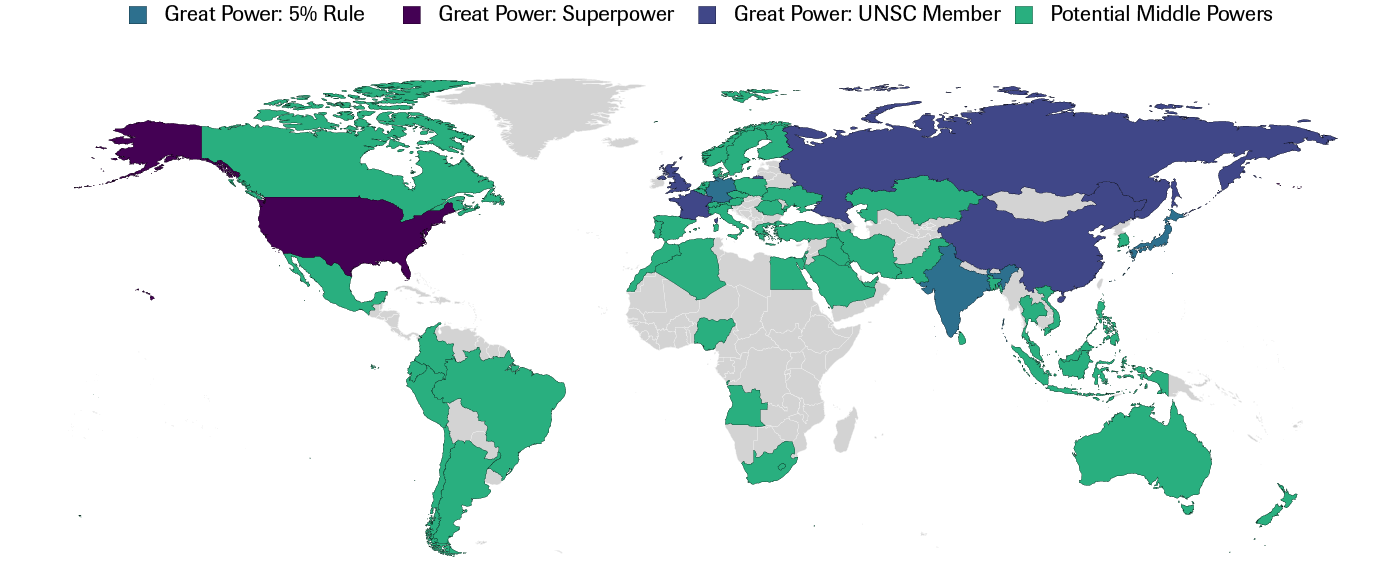
Middle power
98
MENTIONS
25
EPISODES
23
PODCASTS
Search complete. 98 mentions across 25 episodes found for "Middle power".
Sep 20, 2026

Burning BrightHOST
And a couple weeks ago, there was actually a headline that I was going over on my show talking about Operation Economic Outcast.
Burning BrightHOST
There was a Politico headline about Mark Carney, and it said, "Mark Carney's Middle Powers alliance is too late." In other words, they were saying Carney was basically the main political figure worldwide rallying the globalist nations against the trade wars of Donald Trump, and he had named it the Middle Powers Alliance.
Burning BrightHOST
He was recently at an EU summit, I forget what it was, if it was the G7 maybe, when he was talking all that smack about Trump, and he said, "We need a Middle Powers alliance." And then just a couple of weeks later, Donald Trump launched a trade war on him.
Burning BrightHOST
So I think that Carney has been scrambling to keep some semblance of an illusion of a power block against Trump.
Burning BrightHOST
And by the way, when Trump launched this trade war or whatever response to Canada, Trump did not use the term war, but Carney did.

Rigoberto TiglaoNARRATOR
Thank you for lending an ear to the Voice of the Times for Monday, September 21, 2026.
Rigoberto TiglaoNARRATOR
For today's editorial, the Philippines and the Middle Powers option.
Rigoberto TiglaoNARRATOR
The seeds of a new international economic alliance have been sown, and the United States is not part of it.
Rigoberto TiglaoNARRATOR
The US, in fact, is the reason such an alliance is taking shape.

Tim ShipmanGUEST
I mean, any old excuse to go and go to a home game, I suppose.
Tim ShipmanGUEST
Um, but Carney is seen as quite an important kind of figure in this, what is now being referred to as the sort of middle powers, um, the people who, you know, us, the French, the Germans, the Aussies, um, the Canadians, uh, you know, are all, you know, we're not, we're not superpowers.
Tim ShipmanGUEST
Um, if we ever were-
Patrick GibbonsHOST
Are we admitting we're a middle power, Tim?
Noa HoffmanGUEST
[laughs]
Tim ShipmanGUEST
Uh, read more about that in the, the magazine this week, uh, for my views on that subject.
Tim ShipmanGUEST
But yeah, I mean, I, look, there's a, I think there's an idea that, you know, if you can work in concert with some of these, uh, other middle powers, you can achieve things that, you know, um, when you've got, uh, an American president who's not necessarily on side, that might be the, the route forward.
Tim ShipmanGUEST
But I don't think we should, uh, uh, fool ourselves that even a collection of, um, uh, middling types, um, uh, is, is enough to trump, uh, to coin a phrase, um, uh, one of the big boys.

Richard AtwoodHOST
There's a lot of hope at the moment that coalitions of Western and non-Western mid-sized countries can gang together to shore up multilateralism and global order, protect themselves from predation by major powers run amok.
Richard AtwoodHOST
But do those middle powers see the United Nations as the best instrument for that? So to talk about all this, I spoke to Richard Gowan, who is Crisis Group's Director of Global Issues and Institutions, and Daniel Forty, who is our Head of UN Affairs.
Richard AtwoodHOST
I spoke to them both on Wednesday evening.
Richard AtwoodHOST
On Friday, just as we're putting this out, there's quite a bit of talk about the U.S., the Trump administration potentially taking further action against the International Criminal Court, the ICC, maybe more sweeping sanctions.
35 MINS LATER
Daniel FortiGUEST
be able to build relationships with everyone.
Richard GowanGUEST
And I think that there is a feeling that the next UN chief will not be able to start making peace overnight.
Richard GowanGUEST
They will have to start firming up relationships with the P5, developing relationships with middle powers, rebuilding relationships with certain countries like Israel, which has declared Katerish persona non grata, but sort of getting to a point where a range of leaders are comfortable talking to them.
Richard GowanGUEST
And, you know, we do know that that sort of relationship building can make a difference.

Gideon RachmanHOST
And I think that it's not just that peacemaking's gone into retreat, but also that the way that the US in particular invests in it now is very much through an envoy with a personal connection with the president, uh, whether it's Jared Kushner in, in Ukraine or somebody in Sudan or whoever, rather than committing to a multilateral process, which they really don't have any interest in.
David MilibandGUEST
I'm struck that the, the best example of, if you like, a coalition of the willing of the middle powers has been the support for Ukraine.
David MilibandGUEST
I mean, essentially European countries plus a bit of Canada, plus a bit of South Korea, they have moved in to support the Ukrainians.
David MilibandGUEST
They're also now mobilizing to say, "We want our seat at the table on the peace negotiations front." And I don't know about you, but I, I feel when you look at 65 wars going on around the world, I ask myself, why is that happening? Why should there be a world record for the number of wars going on? I think it's two elements coming together.

Aoifinn DevittHOST
And then to add a truly sort of interesting factoid into the mix, we have the European Union inviting Canada to become its first ever associate member.
Aoifinn DevittHOST
So the middle powers are sort of seeing their at least trying to punch above their weight now, as at least as far as Mark Carney is concerned.
Aoifinn DevittHOST
So how are you mapping the various political narratives today? And we can maybe start with Europe and it does relate to inflation and affordability and economic strength.
Aoifinn DevittHOST
It does inflation.
10 MINS LATER
Helen ThomasGUEST
What what it drives down to is.
Helen ThomasGUEST
You're talking about where does the EU or the UK sit on all of this.
Helen ThomasGUEST
In some respects, and you talked about middle powers, they're a bit washed up.
Helen ThomasGUEST
They're a bit just second order considerations.

Jean CharestGUEST
Well, Canada has a, a unique opportunity to lead on this, and this is what the prime minister is doing.
Jean CharestGUEST
You know, what we call middle powers, and by the way, it's a very large definition.
Jean CharestGUEST
You could throw in India for that, for that matter.
Jean CharestGUEST
But what, w- what are the middle powers we're talking about? It's all those who are not superpowers, Matt.
Jean CharestGUEST
Actually, it's not the United States, it's not China.
Jean CharestGUEST
And what we have to create, which is new and never been done before, is a new architecture of trade and relationships among these countries that does not, uh, allow, uh, or does not, uh, is not in reaction or is not dominated by a superpower.

Rory StewartHOST
Let me lean into this then.
Rory StewartHOST
Why is it not being seen as the beginning of development of a completely different way of thinking about the world, moving beyond a US and China centered world towards thinking about how middle powers define values, define ambitions, so that we can really see over hopefully the next three years of your tenure, the beginnings of reconstructing a new architecture rather than Britain flying its own flag.
Rory StewartHOST
You're hired.
Ed MilibandGUEST
I agree with a lot of what you said.
Rory StewartHOST
And of course, as a foreign secretary and a politician, you're going to tell us that Britain matters a lot in the world.
Rory StewartHOST
Fine.
Rory StewartHOST
The more interesting question is, what is the formal architecture that we're going to create? And of course, you're going to say we're going to stick up for values, we're going to work with other people, but Mark Carney has done something very, very unusual, which is to say there is a possibility for an alliance of middle powers.
Rory StewartHOST
And it really matters.

Graham FinlayGUEST
W- Is that market, with the active intervention and resistance of the United States, enough to restore and get the benefits of that old world order? I mean, I guess we'll see.
Graham FinlayGUEST
These countries are going to try, but the US is putting a lot of pressure on middle powers and on Canada not to, to cozy up to China.
Graham FinlayGUEST
Uh, and so like the European trying to play off China versus the US or to work with both is just going to be really, really tricky, not just in the big picture, maybe once Trump's gone, but in the details of, of a, a newly protectionist US, so.
Sean MoncrieffHOST
Yeah.

Rory StewartHOST
Today in Question Time, we are going to be discussing, firstly, what's happening on the ground in Ukraine after the Kushner-Witkoff visit.
Rory StewartHOST
Secondly, we're going to be looking at Mark Carney's idea of a constellation of middle powers.
Rory StewartHOST
And we're also going to talk about the extraordinary funeral of the convicted genocidal war criminal, Mladić, apparently greeted with a hero's welcome in Serbia.
Rory StewartHOST
Alastair, we're starting actually with a question from a listener who is in Kiev, Beatrice.
7 MINS LATER
Alastair CampbellHOST
Yeah.
Alastair CampbellHOST
That's a good, um, link actually to another question here, which we'll, we'll bring it back to Ukraine, but it's, it relates to Ollie.
Alastair CampbellHOST
What would a middle powers alliance actually look like, and is it actually achievable? I mean, I guess this is an example of where- This is Mark Carney's vision where the middle powers, which would include us, which include the, the Gulf, would include Turkey, all sorts...
Alastair CampbellHOST
Australia, Japan, South Korea, that we would actually form some kind of alliance.
15 more episodes mention Middle power.
Create an account to see the whole feed, search across every transcript, and follow the entities you care about.