Middle Kingdom of Egypt
84
MENTIONS
30
EPISODES
25
PODCASTS
Search complete. 84 mentions across 30 episodes found for "Middle Kingdom of Egypt".
Oct 28, 2026

Robert TempleGUEST
And we dated that and we were able to demonstrate that level three was younger than level two.
Robert TempleGUEST
In other words, the tomb of Osiris thing, which is in level three, we were able to demonstrate that that was added in the Middle Kingdom, which was when they were obsessed with tombs of Osiris.
Robert TempleGUEST
That was the thing then.
Robert TempleGUEST
Okay,

JamesHOST
There were religious writings, astronomical treatises, scholarly manuals, and texts dealing with sacred geography and temple organizations.
JamesHOST
Some material preserved much older compositions, including writings associated with Middle Kingdom tombs.
JamesHOST
There was even a work known as the Book of the Temple, describing the architecture of an ideal temple and the duties of its personnel.
JamesHOST
So you have this situation where architectural knowledge could be preserved in writing, copied by trained specialists, and transmitted across generations.
29 MINS LATER
JamesHOST
And the interesting thing is that they demonstrate astronomical orientation already playing a part in prehistoric Egyptian ceremonial life.
JamesHOST
Then you get to the actual Egyptian star clocks, which are extraordinary.
JamesHOST
During the Middle Kingdom, the Egyptians produced what are called diagonal star tables.
JamesHOST
These survive on coffin lids and consist of organized arrangements of star groups known as decans.

Joann FletcherHOST
It's all well and good studying these esoteric aspects that are distinct and marvellous and grand, but when it comes down to it, the things we should really be interested in are these people.
Joann FletcherHOST
Montohotep's reunification of Egypt marked a new beginning, the dawn of what would become known as the Middle Kingdom and the rise of Thebes.
Joann FletcherHOST
Montohotep made it the new spiritual heart of Egypt.
Joann FletcherHOST
and it would stay that way for the next 2,000 years.
Joann FletcherHOST
The first to build at Deir el-Bahri was Monta Hote, the founder of a reunified Egypt.
Joann FletcherHOST
He was so influential that almost 600 years later, female pharaoh Hatshepsut built her own funerary temple right next door to tap into the religious and political power of her illustrious predecessor.
Joann FletcherHOST
In the Middle Kingdom, life for ordinary people was on the up.
Joann FletcherHOST
Food was plentiful.

Andrew M. HenryHOST
But his story begins in the Fayyum.
Andrew M. HenryHOST
During the Middle Kingdom, specifically the 12th Dynasty, the capital of Egypt was located in Ijtawi, a city near the entrance to the Fayyum.
Andrew M. HenryHOST
The pharaohs of this period began the first of many state-run projects to increase the agricultural productivity of the Fayyum region.
Andrew M. HenryHOST
These projects were huge even by modern standards.
Andrew M. HenryHOST
The mortuary cult of the king was tightly connected to the temple at Shedyet and veneration of Sobek.
Andrew M. HenryHOST
This explosion of religious architecture shows how prominent Sobek was in the Fayyum at this time.
Andrew M. HenryHOST
In order to build goodwill with the people, the Middle Kingdom pharaohs unapologetically made everything about Sobek.
Andrew M. HenryHOST
Pharaohs also strengthened their own ties to Sobek by emphasizing his connection to Horus, the god of kingship.
Andrew M. HenryHOST
Horus was literally the power behind the throne.
Andrew M. HenryHOST
The notion that Horus guided the pharaoh and acted as his representative on earth continued into the Middle Kingdom.
Andrew M. HenryHOST
For example, in the story of Sinuha, a popular epic poem written in Middle Egyptian, the reigning pharaoh dies suddenly and his son must rush off to the capital to take his throne.
Andrew M. HenryHOST
However, the king's death is described euphemistically.
9 MINS LATER
Andrew M. HenryHOST
On certain festival days, the figure of the god was removed from the Naos, placed in a shrine on a wooden boat, and paraded through the streets.
Andrew M. HenryHOST
This festival is depicted on scenes inscribed on the walls at the Temple of Edfu, and a replica of the boat stands in the Naos chamber today.
Andrew M. HenryHOST
By building this temple, and doing this ritual, the Ptolemies were carrying out a tradition dating back thousands of years to at least the Middle Kingdom.
Andrew M. HenryHOST
Looking at all of this royal attention, you might start believing that Horus was only a god of the wealthy and powerful.

Gary MannersHOST
Earlier reports, ancient Egyptian logbook of inspector who helped construct the Great Pyramid revealed and how Egyptian pyramid builders moved construction materials by water.
Gary MannersHOST
Image, Egyptians hauling the Colossus of Jehushotep on a sledge, after a Middle Kingdom tomb relief at El Birshi of about 1900 BC, centuries after Khufu.
Gary MannersHOST
It shows how heavy stone was moved by human teams, not how Giza itself was built.
Gary MannersHOST
Hauling the Colossus of Jehushotep, after the tomb relief at El Birshi.
JamesHOST
The University College London collection also confirms that some of these compositions continued to be copied and used long after the Old Kingdom, which means we're looking at a tradition that was deliberately preserved across successive periods of Egyptian history.
JamesHOST
But were these teachings restricted to the pharaohs, or did ordinary Egyptians eventually gain access to the same ideas? That's where the coffin texts become particularly important, because during the Middle Kingdom, beginning around 2000 BC, related religious compositions appeared on the coffins of officials and other members of Egyptian society.
JamesHOST
The Dutch Egyptologist Adriaan de Buck began publishing his monumental edition of these writings in 1935, eventually documenting an enormous body of material associated with the afterlife.
JamesHOST
Some compositions developed from the earlier pyramid texts, while others introduced additional themes, including the transformation of the deceased into different forms and the possibility of reunion with family members beyond death.
JamesHOST
And one of the most extraordinary features is something called the Book of Two Ways, discovered on Middle Kingdom coffins from the Deir el-Bursa region.
JamesHOST
These compositions contain actual diagrams of routes through the realm of the dead, showing dangerous passages, obstacles, and the ways by which the deceased might reach a blessed existence.
JamesHOST
The Egyptologist Leonard Lesko published a major study of the Book of Two Ways in 1972, and Wael Sherbini produced an extensive reassessment in 2017 using original and previously unpublished material.
18 MINS LATER
speaker_0ADVERTISER
Just like that at Lowe's.

SophiaHOST
You know, we have surviving models depicting organized grain storage along with like scribes and workers measuring and recording what was being collected.
SophiaHOST
One, what's it called? The Middle Kingdom granary model in the...
SophiaHOST
Oh my gosh.
SophiaHOST
Yeah.

Dustin NemosHOST
Ramses are the new kingdom.
Dustin NemosHOST
Avaris are the middle kingdom, 13th century.
Dustin NemosHOST
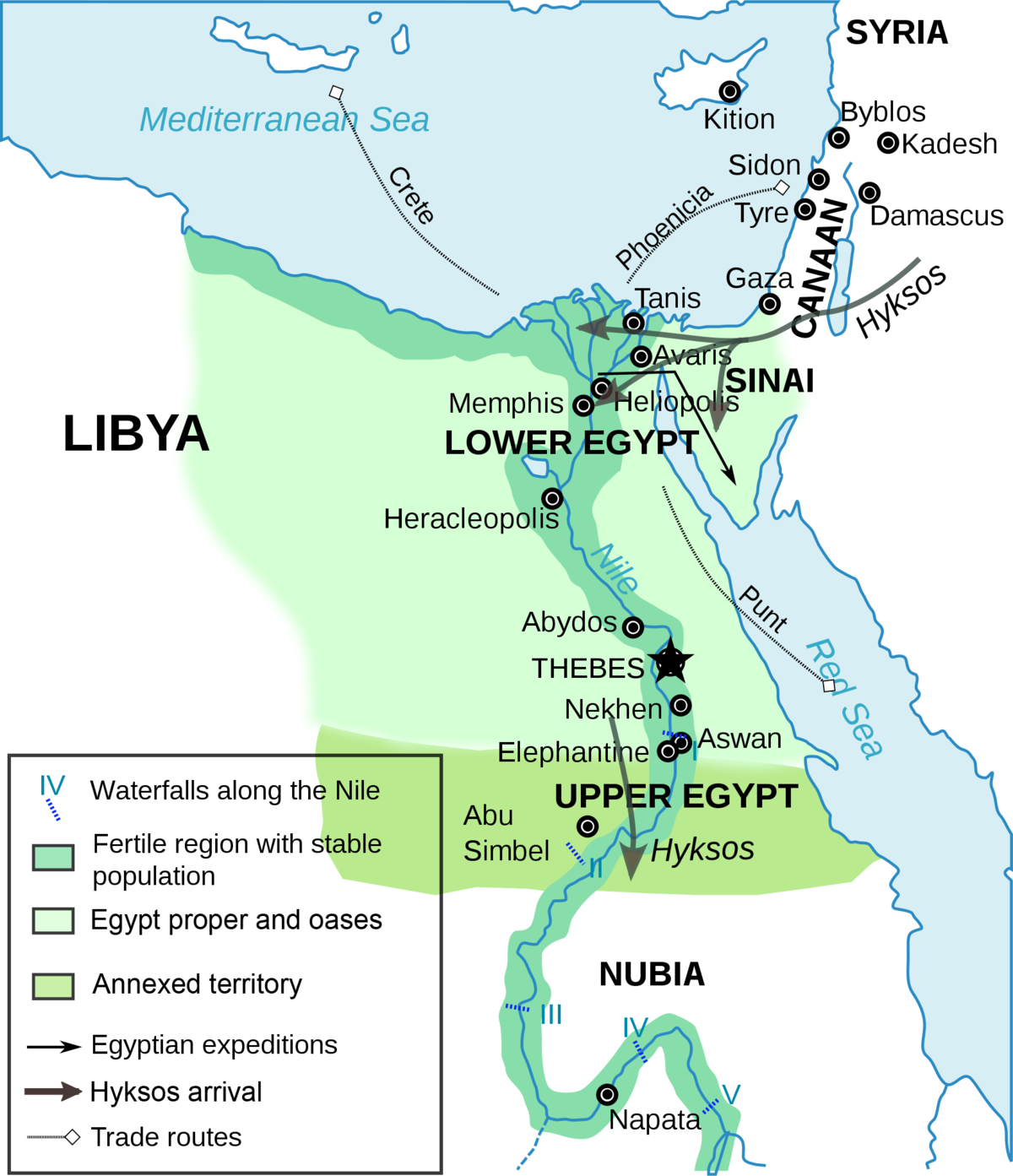
So when Manfred Betak digs up a huge population of Semitic-speaking peoples with Semitic culture living in the city of Avaris for several hundred years, and then, at the end of that period, these Semites all leave, depart with their belongings, and abandon the city.
Dustin NemosHOST
He says, that to me sounds exactly like Israelites.
Dustin NemosHOST
They have donkeys, in some cases, that were buried with them.
Dustin NemosHOST
This is not Egyptian practice.
Dustin NemosHOST
Kevin Sorbo, because he was part of the documentary Patterns of Evidence, says the only time that the archaeology shows massive numbers of Semites living in ancient Egypt is in the early period around the Middle Kingdom.
Dustin NemosHOST
And perhaps you've already heard about this, but now we'll go through something called the Hyksos dynasty, the Shepherd Kings dynasty.

MathasGUEST
The Oxyrhinicus Papyri suggests that Imhotep became a medical demigod during the rule of the 4th Dynasty King Menkaure, a mere 100 years after his death.
MathasGUEST
Middle Kingdom tombs, such as that of King Inteph, featured verses of the Harper's Song.
MathasGUEST
Some of these verses contained references to Imhotep and his teachings, illustrating that even royalty revered Imhotep's work sufficiently to want to include it in their funerary rituals.
MathasGUEST
This cult endured for centuries, with the Turin Papyri illustrating that Imhotep's epithets were increased during the New Kingdom, where he gained the titles of chief scribe, high priest, sage, and son of Ptah, the latter essentially making Imhotep a demigod.
20 more episodes mention Middle Kingdom of Egypt.
Create an account to see the whole feed, search across every transcript, and follow the entities you care about.