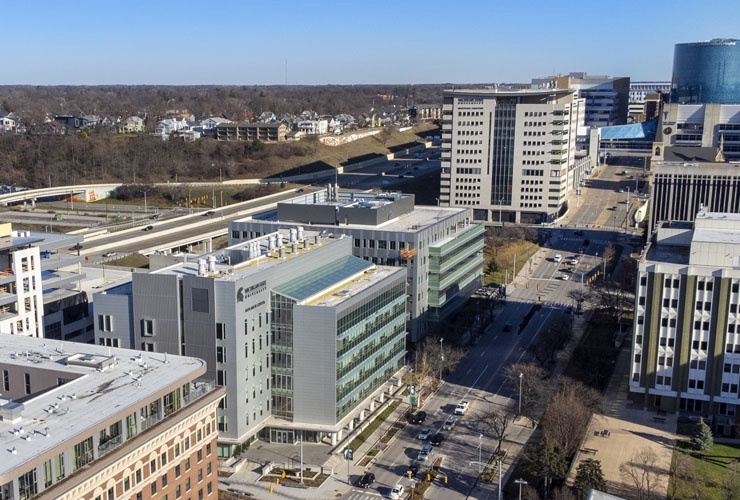
Michigan State University College of Human Medicine
University in East Lansing, MichiganWikipedia
9
MENTIONS
9
EPISODES
6
PODCASTS
Search complete. 9 mentions across 9 episodes found for "Michigan State University College of Human Medicine".
Oct 6, 2026

Aimie ApigianHOST
And that is what we are going to dive into with my guest, Dr. Howard Schubiner.
Aimie ApigianHOST
He is an internist and a clinical professor at the Michigan State University College of Human Medicine.
Aimie ApigianHOST
He has been published in JAMA Psychiatry and has a new book out called Unlearn Your Pain.
Aimie ApigianHOST
He is a repeat podcast guest, and his episode was 91, and this conversation is taking that and going further.

Jeff CranstonHOST
She actually served as two terms plus, she got nine years in office.
Jeff CranstonHOST
She is now assistant dean over, I guess, what would you say, public affairs at the Michigan State University College of Human Medicine?
Rosalynn BlissGUEST
Yeah, external relations.
Rosalynn BlissGUEST
External relations.

Danielle DeLuca-PytellGUEST
Sure.
Danielle DeLuca-PytellGUEST
I am also a graduate of Michigan State University College of Human Medicine, where we met.
Danielle DeLuca-PytellGUEST
I finished my aesthetic surgery fellowship in New York, where I started my practice, returned to Michigan, oh gosh, now 13 years ago.
Danielle DeLuca-PytellGUEST
And I have a boutique pra- plastic surgery practice also in town.

Howard SchubinerGUEST
And that can make all the difference in the world.
Elizabeth WestfieldHOST
Schubiner is a clinical professor at the Michigan State University College of Human Medicine.
Elizabeth WestfieldHOST
He dives into neuroplastic pain in his new book, Unlearn Your Pain, The Science of Recovering from Chronic Pain, Fatigue, Anxiety, and Depression.
Elizabeth WestfieldHOST
When the actual pain reprocessing therapy begins, patients are asked to do something that many of them have spent years avoiding, paying attention to the hurt.
Howard SchubinerGUEST
And that can make all the difference in the world.
Elizabeth WestfieldHOST
Schubiner is a clinical professor at the Michigan State University College of Human Medicine.
Elizabeth WestfieldHOST
He dives into neuroplastic pain in his new book, Unlearn Your Pain, The Science of Recovering from Chronic Pain, Fatigue, Anxiety, and Depression.
Elizabeth WestfieldHOST
When the actual pain reprocessing therapy begins, patients are asked to do something that many of them have spent years avoiding, paying attention to the hurt.

Gabby SandersonHOST
But what actually causes pain? What if pain isn't always a direct reflection of physical damage? What if, in some cases, pain is something our brains have learned and can consequently learn to unlearn? That's the fascinating idea we're exploring with today's guest, Dr.
Gabby SandersonHOST
Howard Schubiner, a doctor and clinical professor at Michigan State University's College of Human Medicine, who has spent decades studying the connection between the brain, the body, and our experiences of pain, anxiety, and depression.
Gabby SandersonHOST
Dr. Howard believes that while all pain is 100% completely real, it is created by the brain.
Gabby SandersonHOST
His work focuses on this.
Howard SchubinerSOUNDBITE_SPEAKER
Long after the injury and what's happened most of the time is that the brain has learned those symptoms and they get stuck in a loop in the brain on autopilot.
Elizabeth WestfieldHOST
That's Dr. Howard Schubiner, clinical professor at the Michigan State University College of Human Medicine.
Elizabeth WestfieldHOST
The pain loops that our brains create are causing neuroplastic pain.
Elizabeth WestfieldHOST
This is pain that's not being caused by any structural damage to our body.
Howard SchubinerGUEST
Long after the injury and what's happened most of the time is that the brain has learned those symptoms and they get stuck in a loop in the brain on autopilot.
Elizabeth WestfieldHOST
That's Dr. Howard Schubiner, clinical professor at the Michigan State University College of Human Medicine.
Elizabeth WestfieldHOST
The pain loops that our brains create are causing neuroplastic pain.
Elizabeth WestfieldHOST
This is pain that's not being caused by any structural damage to our body.

Rick BakerGUEST
And so that's been a long-term vision of, like, how do we invest if you – If you've been to downtown Grand Rapids, you know there's sort of a concentration around what we call Medical Mile.
Rick BakerGUEST
And so we've invested a lot with MSU's College of Human Medicine and others to create that concentration.
Richard HelppieHOST
What would you like to see from the hospitals and health systems in the community?
Rick BakerGUEST
You know, that's a big question.