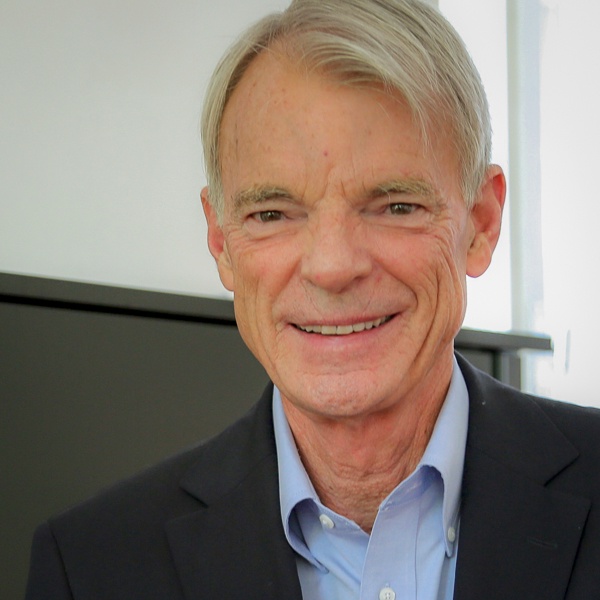
Michael Spence
American economistWikipedia
11
MENTIONS
9
EPISODES
8
PODCASTS
Search complete. 11 mentions across 9 episodes found for "Michael Spence".
Oct 13, 2026

Paul SimmsGUEST
So I think that says something, and if you, uh, again, like I like to sort of see if there's any underlying theory.
Paul SimmsGUEST
There's a guy called Michael Spence, he wrote about this thing called signaling theory, uh, in 1973, way before AI.
Paul SimmsGUEST
And he basically showed that the more a human is shown to make some kind of sacrifice in their relationship or, or communication, the more believable it is.
Paul SimmsGUEST
If you cook Valentine's dinner for your partner in a microwave-

Eric KoesterGUEST
And kind of the idea historically was this idea of the most important thing here is what's called the signals that you put out.
Eric KoesterGUEST
And so there's this really interesting paper research by Michael Spence called signaling theory.
Eric KoesterGUEST
And signaling theory really talks about that idea.
Eric KoesterGUEST
If you want to basically stand out in the employment market, the most important signal you can do and what companies should look for is how elite is the school you went to.

speaker_0NARRATOR
During his distinguished career, Hall has been an active proponent of a flat tax and served as an advisor to President-elect Ronald Reagan, the Justice Department, the Treasury Department, and the Federal Reserve Board.
speaker_0NARRATOR
Hall's receipt of the 2026 Nobel Prize extends a distinguished tradition of economic scholarship at the Hoover Institution, including past prize winners Milton Friedman, Friedrich Hayek, Gary Becker, Douglas North, George Stiegler, Thomas Sargent and Michael Spence.
speaker_1NARRATOR
A great Nobel.
speaker_1NARRATOR
Senior Fellow John H. Cochran celebrates the recipients of the 2026 Nobel Prize in Economics, writing, this is a great prize honoring two superb and highly influential economists.

Manish SabharwalGUEST
So college isn't what it used to be.
Manish SabharwalGUEST
But Michael Spence, you know, got his Nobel Prize for the signaling value of higher education.
Manish SabharwalGUEST
Right.
Manish SabharwalGUEST
My wife went to Harvard.
20 MINS LATER
Manish SabharwalGUEST
You need learning with a multimodal delivery.
Manish SabharwalGUEST
An online classroom should be pedagogically equivalent to an on-site classroom, should be equal to an on-campus classroom, should be equal to an on-job classroom.
Manish SabharwalGUEST
And the fifth one would be learning with signaling value, which is not social signaling value, which is what Michael Spence got his Nobel Prize for, but employability signaling value.
Manish SabharwalGUEST
And that apprenticeships give you that, right, in some sense.

Jacob MorganHOST
So the change came from within rather than from the top down.
Jacob MorganHOST
Now the futurist lens here, Michael Spence, an economist in 1973, he published a paper on what he called job market signaling.
Jacob MorganHOST
He later won the Nobel Prize on this.
Jacob MorganHOST
I think I talked about this a few weeks ago as well.

Ben ZweigHOST
Now the value of signals are changing rapidly, and he's thinking carefully about what comes next.
Ben ZweigHOST
Mike Spence is a Nobel laureate in economics and former dean at both Harvard and Stanford.
Ben ZweigHOST
His work on information asymmetry and growth is so foundational to how economists think about markets and development.
Ben ZweigHOST
Here's our talk.
Ben ZweigHOST
Welcome to The Economics of Work.
Ben ZweigHOST
I'm honored to welcome Mike Spence, Nobel laureate and former dean at both Harvard and Stanford, and just a really clear thinker and writer on so many important topics.
Ben ZweigHOST
Mike, welcome to the show.
Mike SpenceGUEST
Well, it's wonderful to be with you.

speaker_1HOST
Okay, I have to stop you there because we need to look at what exactly is being signaled.
speaker_1HOST
The theory you're referencing, signaling theory, goes all the way back to Michael Spence in the 1970s.
speaker_3HOST
Yes, it does.
speaker_1HOST
The whole point of the signal in Spence's model wasn't just about proving you knew a specific software program.

speaker_2NARRATOR
Instead of appealing to common values, he matched tariffs with targeted ones of his own and turned trade diversification into an actual strategy, not just wishful thinking.
speaker_2NARRATOR
Zooming out, Nobel economist Michael Spence has argued that today's global growth depends on supply-side resilience, not on dreams of frictionless, ever deeper integration.
speaker_2NARRATOR
We're in what he calls an age of permanent crisis, pandemics, wars, climate shocks, trade disruptions, and now an America willing to use tariffs against its allies.
speaker_2NARRATOR
The winners in this world are the countries that diversify their trade and invest in the strengths that make them harder to push around.
Jacob MorganHOST
And so now the power has changed.
Jacob MorganHOST
The other idea behind this is from 1973, an economist named Michael Spence, he published a theory about the job market was something called signaling.
Jacob MorganHOST
He actually won the Nobel Prize on this later.
Jacob MorganHOST
And his idea was that employers can't actually see how good you'll actually be at a job.