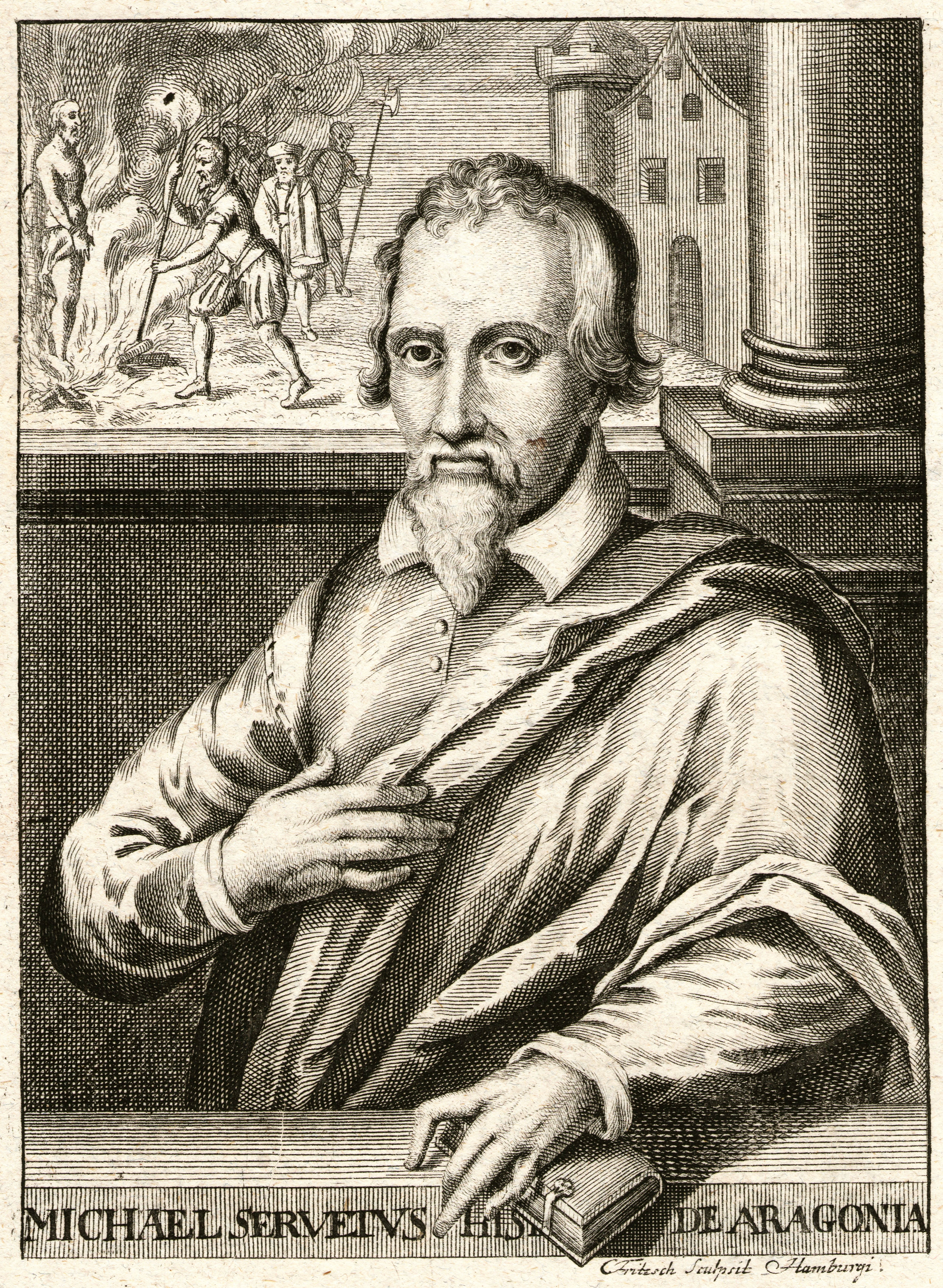
Michael Servetus
Spanish theologian and physicianWikipedia
92
MENTIONS
16
EPISODES
15
PODCASTS
Search complete. 92 mentions across 16 episodes found for "Michael Servetus".
Nov 4, 2026

Stephen WolfeHOST
And by the way, again, you can view everything through the episodes of Burning Heretics.
Stephen WolfeHOST
I get that, Servetus, and these other things.
Stephen WolfeHOST
But if you take the totality of it, if you take actually the full tradition of it, it was a movement towards toleration on the basis of Protestant mutual brotherhood.
Stephen WolfeHOST
There's a story in early 18th century where Cotton Mather, of all people, I mean, he was fine, but given his history, his family's history, preaches an ordination sermon for a Baptist in Boston.
Gavin OrtlundSOUNDBITE_SPEAKER
You find opposition to this theology of killing heretics among the Anabaptists and then later among the Baptists themselves.
Gavin OrtlundSOUNDBITE_SPEAKER
And you also find it in other contexts.
Gavin OrtlundSOUNDBITE_SPEAKER
So for example, in my recent video where I criticized John Calvin for his role in the execution of Michael Servetus, I talk about Sebastian Castelio as an example of an early reformed advocate for religious toleration.
Gavin OrtlundSOUNDBITE_SPEAKER
But the point is that killing heretics, and this is the brutal part of church history.

Gavin OrtlundHOST
And you also find it in other contexts.
Gavin OrtlundHOST
So for example, in my recent video where I criticize John Calvin for his role in the execution of Michael Servetus, I talk about Sebastian Castellio as an example of an early Reformed advocate for religious toleration.
Gavin OrtlundHOST
But the point is that killing heretics, and this is the brutal part of church history we've got to come to terms with, this was largely retained by the Anglican Reformed and Lutheran traditions, not totally.
Gavin OrtlundHOST
And so, for example, when the neo-Calvinists came along, they recognized that in opposing that theology, they were departing from historic precedent.

LitaHOST
couple of things that happened on this day in history? I'd love to know.
LitaHOST
Okay, so on October 27th, And on a Tuesday, 1553, physician Michael Servetus, the first European to correctly describe the function of pulmonary circulation, was condemned as a heretic and burned at the stake near Geneva.
LitaHOST
Wow.
LitaHOST
In 1787, the first of the Federalist Papers, a series of 85 essays calling for the ratification of the US Constitution, was published in a New York paper.

Confex MakhaliraGUEST
who killed people who opposed his views, especially his Christian views.
Confex MakhaliraGUEST
And mainly that comes, the example, if people hear, if you hear people saying that, say, well, what is the example? They are going to give you one example, Michael Servetus.
Confex MakhaliraGUEST
Now, Michael Servetus was a very controversial guy.
Confex MakhaliraGUEST
He was a Spanish physician and a theologian as well, who studied by himself.
Confex MakhaliraGUEST
And he was a fugitive from Roman Catholic Church.

Linda Susan UlrichGUEST
I also have Universalist and Unitarian ancestors.
Linda Susan UlrichGUEST
Hosea Ballou, Michael Servetus.
Linda Susan UlrichGUEST
Frances Ellen Watkins Harper, James Reeb, Viola Liliuzzo.
Linda Susan UlrichGUEST
I have artists in all kinds of genres as ancestors.

Jordan CooperGUEST
I don't get the impression at all that Melanchthon would have thought from their correspondence.
Jordan CooperGUEST
I mean, Calvin even asked for Melanchthon's advice when he was dealing with Michael Servetus.
Keith FoskeyHOST
Hmm.
Jordan CooperGUEST
interesting interesting

Rita BoutrosNARRATOR
You had better live well and die cursing than live badly and die praying.
Rita BoutrosNARRATOR
It would not do to have the common people understand that a man could deny the Bible, refuse to look at the cross, content that Christ was only a man, and yet die as calmly as Calvin did after he had murdered Servetus, or as King David after advising one son to kill another.
Rita BoutrosNARRATOR
the church has taken great pains to show that the last moments of all infidels that christians did not succeed in burning were infinitely wretched and despairing it was alleged that words could not paint the horrors that were endured by a dying infidel every good christian was expected to and generally did believe these accounts they have been told and retold in every pulpit of the world protestant ministers have repeated the inventions of catholic priests and catholics by a kind of theological comity have sworn to the falsehoods told by protestants upon this point they have always stood together and will as long as the same calumny can be used by both upon the death-bed subject the clergy grew eloquent when describing the shudderings and shrieks of the dying unbeliever their eyes glitter with delight it is a festival they are no longer men they become hyenas they dig open graves they devour the reputations of the dead it is a banquet unsatisfied still they paint the terrors of hell they gaze at the souls of the infidels writhing in the coils of the worm that never dies they see them in flames in oceans of fire in gulfs of pain in abysses of despair they shout with joy they applaud it is an odo de fe presided over by god and his angels the men they thus describe were not atheists they were all believers in god in special providence and in the immortality of the soul they believed in the accountability of man in the practice of virtue in justice and liberty but they did not believe in that collection of follies and fables called the bible in order to show that an infidel must die overwhelmed with remorse and fear they have generally selected from all the unbelievers since the day of christ five men the emperor julian spinoza voltaire diderot david hume and thomas paine hardly a minister in the united states has attempted to answer me without referring to the death of one or more of these men In vain have these calumniators of the dead been called upon to prove their statements.
Rita BoutrosNARRATOR
In vain have rewards been offered to any priestly maligner to bring forward the evidence.

SamHOST
Hello, welcome to another episode of Transfigured.
SamHOST
Today I'm going to be talking about and trying to classify and describe and explain the Christology of Michael Servetus.
SamHOST
But I first wanted to say, I haven't made a video for a while, because I had my fifth child and I've been a little bit busy with that.
SamHOST
This video is also sort of a practice run or a rough draft of my presentation that I'll be giving at the Unitarian Christian Alliance Conference this October in Arizona.
SamHOST
So this is sort of like a deep cut, but you'll also get to see a lot more information, some of which probably will get edited out before that recording.
SamHOST
So hopefully you'll see this sometime maybe in mid to late October.
SamHOST
But anyway, without any further ado, the title of this presentation is called Divine Anatomy, Classifying the Christology of Michael Servetus.
SamHOST
so as i think many people know but hopefully maybe you know a lot about michael cervitas maybe you don't know too much but he's probably the most famous anti-trinitarian martyr in history and while everyone agrees that he was not an orthodox christian and did not believe in the orthodox definition of the nicene chalcedonian creed and trinitarianism and all that attempts to describe what he actually believed instead are contentious and the actual contents and beliefs of his theology are disputed or confusing or just unfamiliar to a lot of people honestly even a lot of people that know that he was burnt at the stake don't know what he actually believed and maybe even john calvin himself didn't really understand what he actually believed.

speaker_6NARRATOR
They put him in peril not only of his power, but of his life.
speaker_6NARRATOR
Then came an enemy named Servetus.
speaker_6NARRATOR
Servetus was a heretic.
speaker_6NARRATOR
By profession, a physician, and a very skilful one.
speaker_6NARRATOR
He was interested also in theology.
speaker_6NARRATOR
The Reformation had made it easy to attack all the old beliefs, and of this situation Servetus availed himself.
speaker_6NARRATOR
And this he did, not only with much freedom of thought, but with much freedom of expression.
speaker_6NARRATOR
It was the fashion of the time for the debaters to call one another names, but Servetus carried this to an extreme.

HarmoniaHOST
It arrived as a death.
HarmoniaHOST
In 1553, Michael Servetus was arrested in Geneva.
HarmoniaHOST
His crime was belief, ideas judged heretical by those in power.
HarmoniaHOST
He was tried, condemned, and executed by burning.
6 more episodes mention Michael Servetus.
Create an account to see the whole feed, search across every transcript, and follow the entities you care about.