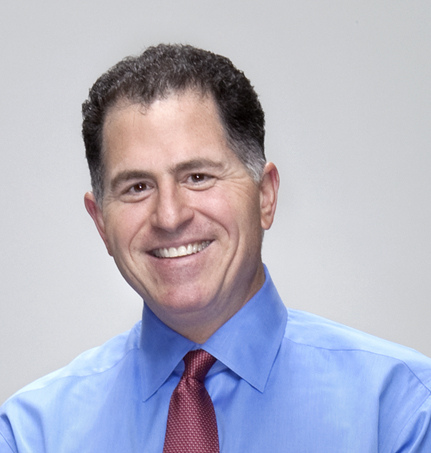
Michael S. Dell
CEO of Dell Technologies
10
APPEARANCES
8
PODCASTS
Jun 24, 2026


Mike DellGUEST
You know? And, and, and like I said, nothing wrong with that, it's just, you know, s- that's the beauty of ham radio and podcasting.
Mike DellGUEST
You know, there's podcasts that are just strictly, you know, reading from a script, and there's podcasts that are, you know, morning zoo show.
Mike DellGUEST
There's, there's all the different genres in, in, and in ham radio there's different modes, there's different frequencies, there's different types of things people like to do.
Mike DellGUEST
There's contesters out there, they wanna see how many people they can talk to in 24 hours.
Mike DellGUEST
Or, you know, there's other things like, you know, packet radio, which is how I really got started.
10 MINS LATER

Michael DellGUEST
You know, my parents were, you know, intellectual and and and, you know, as you said, my father was an orthodontist.
Michael DellGUEST
And she Became a stockbroker as we got a little bit older and could sort of take care of ourselves as kids.
Michael DellGUEST
My parents were talking about economics and the price of oil in the 70s and the stock market and sort of what was going on in the world.
40 MINS LATER
Leon CalvarioHOST
Can you talk, given the stuff you talked about on data, and I've looked at this program, I've spent time with Brad talking about it, What's your ambition? And frankly, from my standpoint, do you think this is a precursor for sort of more directed philanthropy on specific areas where you know you can see an outcome? What was your philosophy behind this fantastic program?


Adam CurryHOST
What do you think of the Adam Accords', uh, idea of cutting in the app developers on the ad spend if they deliver first party data?
Mike DellGUEST
But, uh, on the other hand, how much data do you actually need? Uh, you know, if I do an ad on somebody's podcast, I'm gonna measure it by how much did I sell because of that ad, not how many people listened to it or skipped over it or ignored it.
15 MINS LATER
Mike DellGUEST
So, so, uh, you know, uh, Brendan reached out to me first, but I was real close to reaching out to him, and we said, "Hey, let's do a deal." So now as a, you know, if you're a hosting customer at Blueberry, you have a choice.
Mike DellGUEST
You can use PowerPress and do a WordPress site, or you can do, uh, a Podpage, and you get that, you know, get the free basic, uh, decent-looking page from Podpage just by having a Blueberry hosting account.

Michael DellGUEST
In Samsung, and th-these are not things that are on the screen, right? This is in the real world with the largest companies in the world.
Michael DellGUEST
And so it's propagating broadly across all customers in every industry, in every country.
Michael DellGUEST
And, you know, you see the improvement in all the models, and now we have the agentic capabilities.
Michael DellGUEST
And so while it is exciting, there's been a tremendous amount of growth, I still think it's just the beginning of this wave, particularly when it comes to enterprise, which is really where, you know, we have an enormous opportunity.
Ed LudlowHOST
In this new era, what everyone is trying to work out is, aren't all the GPUs locked up at the hyperscalers? How is Michael Dell gonna service those one thousand new clients with the GPUs to build their own on-prem local AI factory?
Michael DellGUEST
Well, the supply chain that Jensen has built, we've built together, is continuing to scale up.
Michael DellGUEST
And while it's true that there's more demand than supply, there's more supply that's, that's being added and, you know, customers are figuring out how they start to scale these systems up.

Ed LudlowHOST
What is it that those new clients, 5,000 total, are actually building now different to one year ago? I think that's probably a good place to start.

Michael DellGUEST
I think the change we see is it's kind of moved from testing and evaluating into production, and we showed some great examples on stage, right, with Eli Lilly with 1,000 GPUs.
Michael DellGUEST
It's Samsung, and these are not things that are on the screen, right? This is in the real world with the largest companies in the world, and so it's propagating broadly across all customers in every industry, in every country, And, you know, you see the improvement in all the models, and now we have the agentic capabilities.
Michael DellGUEST
And so, while it is exciting, there's been a tremendous amount of growth, I still think it's just the beginning of this wave, particularly when it comes to enterprise, which is really where, you know, we have an enormous opportunity.
Ed LudlowHOST
In this new era, what everyone is trying to work out is aren't all the GPUs locked up at the hyperscalers? How is Michael Dell going to service those 1,000 new clients? with the GPUs to build their own on-prem local AI factory?
Michael DellGUEST
Well, the supply chain that Jensen has built and we've built together is continuing to scale up.
Michael DellGUEST
And while it's true that there's more demand than supply, there's more supply that's being added.


Jason CalacanisHOST
Why Austin? Why Texas? Why does it work here? And is it getting better, or has it just always worked?
Michael DellGUEST
You know, I think Texas has had a, uh, you know, low tax, pro-growth, uh, environment for a long time, and pro, you know, sort of progressive business climate.
Michael DellGUEST
And, you know, if, if you sort of look at the, the growth of the Texas economy relative to the rest of the United States without Texas, you know, Texas just kinda looks like a better version of the US economy.
Michael DellGUEST
And, uh, you know, you- now you've got, uh, Austin is sort of just about in the top 10 cities in, in the United States.
Michael DellGUEST
When that happens, you'll have four of the ten largest cities in America in Texas.
Jason CalacanisHOST
Maybe you could talk a little bit about the data center boom that's going on in Texas that maybe people aren't paying attention to.


Jim CramerHOST
But what you've developed is such a powerhouse that I think your stock is outperforming the Big Magnificent Seven.
Michael DellGUEST
It has over the last five years, and there's only one stock that's performed better.
Jim CramerHOST
Your plan to give how many, how many families $1,000 when the... for their account by S&P?
Michael DellGUEST
In government, a number of the projects advance from the pilot phase to production phase.
Michael DellGUEST
open, scalable systems to enable all the great sciences occurring in the national labs and beyond.
Michael DellGUEST
Certainly, we have a fabulous example in the Doudna cluster that we're beginning to deploy.
6 MINS LATER
Ed LudlowHOST
What are you seeing right now on particular bottlenecks or where, you know, from a CapEx deployment standpoint, the priority really is?
Michael DellGUEST
Well, you know, our foundation has been focused on children since the beginning.
Michael DellGUEST
And when this Invest America Act was passed earlier this year, you know, we saw it as a platform for companies and families and communities and philanthropists to contribute to these accounts.
Michael DellGUEST
And as you probably know, you know, the government is giving a thousand dollars to every newborn child.
Michael DellGUEST
It could be used for education, to start a business, to start a family, for continued savings, to buy a home.
8 MINS LATER

Caroline HydeHOST
What do you think about a concern about an AI bubble and this really reaping rewards from a productivity perspective? Or are we in some sort of bubble or circular finance concern for you?


Michael DellGUEST
... drove this thing, uh, passionately for several years, and it's amazing that it got done.
Michael DellGUEST
I do think you'll see many companies provide, uh, matching contributions and, uh, you know, a number of companies have already said they're gonna do that.
Michael DellGUEST
Uh, and it'll be like a benefit, you know, come work at our company and- and, uh, have a kid (laughs) and y- your- your- your child will get this.
Michael DellGUEST
I think it's also a chance to teach every child about financial literacy and about, uh, capitalism and free markets, and, uh, you know, look up in 15 or 18 years and you've got 70 million kids with these accounts.
Michael DellGUEST
I also think you're gonna have philanthropists, uh, and, uh, Susan and I will- will definitely be a part of that, that we'll say, "Hey, you know, this is a really good way to get money directly to the next generation in a, uh, way that it's going to compound and have a difference in- in their life." Our foundation has studied it, this very carefully and we believe it's worthy of a significant contribution.
40 MINS LATER