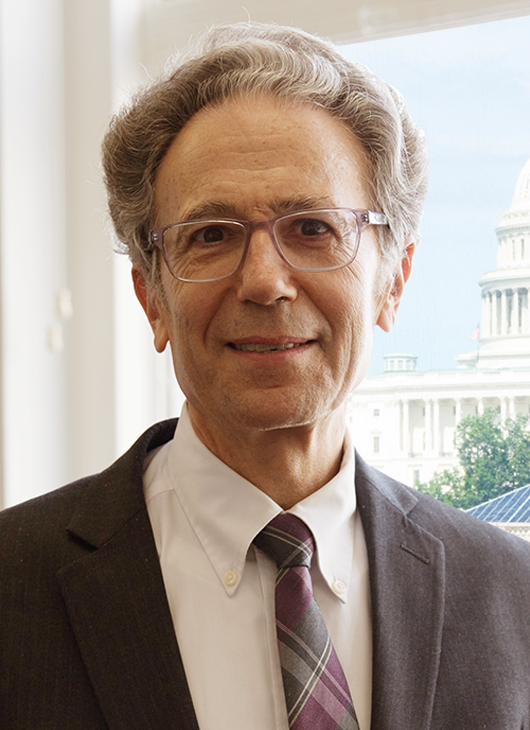
Michael Pack
American filmmaker
28
APPEARANCES
13
PODCASTS
Sep 12, 2026


Jeff CrouereHOST
What did you learn about this withdrawal that maybe you didn't know going into it after concluding the project?

Michael PackGUEST
It tells the story, as even that teaser reveals, right from President Biden's decision to go to zero, zero troops behind at a date certain, hence the path to zero, and the cascading series of mistakes that we made starting in that time in April 2021 and then on to the end of August.
Michael PackGUEST
And that, you know, leaving Bagram, not supporting the Afghans, delaying the announcement of an evacuation, et cetera, et cetera, that in the end left that chaos that you see even in the teaser at the gates at Kabul airport, HK airport.
Michael PackGUEST
And the horrors that went on there, I sort of knew them in general as maybe the teaser reveals, but certain aspects of them were not obvious to me that I learned in making the film.
Michael PackGUEST
For example, the moment when the C-17 takes off is because the airport has been overrun and the Marines couldn't clear it because the people who had overrun the airport were afraid if they left the airport, the Taliban would kill them.
Michael PackGUEST
And the CIA had to bring in these zero units that were able to clear the airport.


Tim TappHOST
I guess the real question that is answered here that I think everybody – the one thing that I would highly recommend everyone watch it for is those first-hand accounts of what actually happened at the gates of the Kabul airport.
Michael PackGUEST
But and this is, as you said, I think in your intro, this is a really appropriate time to think about it.
Michael PackGUEST
So the film tells the story, as you know, from President Biden's decision to go to zero, which was in April of 2021, a few months into his administration.
Ryan SeacrestADVERTISER
Sponsored by Chumba Casino.
Michael PackGUEST
You know, you know, some of them, Steve, you know, my wife, Gina, my business partner, my son, Thomas, story editor on this film.
Michael PackGUEST
I think it was very important to get realistic footage to bring people into feeling what people felt like.


Michael PackGUEST
And then it would also have been, I think, a better place to do the evacuation, the noncombatant evacuation operation, the NEO.
Michael PackGUEST
But the State Department, as we explained in the film, had this idea that the embassy was going to survive our withdrawal, that we would withdraw all forces, the embassy would still be there, that either first they thought, well, maybe that the Afghan forces would defeat the Taliban.
Michael PackGUEST
Then they thought... well, there'd be a coalition government between the Taliban and the current Afghan government, current at the time.
Michael PackGUEST
And then they thought, well, the Taliban, it's Taliban 2.0. They're a different Taliban.


Kimberly BonattiHOST
So first off, can you give us your thoughts on the current Fauci diary debacle, his testimony before the Senate and the recent contempt charges?
Michael PackGUEST
I think that all these recent revelations probably are not surprising to your viewers and listeners, and they're not surprising to people who've seen the documentary.
Michael PackGUEST
I think the fact that he had misled the public has been on the surface for a long time.
Michael PackGUEST
So Jay Bhattacharya, now the head of the NIH and then a Stanford professor, as early as March of 2020, had conducted a study in Santa Clara County, California, which was replicated all over the country, that found what we now know to be true, that the virus disproportionately affects older people, that there had been a lot of asymptomatic transmission, so it was too late to lock down anyway, and that it hardly affected young people.
Michael PackGUEST
So it made no sense to close the schools, And he recommended focused protection that we focus on the people at risk and let everybody else go about their daily life, which was the normal way to treat pandemics for hundreds of years.
Michael PackGUEST
But once that came out, Anthony Fauci, Deborah Birx and others acted to suppress that information.


Kimberly BonatiHOST
So first off, can you give us your thoughts on the current Fauci diary debacle, his testimony before the Senate and the recent contempt charges?
Michael PackGUEST
I think that all these recent revelations probably are not surprising to your viewers and listeners, and they're not surprising to people who've seen the documentary.
Michael PackGUEST
I think the fact that he had misled the public has been on the surface for a long time.
Michael PackGUEST
So Jay Bhattacharya, now the head of the NIH and then a Stanford professor, as early as March of 2020, had conducted a study in Santa Clara County, California, where which was replicated all over the country, that found what we now know to be true, that the virus disproportionately affects older people, that there had been a lot of asymptomatic transmission, so it was too late to lock down anyway, and that it hardly affected young people.
Michael PackGUEST
So it made no sense to close the schools, And he recommended focused protection that we focus on the people at risk and let everybody else go about their daily life, which was the normal way to treat pandemics for hundreds of years.
Michael PackGUEST
But once that came out, Anthony Fauci, Deborah Birx and others acted to suppress that information.


Michael PackGUEST
As the trailer makes clear, that first decision of Joe Biden's to go to zero in April led to a series of consequences.
Michael PackGUEST
We made one error after another, leaving Bagram, not supporting the Afghan army.

Michael PackGUEST
One of the ide- one of the issues was the State Department really felt that it was gonna ha- continue to have an embassy after the withdrawal.
Michael PackGUEST
I mean, they had this idea that the Taliban would maybe do a, a, a government in collaboration with the Afghan mil-- the, the current Afghan government supported by us, and that they would permit an embassy to be there.
12 MINS LATER
Michael PackGUEST
It was totally preventable, as we said, trailer makes clear that first decision of Joe Biden's to go to zero in April led to a series of consequences.
Michael PackGUEST
We made one error after another, leaving Bagram, not supporting the Afghan army.
Michael PackGUEST
I mean, it is true that this is the fifth anniversary of the massacre at Abbey Gate.
Michael PackGUEST
And we tell the story, as even that little teaser reveals, from the decision to go to zero by Joe Biden in April of 2021, early in his administration, all the way forward until the last planes leave at the end of August.
Michael PackGUEST
And I think a key thing about it that is often lost is how preventable it all was.
Michael PackGUEST
In the first part of the film, we look at the bad decisions, Biden's decision, the decision to leave Bagram, the decision not to support the Afghan allies, the decision to leave hardware behind again and again.
Michael PackGUEST
But in the end, the net of it all was the Taliban surround Kabul, they take over Kabul.
Michael PackGUEST
I mean, it is true that this is the fifth anniversary of the massacre at Abbey Gate.
Michael PackGUEST
And we tell the story as even that little teaser reveals from the decision to go to zero by Joe Biden in April of 2021, early in his administration, all the way forward until the last planes leave at the end of August.
Michael PackGUEST
And I think a key thing about it that is often lost is how preventable it all was.
Michael PackGUEST
In the first part of the film, we look at the bad decisions, Biden's decision, the decision to leave Bagram, the decision not to support the Afghan allies, the decision to leave hardware behind again and again.

Michael PackGUEST
I think that a lot of people thought that the start of this parliament after a five-week break, and parliament's only sat for three days, that it would be a lot more substantive compared to what has been discussed.
Michael PackGUEST
There was talk that Tony Burke, the Home Affairs Minister, the Immigration Minister, would hold a speech this week to outline what Labor's immigration policy and target would be.
11 MINS LATER


Eric MetaxasHOST
And, and that to me, this is, you know, one of the key issues in that this was, this was, This was how they were trying to do it, which I know you talk about in the film.
Michael PackGUEST
Another thing, another aspect of that same thing that relates to the founding is Scott Atlas makes the point in the film that, you know, we as a country allow we've got we have this, as you say, this is the 250th anniversary of the Declaration announcing our unalienable rights from God, not from the government.
17 MINS LATER
Michael PackGUEST
I knew about the administrative state, the swamp, and I had been in government briefly in the George H.W. Bush administration.
Michael PackGUEST
But the, the n- nature of the attacks, you know, it- it's maybe obvious, but you feel it differently when there are attacks on you and your organization.
5 MINS LATER
23:38
What, what are the films you're making over there, and why'd you choose this subject?

Steve BannonHOST
Why did they pick, why did they say Michael Pact is a guy that we have to burn it down before we let him take over? Why was that?
Michael PackGUEST
And it had really been run essentially by Democrats through the intervening, you know, 20 plus years.
Michael PackGUEST
And, you know, I assured my wife and family that my own nomination and service would be uncontroversial.
Michael PackGUEST
I think what it comes down to, Steve, is not me personally, but I think that they recognize that this is a huge media enterprise.
11 MINS LATER
Steve BannonHOST
What are the films you're making over there and why did you choose this subject?

Michael PackGUEST
Even beyond that, you know, they're, you know, the people postpone medical procedures- Mm-hmm ... and then hurt later.

Michael PackGUEST
I mean, this is part of a partnership that we've launched with the Wall Street Journal opinion section to do short documentaries, about 30 minutes on important issues and events that have been misreported or memory holds.
Michael PackGUEST
They're not behind the Wall Street Journal paywall at WSJ dot com slash opinion docs or go to our Web site, Palladium Pictures dot com.
10 MINS LATER
Sean ThompsonHOST
Is this something that you include in the dissidence film, the areas that push back?
Tim TappHOST
But the ridiculousness here is how much stuff actually occurred and how we're still finding out new bits of information thanks to efforts like this project.


Michael PackGUEST
Scott Atlas says in our film, echoing what you just said, that, um, the government took away our unalienable rights, so they're not unalienable anymore.
Michael PackGUEST
This is the 250th anniversary of the Declaration of Independence, where those rights were, the, the theory of those rights were laid out, and the, and w- shortly later, they were enumerated in the Bill of Rights.
Michael PackGUEST
And we, on the behest of the government, gave up our freedom of speech, freedom of assembly, freedom of religion, churches were closed, and Americans didn't protest.
Michael PackGUEST
It was j- turn- according to, uh, government and scientists, okay to protest BLM, but it was not okay to protest COVID.

Michael PackGUEST
We worked on one that sort of involved you, Tony, the one created equal, Clarence Thomas and His Own Words.
6 MINS LATER
Michael PackGUEST
You may remember the Biden administration had a department of misinformation, disinformation that was controversial at the time.
Michael PackGUEST
And they would threaten them in a sort of vague terms, but as David Zweig says, you know, a threat from the federal government is taken pretty seriously when you're a social media company.
Michael PackGUEST
The idea was, as James says, that if you don't take them down, people will die and there'll be consequences for you.

Paul GigotHOST
Michael, what can we say about the lockdowns? Were they effective? What costs did they impose on society, on childhood learning, on public health?

Michael PackGUEST
We- we're now doing a series of short documentaries with The Wall Street Journal, um, with our new company, Palladium Pictures.
Michael PackGUEST
We've done two, we have three in the hopper, and one of them is about the withdrawal from Afghanistan, from the time that Joe Biden announced we're going to zero in April, um, to the final withdrawal at the end of August.
Michael PackGUEST
Um, so unlike The Last 600 Meters, we do look at how it happened and why and who made those decisions.
Michael PackGUEST
But it e- it begins and ends with the bombing at Abbey Gate, and I think we should remember those Marines, the ones that died there, surely, but also, the...


Newt GingrichHOST
Can you start by telling us what this film is about and why you chose to focus on these two battles from the Iraq War, Najaf and Fallujah?
Michael PackGUEST
It's not only the day before Veterans Day, it's the 250th birthday of the Marine Corps.
Michael PackGUEST
It's called The Last 600 Meters because a sniper in the film says, "I don't make foreign policy.
Michael PackGUEST
I deliver the last 600 meters of it," meaning what he could see through a sniper scope.
Michael PackGUEST
And that's the purpose of the film, to tell these battle stories from the point of view of those on the ground, not to go into the politics and policy, or should we not have been in the war.
Michael PackGUEST
I mean, whatever you think of the Iraq War, we need to celebrate the young men and women that we asked to be on the front lines for us and risk their lives.
Michael PackGUEST
I think their s- their honor has been clouded by mixed feelings about the war.
Michael PackGUEST
But now, as you know, we finished this film 17 years ago, but now maybe it's its right time.
Scroll for more appearances