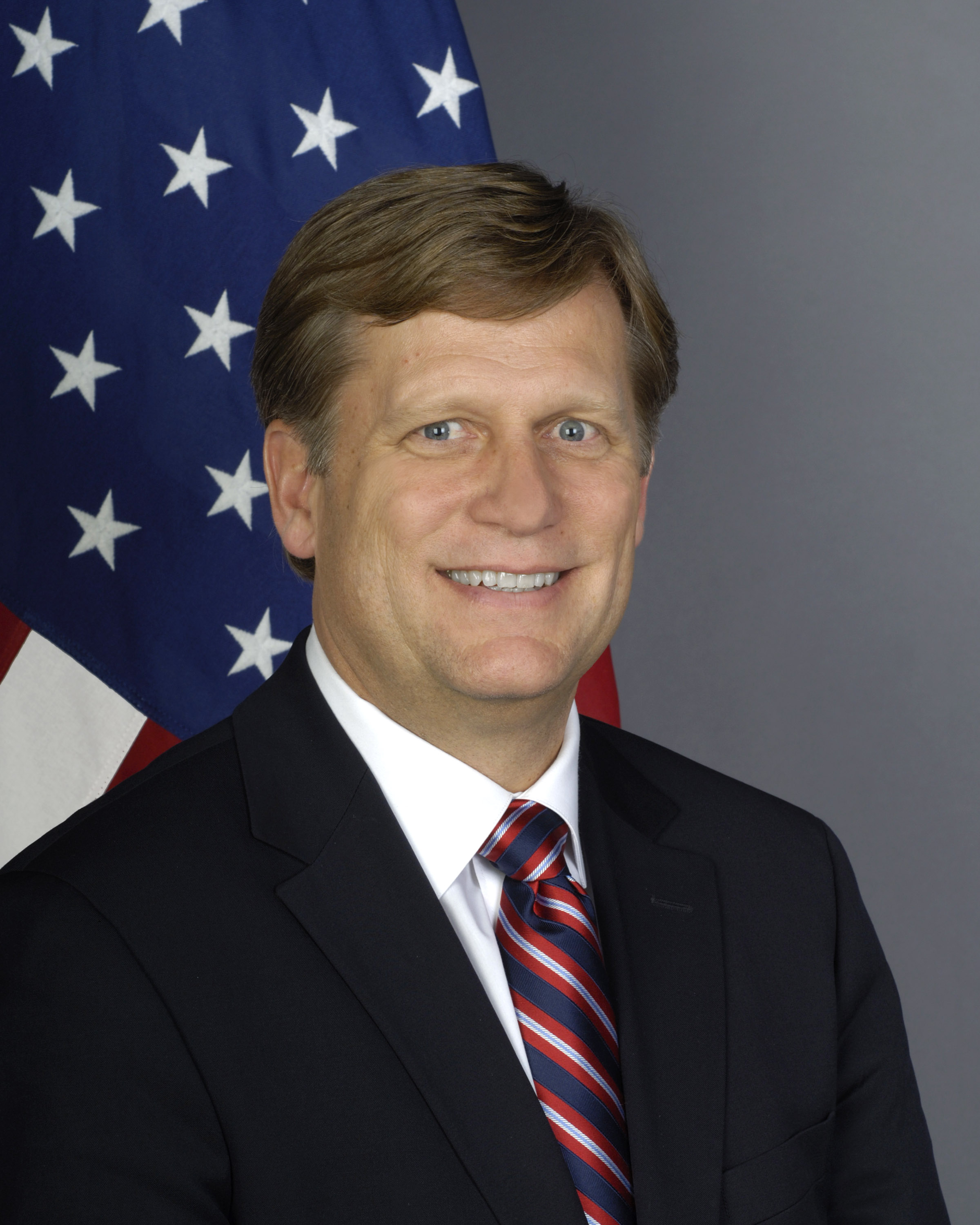
Michael McFaul
Former United States Ambassador to Russia
142
APPEARANCES
29
PODCASTS
Sep 23, 2026


Nicolle WallaceHOST
Um, there's a, um, there's a, a piece where this is, of course, uh, perhaps the least surprising news that we would cover today, but there's a disorienting piece and maybe, um, a sign that some of what Trump has done by branding aggressive investigative coverage of what Russia is doing to the entire United States of America as the Russia hoax, where people might be reluctant to cover this, but this is precisely what Robert Mueller outlined in volume one of his investigation.

Michael McFaulGUEST
Uh, because he has flooded the zone with Russia, Russia hoax, I can tell you that academics don't study it the way we did after 2016, including here at Stanford.
Michael McFaulGUEST
Some have been sued for looking at disinformation, for looking at things that are not true in the, in the internet.

Michael McFaulGUEST
not optimistic at all of a breakthrough on iran uh we did this war we didn't need to do this war we're stuck it's worse than when we started the war i don't see any uh change in that horrible status quo we're in there i think in this bigger question that you're talking about the you know nobody cares about trump uh our reputation around the world has just tanked and i really encourage everybody watching to go to the pew polling data They've been doing data polling about America's reputation in the world for decades.
Michael McFaulGUEST
Excuse me, less people support the United States than support the United States by just historic numbers.

Stephanie RuhleHOST
I don't think that they would think that was something President Obama ever even considered.

Michael McFaulGUEST
So I was not in the government at the time, but I was most certainly interacting with the government and part of the debate more generally.
Michael McFaulGUEST
We should have had more sanctions and we should have provided arms to the Ukrainians.
Michael McFaulGUEST
so that they could deter a future intervention, a future invasion, as we saw tragically in 2022.
24 MINS LATER

John BatchelorHOST
What did we learn then? What do we know now about that confrontation that helps us here in the 21st century? Good evening, Professor.
Michael McFaulGUEST
I think it's a great place to start because it was, in my view, one of the most dangerous, probably the most dangerous moment in the Cold War.
Michael McFaulGUEST
And obviously, we still call it the Cold War historically because it didn't become a hot war between the United States and and the Soviet Union, even though they did fight from time to time proxy wars.
Michael McFaulGUEST
And the use of nuclear weapons means complete obliteration of both countries involved and lots of other countries would be affected by it.
9 MINS LATER


Emma AshfordGUEST
But again, the argument that I would make is that for NATO as an organization, admitting some of these states did not necessarily improve the security of existing members, and for Europe as a whole, you know, you have to ask yourself, again, this is a counterfactual, would we have rather had a Europe with a major land war in Ukraine with all this, you know, these weapons being spent, these lives being spent in the biggest land war that we've had in Europe basically since World War II, or would we rather have had more of, let's say, a gray zone between Russia and the West, where some of these states perhaps did not have the full freedoms that they might have if they were members of, of NATO, but where, you know, perhaps it would not have been as prone to conflict? And I think, again, it's a, it's an unpleasant counterfactual, but it's one worth making.
Michael McFaulGUEST
The, the, the underlying assumption there in that argument is that NATO expansion caused Putin's invasion of Ukraine.
Michael McFaulGUEST
You know, how do we make that argument? The first invasion, first let's go back to 2014, was not about NATO expansion.
7 MINS LATER

Nick DanforthHOST
And so I'm curious, I'd be curious to hear you speak to that tension, and also to say, I mean, what did the Russians themselves think about this? Because in part, you know, even if it was clear to us, even if it was clear to people who were involved that Ukraine's NATO membership was off the table for the short term, if the Russians believed, you know, fairly, unfairly, that they'd seen the trajectory things had taken over the last decade and a half, that perception in itself may have been a causal factor.
Michael McFaulGUEST
Uh, it's been very clear to me from the very beginning of the second Trump administration that the Putin strategy was to engage with the United States and with those particular people, Witkoff in particular, to make this about win-win economic transactions for Americans and Russians.
Michael McFaulGUEST
That's the primary focus, and ending the war dealing with Ukraine, that's secondary.
Michael McFaulGUEST
It was clear when they first showed up, the first meeting between Secretary Rubio and Foreign Minister Lavrov.
Michael McFaulGUEST
By the way, the Russian team, they're all the same people that I dealt with [laughs] uh, uh, when I was the ambassador.

Ben MeiselasHOST
But let's talk about Asia right now, what you're seeing over there, because Xi Jinping is rising in a way he was before, but that's accelerating fast.

Michael McFaulGUEST
Uh, it's been very clear to me from the very beginning of the second Trump administration that the Putin strategy was to engage with the United States and with those particular people, Witkoff in particular, to make this about win-win economic transactions for Americans and Russians.
Michael McFaulGUEST
That's the primary focus, and ending the war dealing with Ukraine, that's secondary.
Michael McFaulGUEST
It was clear when they first showed up, the first meeting between Secretary Rubio and Foreign Minister Lavrov.
Michael McFaulGUEST
By the way, the Russian team, they're all the same people that I dealt with [laughs] uh, uh, when I was the ambassador.
Ben MeiselasHOST
But let's talk about Asia right now, what you're seeing over there, because Xi Jinping is rising in a way he was before, but that's accelerating fast.


Alicia MenendezHOST
Ambassador, I don't need to tell you that's not how alliances work, but if you are our allies and you are reading this Washington Post reporting, how is it then factoring into your strategic thinking about your country's alliance and allegiance to the United States?
Michael McFaulGUEST
I've studied American policy for most of my life here as a professor at Stanford.
Michael McFaulGUEST
I can't think of a moment in history where you get non-concur from so many commanders that you just described in this reporting.
6 MINS LATER
Michael McFaulGUEST
again just on the diagnostics to underscore this is such a tragic mistake such a fatal mistake for american national security interests for american uh well-being and for the well-being of our allies and partners all over the world remember the world economy is suffering because of this war and it didn't accomplish any of the goals that you just outlined i i went back alex and re-read what i wrote a week after the war nothing's changed Since since a week after the war, none of those goals have been accomplished.
Michael McFaulGUEST
And in addition, now we have the additional problem of the Strait of Hormuz being closed.
Michael McFaulGUEST
Thank you for the data that you had in the in the opening to show that it is not status quo before.
Michael McFaulGUEST
And this notion that we're now going to use economic sanctions after war has failed is Usually it's the other way around.

Alex WittHOST
Of these three messages, which do you think the U.S. wants to see happen the most?

Eugene DanielsHOST
So much of the president's messages about this administration or about the golden era of America or going back to some former glory, when you hear what the premier says, when you've been—as you've been watching this all play out, does it feel like America is in a golden age, especially when it comes to our relationships with our allies?
Michael McFaulGUEST
We treat communist China, Xi Jinping, President Trump treats communist leader Xi Jinping much better than he treats our Canadian allies, much better than he treats our South Korean allies, much better than he treats our European democratic allies.
6 MINS LATER
Eugene DanielsHOST
What does a country right now currently, and as we end 2026 here, have to gain by saying yes to the United States, by being our ally? That's a
Stephanie RuhleHOST
Do you believe this is the answer or, um, or, um, will be a very impactful tool?
Michael McFaulGUEST
Uh, have they said that? Is that what the goal is here? I thought the goal was to get rid of their nuclear weapons, to end, uh, support for terrorism, to open the Strait of Hormuz, and this is a principle problem first with this day, this D-Day, in that sanctions work best when we know what the explicit goal is.
Aug 16 · 37m
Michael McFaulGUEST
So I was not in the government at the time, but it's most certainly interacting with the government and part of the debate more generally.
Michael McFaulGUEST
We should have had more sanctions and we should have provided arms to the Ukrainians.
Michael McFaulGUEST
so that they could deter a future intervention, a future invasion, as we saw tragically in 2022.
23 MINS LATER
Aug 16 · 37m
John BatchelorHOST
What did we learn then? What do we know now about that confrontation that helps us here in the 21st century? Good evening, Professor.
Michael McFaulGUEST
I think it's a great place to start because it was, in my view, one of the most dangerous, probably the most dangerous moment in the Cold War.
Michael McFaulGUEST
And obviously, we still call it the Cold War historically because it didn't become a hot war between the United States and and the Soviet Union, even though they did fight from time to time proxy wars.
Michael McFaulGUEST
And the use of nuclear weapons means complete obliteration of both countries involved and lots of other countries would be affected by it.
8 MINS LATER

Stan ChristensenHOST
What, what's your advice on how we should approach negotiating with Putin there?
Michael McFaulGUEST
Well, it's interesting you mention Bush, uh, and, 'cause that was the first time, uh, I actually briefed the president, uh, President Bush two weeks before he had that meeting, and I remember as I was listening to him talk, he's a business guy, brand new in the White House, and he genuinely wanted to do what a lot of these leaders wanna do, which is to develop a personal relationship with Putin.
Michael McFaulGUEST
Uh, that was my impression from having seen him before, 'cause he thought, "Well, let's have a personal relationship, and then we'll get to these harder things." So for him, it was like he's gonna withdraw from the ABM Treaty, but if I get a, a rapport going with him, you know, I'm a business guy.
24 MINS LATER
Stan ChristensenHOST
Help us understand what we misunderstand about Xi and the current government in China and what we're missing as a country.
Alex WittHOST
Do the president's latest remarks suggest an off-ramp is now on the back burner? And do you or how do you envision this playing out if more countries get drawn into this war? Which ones might be expected to line up for versus against the United States?
Michael McFaulGUEST
Everybody should ask him every time he says that, what is your definition? To the best of my reading of what he says, he's actually just trying to open the Strait of Hormuz right now.
Michael McFaulGUEST
And I want to remind everybody that Strait was opened before he launched this war.
Michael McFaulGUEST
All the other goals, eliminating the nuclear weapons program, eliminating missiles, ending terror support, liberating the Iranian people, he's not even talking about.
Stephanie RuhleHOST
Do you see any chance of diplomacy turning this around? And again, those people leading the charge in terms of diplomacy, we're talking about Steve Witkoff, Jared Kushner, maybe a little JD Vance, possibly with a sprinkle of Marco Rubio in there.
Michael McFaulGUEST
The problem is I don't see a strategy that the president has devised to ach- get to that end, let alone to put pressure on the Iranians to negotiate.
Michael McFaulGUEST
And I wanna emphasize, this is all, every single campaign, the last 13 days that you emphasized, is not about the nuclear weapons program.
Alex WittHOST
But could there be other scenarios, some of which Peter just mentioned, that may have warranted that level of precaution?
Michael McFaulGUEST
Well, first, I want to level set by saying I just think it is absolutely absurd that President Trump took this gift from another country and now is using it to fly around as the president of the United States of America.
Michael McFaulGUEST
I think we've gotten so used to this administration, we just we forget about that.
Michael McFaulGUEST
They just want because they love the United States of America so much that we need to remember first.
Michael McFaulGUEST
Secondly, it always seemed to me absurd that they would be able to refit this plane with all of the materials that you need to keep the president safe and to keep him in communication with the world.
Alex WittHOST
You agree with that, Michael, that indeed this is just an effort to suppress the press? Or is there more to it? Could there be more to it?

Michael McFaulGUEST
But you're underscoring something I, I just think it's important we keep focusing on.
11 MINS LATER
Stephanie RuhleHOST
Ambassador McFaul, based on what we heard from the president this morning, how do you think the rest of the summit is going to go?
6 MINS LATER


Michael McFaulGUEST
Second, we're doing this according to the president, and I, you know, he says a lot of things he doesn't do, so let's be careful.
Michael McFaulGUEST
Um, but we're gonna have a joint venture with a despotic regime where we're gonna charge and we're gonna take money? That seems like a really bad idea, um, uh, A, because we shouldn't be doing business with the regime, but two, you know, so many critics of our, the Obama administration's approach to Iran, was that we lifted sanctions, uh, in order to get the Iran nuclear deal.
Michael McFaulGUEST
This idea is gonna generate billions and billions of dollars for this regime.
Michael McFaulGUEST
Moreover, again, this is the president, not me, but he's hinted at lifting sanctions and tariffs on the Islamic Republic of Iran as part of, of getting a deal, uh, to, uh, to end this war.
Michael McFaulGUEST
We just talked about the objectives and are they achieving them or not, and it's a very mixed picture I would say so far regarding their defined objectives.

Alex WittHOST
So what message are Trump and Republicans trying to send today by referencing the torn up JCPOA?
Michael McFaulGUEST
I, I, I'm trying to think of a more diplomatic word, but the way they talk about what has been accomplished in this memorandum of understanding compared to the JCPOA is complete nonsense.
Michael McFaulGUEST
It's right in the preamble that Iran reiterates commitment to not developing a nuclear weapon.
Michael McFaulGUEST
Second, everyone needs to be crystal clear that what President Trump signed a few days ago is a ceasefire agreement to open the Strait of Hormuz.
Michael McFaulGUEST
It says nothing about control on enri- nuclear enrichment or nuclear weapons or missiles or support for terrorism, let alone supporting democratic change in Iran, all the goals that they've been talking about for three months.
speaker_11ADVERTISER
Terms and more at applecard.com.


Melissa MurrayHOST
What should we make of the fact that those discussions around Iran's nuclear capabilities are being deferred to another day?
Michael McFaulGUEST
Uh, he had other war objectives that he didn't achieve, but that was the paramount one.
Michael McFaulGUEST
Uh, he didn't get it done, and he had to, uh, sign this memorandum of understanding to open the Strait of Hormuz, which was open before he started his war.
Michael McFaulGUEST
And not only did he have to do that, he had to pay, or at least make pledges of payments, of billions of dollars, some, uh, that we have frozen assets for the Iranians, others that our partners in the region will transfer, up to $300 billion.
Melissa MurrayHOST
Ambassador McFaul, is your former boss understating things? Are we just a little bit worse off, or is this a real loss for the United States? Have we lost ground here?
Michael McFaulGUEST
Second, pretty surprising because this memorandum of understanding from what we learned from the vice president is only a page and a half long.
Michael McFaulGUEST
It doesn't deal with any of the hard issues that President Trump promised that he was going to resolve.
Michael McFaulGUEST
He promised he was going to make Iran nuclear free, including getting rid of the enriched uranium.
Michael McFaulGUEST
Well, I hope I do in the book try to spell out a grand strategy for decades to come.
Michael McFaulGUEST
And when I add up the power and on autocrats versus Democrats, I still want to be on the side of the I still think when it comes to military power, if we have our allies together, we're much stronger than the autocrats.
Michael McFaulGUEST
When it comes to economic power, yes, the Chinese are growing, but you bring the free world together, nine of the 10 largest economies in the world are democracies.
John BatchelorHOST
Do we strengthen them when we act so divided over something so obviously wrong direction, trade?
John BatchelorHOST
What can be done with an autocracy that is so sealed and yet it's so dangerous to our European allies and to world peace?
Michael McFaulGUEST
That would be good for Ukraine and it'd be good for small D Democrats and liberal minded people inside Russia.
Scroll for more appearances