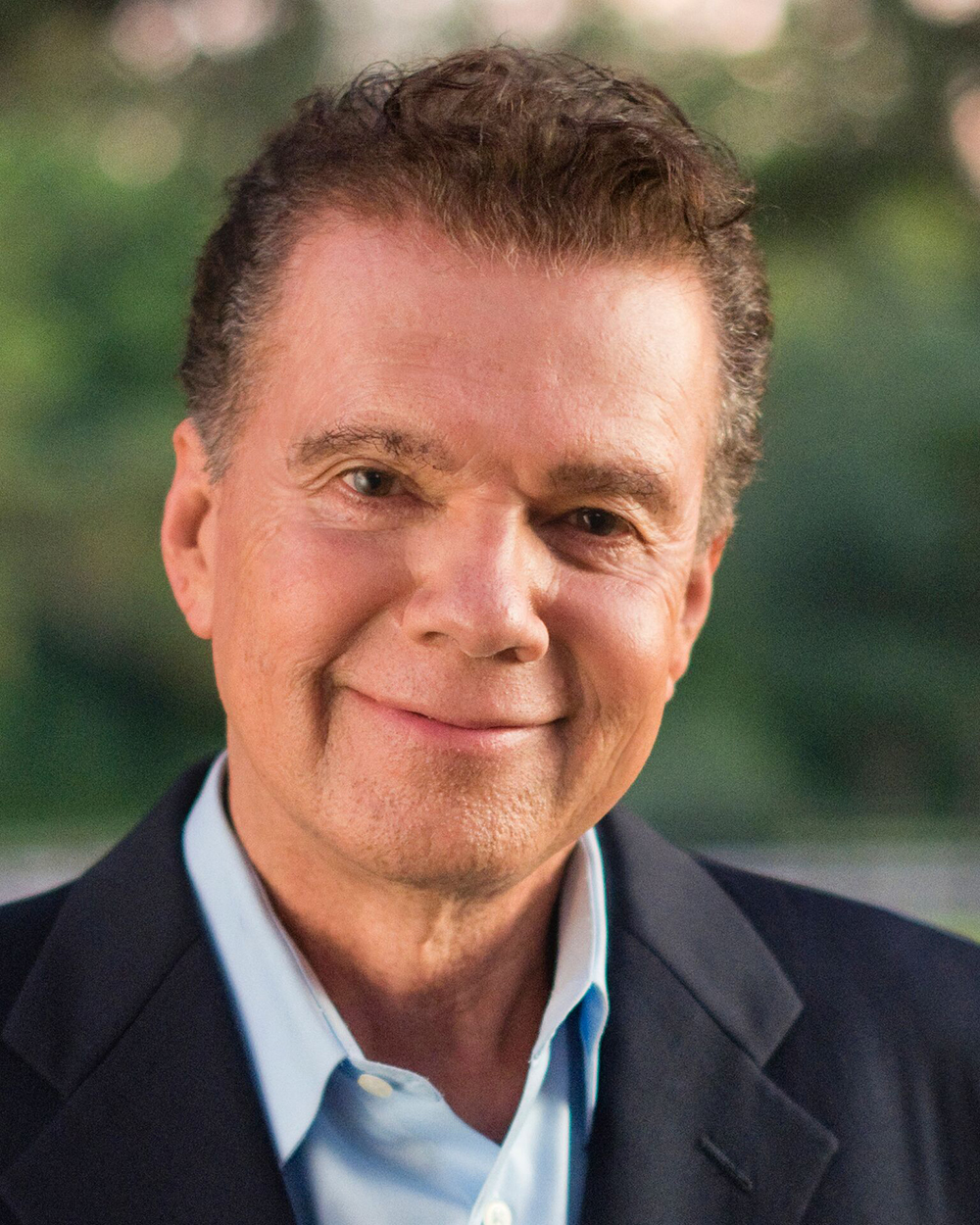
Michael Guillen
Scientist
10
APPEARANCES
9
PODCASTS
Aug 5, 2026

11 MINS LATER

Raj NairHOST
As a scientist, as someone who's dedicated their life to physics and math and astronomy, what would be a helpful cracking of the dam conversation, if my friend here is listening, that would allow them the bandwidth to even start to have that conversation?

speaker_1HOST
To join in the celebration and to hear some of the stories of people whose faith journeys have been impacted by all the writings of Sarah Young, head over to JesusCalling.com.
speaker_1HOST
Let's start with Michael's story.
Michael GuillenGUEST
I had this dream of becoming a scientist, and that dream took me from the Mexican barrio of East LA to UCLA and then Cornell, where I earned a PhD in physics, math, and astronomy, and then I was fortunate enough to go from there.
Michael GuillenGUEST
And in between, I became the science editor for ABC News, and I traveled the world covering all the major science stories for 14 years.

Steve KatesHOST
Tell us your original, where were you born? Where did you grow up? And tell us some of those stories.

Michael GuillenGUEST
I was born in East Los Angeles, so right off the bat, I'm born on the wrong side of the tracks in L.A., right? Right in the middle of the Mexican body.

Michael GuillenGUEST
If, if you reverse the, uh, uh, the videotape of an explosion, you'll see that it begins with some kind of a bomb.
Michael GuillenGUEST
So Fred Hoyle, when he was being interviewed on the radio, referred to this, uh, so- so-called, uh, i- initial moment of the universe, the Big Bang Theory.
Michael GuillenGUEST
He goes, "Yeah, there was a, like a big bang that started the universe." Well, that was the start of the, of, of science's migraine headache because they had to scramble all of a sudden [laughs] to explain, well, what triggered the Big Bang? I mean, what triggered everything? And do you know that to this day, like almost 100 years later...

speaker_1ADVERTISER
Any door, the right support.
Michael GuillénGUEST
And during that time, Stephen came to our campus and was there for about like a week.
7 MINS LATER

David KnightHOST
Once you start with a understanding that there is a designer, that there is intelligence behind all this, then you can really see how it fits together and you can see that better.
Michael GuillenGUEST
Yeah, and you've said so many things in just that one little bit, I don't even know how to reply, except let me, and we can pursue it even more, because yeah, your remarks just now are just rich with meaning, rich with depth.
Michael GuillenGUEST
When I fell madly in love with science, I was, what, like a seven-year-old kid.
Michael GuillenGUEST
And I just thought to myself naively that to be a scientist, you had to take a very pragmatic view of things.
Michael GuillenGUEST
It just seemed like the most reasonable thing for a would-be scientist to believe.
19 MINS LATER
David KnightHOST
Once you start with a understanding that there is a designer, that there's intelligence behind all this, then you can really see how it fits together and you can see that better.
Michael GuillenGUEST
Yeah, and you've said so many things in just that one little bit, I don't even know how to reply, except let me, and we can pursue it even more, because yeah, your remarks just now are just rich with meaning, rich with depth.
Michael GuillenGUEST
When I fell madly in love with science, I was what, like a seven-year-old kid.
Michael GuillenGUEST
And I just thought to myself naively that to be a scientist, you had to take a very pragmatic view of things.
Michael GuillenGUEST
It just seemed like the most reasonable thing for a would-be scientist to believe.
19 MINS LATER

Michael GuillenGUEST
The question is, how much confidence do you have in what science is saying? And I think more to the point, Caleb, and I think this is the point you're driving at is and this for me was part of my awakening.
10 MINS LATER
Caleb CollierHOST
And I'd love for you to break this down for the audience to understand, because this was really kind of the crux of your journey here was realizing that for science, the vast majority of matter or maybe I'm not saying that the best way, but it is actually invisible.


Michael GuillenGUEST
But before I do that, I need to set the stage, right? For the longest time, really, since Aristotle.
Michael GuillenGUEST
Isaac Newton is the father of modern science, the modern scientific method, or the classical scientific method.
10 MINS LATER

Tim DennisHOST
I don't think most people who consider themselves a devout atheist even know that that book exists.
Michael GuillenGUEST
But yeah, it's The Little Book of Atheist Spirituality, and it's a, a best seller among, you know, that crowd.
51 MINS LATER