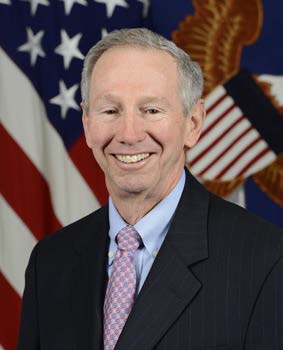
Michael Griffin
Physicist and former Under Secretary of Defense for Research and Engineering of the United States
4
APPEARANCES
4
PODCASTS
Jun 29, 2026


Alan MorrisseyHOST
It's about, I guess, striking that balance, if at all possible, using it in an appropriate way.
Michael GriffinGUEST
Now, that's going to be a very, very delicate and difficult balance to strike, I think.
Michael GriffinGUEST
AI, I can see all of the benefits of it in science in terms of rapid diagnostics, you know, rapid computation of things like, you know, genetic sequencing and all that kind of stuff.
Alan MorrisseyHOST
How do we roll back on the way the road AI has taken us down? Is students' critical thinking only heading one way and that's downwards?

Marissa JonesHOST
We asked Detective Griffin if he could walk us through the early days of the investigation into Trudy's disappearance.
Michael GriffinGUEST
Her dad had come home from work, uh, saw that she wasn't home like she was supposed to be.
Michael GriffinGUEST
Did the normal thing, checked with neighbors, checked with friends, checked with...
Michael GriffinGUEST
Trudy and his mom and dad were not married, so he checked with her mom, her mom's relatives.
Michael GriffinGUEST
So when we have a missing child, depending on the age, depending on medical history like that, if it's a significantly at risk, almost everyone in the department drops what they're doing, and they go out and look.
9 MINS LATER
Marissa JonesHOST
Detective Griffin told us what he thinks happened to Trudy on August twenty-first, nineteen ninety-six.

Michael GriffinGUEST
Uh, his mother was Anne Jones, uh, whose father was Oliver Jones, who was an Anglican priest in the Diocese of Elphin.
Michael GriffinGUEST
Goldsmith himself was the second son and the fifth child of eight, so it was a large family, and there was, there was plenty of clerical activity, uh, and cler- clerical culture, I suppose you'd say, in, in the family.
39 MINS LATER


Melvyn BraggHOST
This is In Our Time from BBC Radio 4, and this is one of more than a thousand episodes you can find on BBC Sounds and on our website. If you scroll down the page for this edition, you can find a reading list to go with it. I hope you enjoy the program. Hello. The Irish writer Oliver Goldsmith, 1728 to 1774, has a memorial in Westminster Abbey's Poets' Corner, celebrating his life as a poet, natural philosopher, and historian. To this could be added playwright and novelist and science writer and pamphleteer and much besides, as Goldsmith began on Grub Street, where writers-for-hire were jacks-of-all-trades and masters of just a few. Yet while much of Goldsmith's early work was ephemeral, his lasting triumphs include his poem The Deserted Village, play She Stoops to Conquer, and book The Vicar of Wakefield. With me to discuss Oliver Goldsmith are David O'Shaughnessy, Professor of 18th Century Studies at the University of Galway, Judith Hawley, Professor of 18th Century Literature at Royal Holloway, University of London, and Michael Griffin, Professor of English at the University of Limerick. Mike Griffin, what should we know of Goldsmith's early life?
Michael GriffinGUEST
Well, he's, he's very much a child of the midlands, uh, in Ireland. He was born on the 10th of November, uh, 1728. His father was the Reverend Charles Goldsmith. Uh, his mother was Anne Jones, uh, whose father was Oliver Jones, who was an Anglican priest in the Diocese of Elphin. Goldsmith himself was the second son and the fifth child of eight, so it was a large family. And there was, there was plenty of clerical activity, uh, and cler- clerical culture, I suppose you'd say, in, in the family. He was not a particularly, uh, promising child. Uh, this was referred to by a number of people. He was som- somewhat wayward. His first teacher was a woman by the name of Elizabeth Delap, uh, who thought that he showed some promise in verse, but failed to apply himself in much of his study. But then, as his childhood went on, he, he was exposed to, to a few other teachers who I think cultivated in him a love of learning, particularly in poetry and the arts. He was badly damaged... Uh, this is actually an important part of his life story, I suppose, is that he was badly damaged by smallpox at the age of eight or nine, which left marks on his face, uh, and would lead to a number of people remarking over the course of his life that he was pretty ugly. That's something that, uh, was a, was a source of unkind remarks throughout. But he was in the school of Thomas Byrne at the time when he was struck by smallpox. Thomas Byrne was a very influential figure in his life, because he was a returned soldier. Uh, the figure of the returned soldier is, uh, is a figure that recurs in Goldsmith's writing. And he taught him aspects of the classics, was good with ballads, uh, and he, I think, cultivated in the young Goldsmith, uh, a greater, e- and greater love of, uh, of poetry.
42 MINS LATER
Melvyn BraggHOST
What would you like to say, Michael Griffith, that you didn't have time to say in the, uh, program? Was he, was he being, uh, the Irishness in any way a hindrance to him?
Michael GriffinGUEST
Well, I don't think his, uh, not in material terms, in terms of his, uh, the reviews, um, nobody alluded to it. Uh, at the very beginning of his London career, in seven, to late dis- late 1757, uh, December, he writes a letter home, uh, in which he complains about the fact that he's brought out of Ireland nothing but his brogue and his blunders. Uh, so he feels very, uh, I think when he initially arrives in London, he does feel quite awkward. And he does feel, he says that being an Irishman in London at this time is something that's going to hinder his employment, and he expresses what he calls an unaccountable malady du pays, which is a kind of a homesickness. You know, he's, he's, he's sort of keen, I think, at that phase to, even talks about, you know, th- as almost kind of a suicidal, uh, feeling, uh, that he has around about this time. But he quickly embeds himself in this, in this literary marketplace, and I think once he, uh, begins to establish himself, his Irishness is not a major impediment. It's remarked upon, uh, amongst a closer group of friends, but it's not something that the reviews refer to. There is one enemy, uh, that he seems to, uh, acquire over the course of his career, which is a character called William Kenrick, uh, who would refer to him in, in very negative terms in the reviews, but not necessarily in relation to his nationality, but more to do with his, uh, the quality of his writing, or the lack thereof, as he saw it.