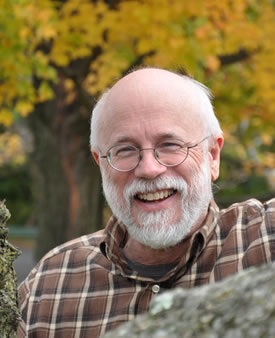
Michael Behe
American biochemistWikipedia
36
MENTIONS
12
EPISODES
11
PODCASTS
Search complete. 36 mentions across 12 episodes found for "Michael Behe".
Sep 25, 2026

Andrew McDiarmidHOST
You're welcome.
Andrew McDiarmidHOST
Well, in his book Darwin's Black Box, biochemist Michael Behe writes that in order to understand the barriers to evolution, we have to bite the bullet of complexity, he says.
Andrew McDiarmidHOST
He also adds, "To appreciate complexity, you have to experience it." And in his recent book Foresight, Brazilian chemist Dr.
Andrew McDiarmidHOST
Marcos Eberlin encourages us to dip a toe in the ocean of ingenuity, ingenuity that in our universal experience is wedded to a power unique to intelligent agents, and that's foresight.

Peter RobinsonHOST
And the comments on this show on YouTube were scathing.
Peter RobinsonHOST
Why are you wasting, to me, why are you wasting your time with these cranks? 2023, we recorded another show with you and John and Michael Behe, not the same topic, but similar topic.
Peter RobinsonHOST
and the tone of the comments was completely different.
Peter RobinsonHOST
Do you feel a change in the way you're being received? Is it generational?

Joe HoldenHOST
The theory of evolution cannot explain the highly complex information systems that are found in the cell.
Joe HoldenHOST
Michael Behe, he is a biochemist at Lehigh University.
Joe HoldenHOST
He wrote a book called Darwin's Black Box.
Joe HoldenHOST
And in it, he talked all about this concept at the cellular level with these biological systems at a very simple level.

Luke JansenHOST
Did you want to say anything about that, Scott?
Scott DyerHOST
I will say this, that when Michael Behe's book came out, and before him, William Dembski, he's a mathematician, and he wrote a thesis, a published thesis, on this idea of irreducible complexity, and then Behe argued that a great example of that is the bacterial flagellum, that all of that did really stir my interest, and I wondered, maybe, okay, maybe we found it, you And I'm still wondering about this, but if we really did find something that was irreducibly complex, we couldn't reduce it to simple steps, would that then be a blow to evolution being purely undesigned? I don't know.
Scott DyerHOST
But the point is, we haven't.
Scott DyerHOST
And the bacterial flagellum, like you said, it's been kind of the superstar of this.
Scott DyerHOST
But in our own discussions with Michael Behe, we came to... see that they seem to be in some kind of denial that this has been demonstrated to have evolved.
Luke JansenHOST
And that irked me.
Luke JansenHOST
Like, you were there too.
12 MINS LATER
Luke JansenHOST
All right, let's talk about the video that actually caught our eye, and this one about the bacterial flagellum.

PaulogiaHOST
The third is design and fine-tuning in biology and cosmology.
PaulogiaHOST
Carey points to Michael Behe's bacterial flagellum, Hubert Yawkey's objections to the odds of life arising by chance, and Hugh Ross's long lists of finely calibrated physical constants, treating the accumulation of examples as evidence of a superintelligence behind the structure of life in the cosmos.
Gary HabermasSOUNDBITE_SPEAKER
Arguing from the nature of cell design, Behe noted the presence of irreducible complexity.
Gary HabermasSOUNDBITE_SPEAKER
In particular, Behe made famous the example of the bacterial flagellum, which appeared to be thin hairs with rotary motors made of protein that protrude from microorganisms, propelling the organism along.
Casey LuskinGUEST
We're, we're gonna tell this story in just a second here, but here's the real moral of the story.
Casey LuskinGUEST
The, the ultimate source of misinformation that led to this misquote, this fake quote of Michael Behe, was the Kitzmiller versus Dover ruling.
Casey LuskinGUEST
And so the moral, moral of the story is to reaffirm something that we've known for a long time, and that is that the Kitzmiller versus Dover ruling is full of errors about intelligent design.
Casey LuskinGUEST
And is really not a reliable source of information about ID.
Casey LuskinGUEST
And if you're gonna trust Judge Jones, trust the Dover ruling as a reliable source of information, you need to fact-check Judge Jones, and if you don't do that, you can actually get yourself in s- a serious sort of academic hot water situation, and you could get really burned by Judge Jones.
Casey LuskinGUEST
And sadly, I think that in this case, as we'll talk about, C.W. Howell, he relied on Judge Jones' Kitzmiller versus Dover ruling.
Casey LuskinGUEST
I don't think he fact-checked it, and because of that, he incorporated false information, this fake quote from Michael Behe into his book, and it really, really came back to hurt his scholarship.
Casey LuskinGUEST
So the moral of the story is to affirm something we always knew or we've known for a long time, that the Dover case, the Dover ruling is full of misinformation about ID, and you gotta fact-check it before you just quote it and blindly trust it.

Baba LouieHOST
... not gonna be
JoshHOST
beHe could also get his 22nd consecutive point per game season.
JoshHOST
He already owns the record at 21.
JoshHOST
Extending it at age 39 would add another season to one of the most remarkable longevity records in hockey.

Ken OrtizeGUEST
Why not get the salad instead of the cheeseburger? Have you tasted salad? But you have to understand that the whole terminology has grown up around these things, that they have to use the language of intelligent design in order to explain the fact that the universe is intelligently designed.
Ken OrtizeGUEST
And the more we know in the macro universe, talking about astronomically and so forth, the universe, the more we know about the micro universe, where we're talking about genetics or biology or anything, Over and over again, the evidence comes back to there's an intricacy or what Michael Behe referred to as irreducible complexity.
Ken OrtizeGUEST
That the universe is so incredibly complex that when Darwin said, well, the simple cell gave birth was the beginning of life, he didn't even know that there was a thing called a molecule.
Ken OrtizeGUEST
in order to understand the complexity of the molecule.

speaker_0GUEST
We know that takes some kind of cognitive reasoning why not get the salad instead of the cheeseburger? Well, Have you tasted salad? But you have to understand that the whole terminology has grown up around these things, that they have to use the language of intelligent design in order to explain the fact that the universe is intelligently designed.
speaker_0GUEST
And the more we know in the macro universe, talking about astronomically and so forth, the universe, the more we know about the micro universe, where we're talking about genetics or biology or anything, Over and over again, the evidence comes back to there's an intricacy or what Michael Behe referred to as irreducible complexity.
speaker_0GUEST
That the universe is so incredibly complex that when Darwin said, well, the simple cell gave birth was the beginning of life, he didn't even know that there was a thing called a molecule.
speaker_0GUEST
in order to understand the complexity of the molecule.

Niall CanavanGUEST
And when they played this year, obviously, Scannamont, Beniaminock got over the line.
Niall CanavanGUEST
But for Behe, you know, it's a huge game as well.
Niall CanavanGUEST
You know, they have serious battlers and...
Niall CanavanGUEST
They won't like the fact that they're in this relegation to go down to junior.
2 more episodes mention Michael Behe.
Create an account to see the whole feed, search across every transcript, and follow the entities you care about.