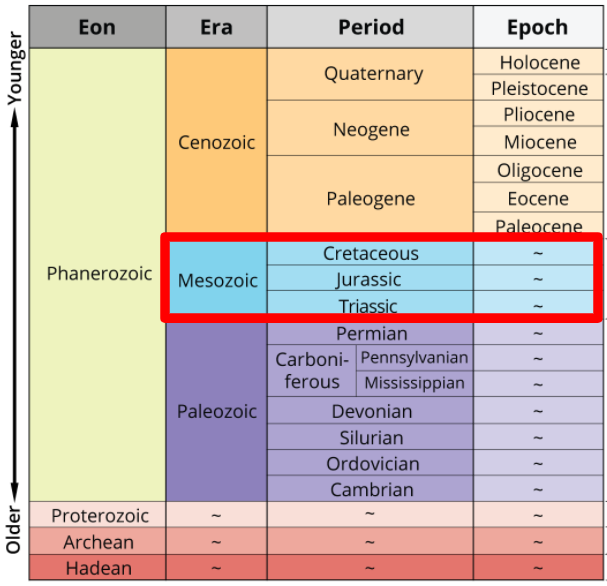
Mesozoic
Geologic periodWikipedia
131
MENTIONS
77
EPISODES
67
PODCASTS
Search complete. 131 mentions across 77 episodes found for "Mesozoic".
Sep 21, 2026

Nati HimapanHOST
You're listening to Love in the Time of Chasmosaurs, the podcast, the audio supplement to our blog of the same name about the art, science and popular culture of mostly Mesozoic life.
Nati HimapanHOST
I'm Nutty.
Nati HimapanHOST
I'm Mark.
13 MINS LATER
Nati HimapanHOST
In many ways, it felt to me like a kind of an immersive illustrated book, if you will.
Nati HimapanHOST
We know, of course, that there were re-edited sequences from Apple TV's Prehistoric Planet, which are projected onto the walls of the show space in 360 degrees, and in most cases at life-size, so that you could, for example, feel yourself at the feet of Dreadnoughtus as they walked through.
Nati HimapanHOST
And these weren't done at random as a kind of montage, but the sequences were organized under sort of mini chapter headings of sorts about the Mesozoic world.
Nati HimapanHOST
whilst recalling parallels with the extant wildlife of the modern one and how they inform how we reconstruct the animals of the past.
Nati HimapanHOST
And these re-edited sequences from the show were interspersed with other images, photographs, illustrations, CG sequences, which apparently were bespoke for the display.

ChaseVOICE_ACTOR
Y esa no es la única mentira que te han dicho sobre los dinosaurios.
ChaseVOICE_ACTOR
Desde especies inexistentes hasta la capacidad de visión del tiranosaurio rex, hay muchos mitos y conceptos erróneos con respecto a la era mesozoica.
ChaseVOICE_ACTOR
Arranquemos.
ChaseVOICE_ACTOR
Uno de los mitos más descabellados es que todos los dinosaurios eran monstruos verdes con escamas.
ChaseVOICE_ACTOR
Los estudios sugieren que la visión del Tiranosaurio rex era muy superior a la de las aves actuales, considerando sus enormes nervios ópticos.
ChaseVOICE_ACTOR
Es fácil olvidar que los dinosaurios no existieron en forma simultánea.
ChaseVOICE_ACTOR
La era Mesozoica, también conocida como la era de los dinosaurios, abarcó más de ciento ochenta millones de años.
ChaseVOICE_ACTOR
¡Guau! Tuvo tres períodos distintos: Triásico, Jurásico y Cretácico, cada uno con sus especies particulares.

Andrew WyattHOST
Um, But I like the, I like the, like the high concept is pretty cool.
Andrew WyattHOST
The idea of like temporal co-location for a brief period or a transposition of two, you know, there's this sort of cylinder or platter of landmass that is switched places between modern day 1980s Detroit and You know, the middle of the Mesozoic.
Andrew WyattHOST
I'm not sure exactly what era it's supposed to be.
Andrew WyattHOST
I get the impression that's maybe like Triassic-Jurassic boundary based on the dinosaurs that we see.

Melanie Schleter-McCalmontNARRATOR
but on the latter point he wisely held that quote it would be manifestly absurd to introduce into a newly studied province the nomenclature which had been adopted in those provinces previously studied in quote uinta page thirty eight this principle guided him some years later when he pointed out in his first report as director of the united states geological survey that the introduction of local formation names has taken place in opposition to received opinions and in spite of the almost universal efforts of geologists to attain uniformity it therefore represents the logical and necessary growth of the science End quote.
Melanie Schleter-McCalmontNARRATOR
Powell was one of the pioneers in the demonstration of the almost undisturbed continuity of deposition in the West from the Cambrian to Tertiary time, sometimes slightly interrupted by gentle unconformities, but without trace of the revolution that, from the structures known in Europe and eastern North America, had been previously supposed to mark a worldwide break between the depositional records of Paleozoic and Mesozoic times.
Melanie Schleter-McCalmontNARRATOR
he was the first to bring out the great structural features of the plateau province already referred to he repeatedly emphasized the action of uplifting rather than of compressing forces for he had chiefly to do with broad structures of nearly horizontal strata limited by faults or as he so justly remarks their homologues monoclinal flexures and the latter style of deformation was in his time a geological novelty complicated deformation was mostly limited in the plateau region to zones of diverse displacement between extended areas of little disturbance the only sharp folds with which he had to do occurred in these narrow zones he suggested that flexing of strata was probably a deep-seated process while faulting was a more superficial one as in his discussion of the problem of antecedents stated above so through all his writings he strongly supported the then growing idea that upheaval was not marked by a great convulsion for the lifting of the rocks in the uintas was so slow that the rains removed the sandstones almost as fast as they came up Following his systematic habit of mind, he grouped the mountainous reliefs of his region into two great classes.
Melanie Schleter-McCalmontNARRATOR
Some were composed of sedimentary strata and others of extravasated materials.
19 MINS LATER
Melanie Schleter-McCalmontNARRATOR
But Powell is much more thoroughgoing and definite than any of his predecessors.
Melanie Schleter-McCalmontNARRATOR
He states in his second report, after recognizing the rapid wearing down of Highlands, quote, the degradation of the last few inches of a broad area of land above the level of the sea would require a longer time than all the thousands of feet which might have been above it so far as this degradation depends on mechanical processes but here the disintegration by solution and the transportation of the material by the agency of fluidity come in to assist the slow processes of mechanical degradation and finally perform the chief part of the task u one ninety six this passage is of special interest as being the most explicit statement made by powell regarding the general possibility that normal erosional processes working on a land mass long undisturbed will ultimately reduce the whole surface to a low land but little above sea level End of section 9.
Melanie Schleter-McCalmontNARRATOR
X. PLANATION these general results were not left without practical application the great plains of erosion revealed by the superb unconformities in the bottom of the grand canyon of the colorado in northern arizona were evidently regarded as the result of persistent erosion by rain and rivers during prolonged still stands of the region in ancient geological periods but the phraseology adopted for the peroration in which the history of these buried lands is set forth must leave the uninformed reader in some doubt as to the precise nature of the facts and inferences there presented a simpler statement is given for the plateau like highlands of crystalline schists flanked by upturned sedimentaries in the colorado front range which has made a deep impression on powell when he crossed them in his first western journey in eighteen sixty seven he afterward recalls that he had then dimly conjectured that tens of thousands of feet had been eroded from some of the ranges and that the table or plateau like character of the ranges was due to some epoch of this later denudation of the ranges when they were planed down to a common level such a planing down occurs when the channels of the eroding streams remain for a great length of time at a general base level you into page twenty seven it would thus appear that the first observer to recognize this fundamental process in the origin of the front range of the rocky mountains was not marvin to whom it has elsewhere been credited but powell true he does not explicitly state that the plain down surface of the front range was afterward broadly uplifted to its present highland altitude in order to excite its streams to erode the gorges by which it is now dissected but no one who reads his reports can doubt that he understood the uplift as clearly as the planing down following the principles so well and so early applied in colorado he afterward perceived that the ranges of the great basin though composed of ezoic and paleozoic rocks are mountains of very late upheaval, and that before upheaval their region was, quote, a comparatively low plain, constituting a general base level of erosion, to which that region had been denuded in Mesozoic and early Tertiary time, when it was an area of dry land.
Melanie Schleter-McCalmontNARRATOR
He was thus led to say, Mountains cannot long remain as mountains.

CurtisHOST
Why are you
JamesHOST
going to want to do the dinosaurs first? Is it because they're from the earlier Mesozoic? As opposed to the early Cretaceous.
AmandaHOST
Um, Well, okay, so I did look at that.
AmandaHOST
That actually played less of a role in my decision to read that paper first because it was one page longer.

speaker_3NARRATOR
On the west they are invaded by a labyrinth of bays, channels, sounds, and inland watercourses, which for beauty and intricacy are unsurpassed and probably unequaled on any other coast.
speaker_3NARRATOR
The intensely rugged nature of these mountains and of the Pacific coast is doubtless largely due to the comparatively recent age of the former, from the highly inclined position of the Miocene strata, supra-Patagonian beds, all along the eastern base of the mountains, it is evident that while the actual birth of the latter may have taken place during Mesozoic times, yet the greatest development was not accomplished until the Miocene, and hence they now present numerous sharp peaks, bold lines, and rigid angles, which the eroding elements in nature have not yet had sufficient time to soften.
speaker_3NARRATOR
Yet it cannot be said that they do not harmonize well with their surroundings, for only that which is rugged in the extreme could comport with perpetual storms which forever rage about the summits and the terrific onslaughts of waves that constantly attack the basis.
speaker_3NARRATOR
Nature always produces most perfect harmony, and as these lofty peaks are lowered and their sharp angles rounded by erosion, Just so will the causes of the truly terrible storms that now prevail here be removed in equally harmonious conditions preserved.

Kevin QuigleyHOST
So, like, here's a little part from Europe, you know, and here's a little part from Asia, and you see this.
Kevin QuigleyHOST
And then r- in Tropical Americas, uh, you'll see that there's a little part that sticks out, uh, that is like a, like a, um, Mesozoic temple.
Kevin QuigleyHOST
Um, and that's not, it, with a monkey on it.
Kevin QuigleyHOST
That's not in Animal Kingdom yet, but Joe Rohde was trying desperately to manifest it.

Jingmai O'ConnorGUEST
You have to have just the right conditions to fossilize them.
Jingmai O'ConnorGUEST
So actually, all the fossil sites that have those just-right conditions that are showing us what feathers were like in the Mesozoic, they're almost all from the Early Cretaceous.
Jingmai O'ConnorGUEST
Our understanding of feathers in the Late Cretaceous is extremely limited.
Jingmai O'ConnorGUEST
So you know, the Hell Creek is one of the best known, you know, fossil-bearing geologic units in the world, right? You know, it's where T.
Bob McDonaldHOST
How well-preserved is this feather?
Jingmai O'ConnorGUEST
It's pretty darn perfect.
Jingmai O'ConnorGUEST
Like, uh, it's, it's the best preserved feather from the Mesozoic.
Jingmai O'ConnorGUEST
The previous best feathers were all preserved in, in amber, but in amber you still get, uh, some distortion in the, in the resin, so, you know, you're not able to, uh, see certain very fine detailed features.

Mark DavisHOST
earth.
Mark DavisHOST
Exactly, the Mesozoic era of high school.
Mark DavisHOST
Where'd you go to school? Where'd you grow up? Plano High School,
Vinny MinchilloGUEST
Plano Senior High School.

speaker_1NARRATOR
The process was slow by human standards, but catastrophic by biological standards.
speaker_1NARRATOR
An entire continental ecosystem, one that had persisted for hundreds of millions of years, through the age of dinosaurs, through the age of mammals, through every climatic shift of the Mesozoic and the early Cenozoic, was extinguished.
speaker_1NARRATOR
Not by an asteroid, not by a volcanic catastrophe.
speaker_1NARRATOR
By the slow, patient, inexorable accumulation of frozen water covering the forests, the river valleys, the animal burrows, the soil, the entire biological and geological surface of the continent under a growing, thickening, spreading layer of ice.
67 more episodes mention Mesozoic.
Create an account to see the whole feed, search across every transcript, and follow the entities you care about.