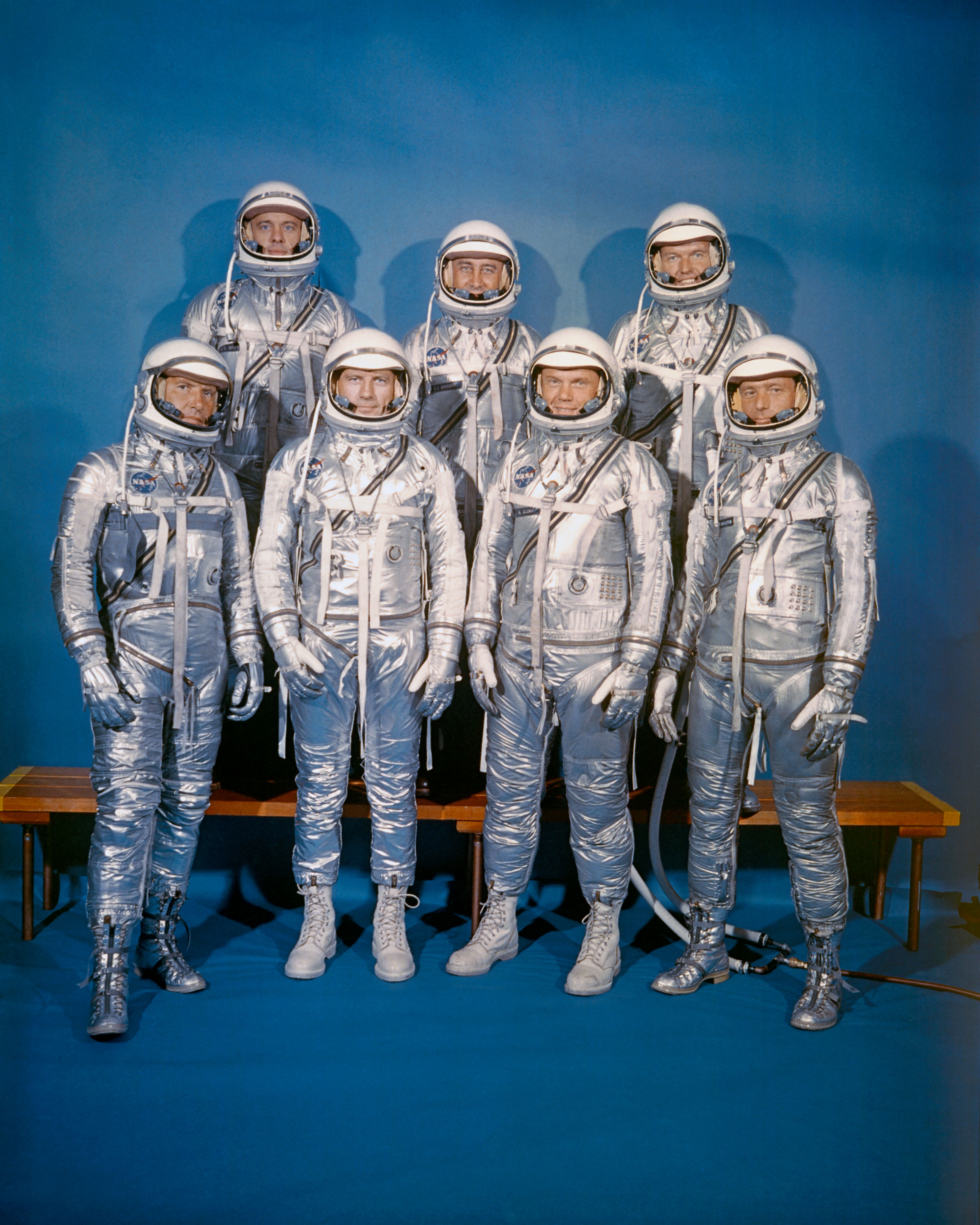
Mercury Seven
39
MENTIONS
24
EPISODES
19
PODCASTS
Search complete. 39 mentions across 24 episodes found for "Mercury Seven".
Nov 22, 2026

Steve KatesHOST
Describe to this audience, this is a time period, set the date and the calendar and the year first, not the calendar per se.
Steve KatesHOST
What was the space world like down at this time that you're again starting to cover this? I mean, this is again after the Mercury program.
Steve KatesHOST
This is an amazing story, too.
Steve KatesHOST
But describe in the best way you can.
5 MINS LATER
Steve KatesHOST
Not everything was easy, as you know.
Steve KatesHOST
Many rockets exploded, obviously, before they put humans on there.
Steve KatesHOST
The Mercury program, of course, the beginnings of our space journeys.
Steve KatesHOST
This is incredible.
Steve KatesHOST
No apology necessary in these very difficult times and maybe many more to come.
Steve KatesHOST
When we come back, I'd like to ask our special guest her experiences with the early Mercury program and her relationship with an astronaut that I met one time on the telephone, Wally Schirra.
Steve KatesHOST
Very interesting man.
Steve KatesHOST
Very interesting story.
6 MINS LATER
Steve KatesHOST
you know, as this hour winds up quickly here in about eight minutes.
Steve KatesHOST
But it's interesting.
Steve KatesHOST
They were in, these in Mercury 7, the tiny little capsule sitting there by themselves.
Steve KatesHOST
I mean, the legacy goes on, and they were the people with the right stuff.

Scott ManleyHOST
Now, at this time, the astronaut office was still run by Deke Slayton.
Scott ManleyHOST
If you remember, he was one of the Mercury 7, but he didn't get to fly because of a medical issue.
Scott ManleyHOST
So he ended up pretty much creating and running the astronaut office, deciding who would get allocated to missions and representing astronauts' interests.
Scott ManleyHOST
And since they were all pilots, they all thought about landing as a powered landing with jet engines.

Michael SchrattGUEST
Quote, we never could get close enough in our saber jets to pin them down, but they were round in shape and very metallic looking, coming from Gordon Cooper.
Michael SchrattGUEST
Now, later on, Gordon Cooper became a Mercury 7 astronaut.
Michael SchrattGUEST
We're talking about someone with a very decorated military career.
Michael SchrattGUEST
He is to be known as a reliable military witness, no doubt about it.

Chris RamsayHOST
What do we do with the testimony of people whose whole careers were built on the reliability of their own observations? Here's how this is going to go.
Chris RamsayHOST
We're going to go chronologically about 25 people over the last 70 years, test pilots before NASA existed, then Mercury, Gemini, Apollo, Skylab, Soviet space station, and the present day.
Chris RamsayHOST
A lot of the audio you're going to hear comes from these newly released tranches, hate that word, that the Pentagon's been releasing.
Chris RamsayHOST
But they released a whole bunch of files and debriefings from astronauts.
Chris RamsayHOST
And the institutions they report to are becoming actively interested in making those reports seem less important.
Chris RamsayHOST
Sounds a little suspicious.
Chris RamsayHOST
And that, my friends, is the atmosphere which lands us here, where two future Mercury astronauts end up seeing something.
Chris RamsayHOST
So Deke's late in December 12th, 1951.

DanHOST
Running from 1958 to 1963, Mercury's mission was to put an American in orbit and bring him home safely.
DanHOST
The 7 honored the program's original astronauts, the Mercury 7, and every crewed capsule carried it in its name from Alan Shepard's Freedom 7 to John Glenn's Friendship 7.
speaker_1NARRATOR
Answer 4.
DanHOST
The UK's House of Commons has 650 members of parliament, each representing one constituency.

John SiuntresHOST
No, I do things in astronaut terms.
John SiuntresHOST
I'm like, hey, man, I was one of the Mercury 7.
John SiuntresHOST
And that's my other thing.
John SiuntresHOST
I quote George Burns.
Scott ManleyHOST
Now, NASA also has a couple of high-profile examples of astronauts who are affected by medical conditions that stopped them flying.
Scott ManleyHOST
Their original Mercury 7 has both Alan Shepard and, you know, Deke Slayton.
Scott ManleyHOST
Now, Alan Shepard, of course, he flew, but then at one point he ended up with Meniere's disease, which was basically a problem with the inner ear.
Scott ManleyHOST
He was experiencing balance and tinnitus, and he was grounded for some time until he ended up being assigned to Apollo 14.
Scott ManleyHOST
And then there's Deke Slayton, who was famously part of the Mercury 7, but he never flew on a Mercury mission because he was diagnosed with a heart fibrillation issue, which basically kept him grounded all the way through the Mercury, Gemini, and Apollo programs.
Scott ManleyHOST
It wasn't until right at the end of the Apollo program he was, and apparently the Mayo Clinic finally cleared his heart for flight.
Scott ManleyHOST
he famously assigned himself to the Apollo-Soyuz mission and sort of set forth a precedent that whoever was running the astronaut office could assign themselves a mission and then resign.

HaitchHOST
They quickly realize that the only men with the strength, training, and will for the mission are test pilots, who regularly face deadly odds to break barrier after barrier in dangerous new planes developed for speed over safety.
HaitchHOST
In their quest to become NASA's Mercury 7, John Glenn, the Boy Scout, Alan Shepard, the Hotshot, Gus Grissom, the Grunt, and Gordo Cooper, the Goof, will be poked and prodded and sold to an eager public ready to believe they will lead America to victory.
HaitchHOST
But they will also be forced to fight the engineers for the features that may save their lives, but also make them true pilots of these starships.
HaitchHOST
But as they chase the Russians into orbit, the man they left behind, the greatest test pilot of them all keeps climbing alone towards the edge of space, proving to the world and themselves that they truly have the right stuff.

Sean AylmerHOST
This will be NASA's 25th astronaut class.
Sean AylmerHOST
since the original Mercury 7 in 1959.
Sean AylmerHOST
All right,
Michael ThompsonHOST
there we go.
14 more episodes mention Mercury Seven.
Create an account to see the whole feed, search across every transcript, and follow the entities you care about.