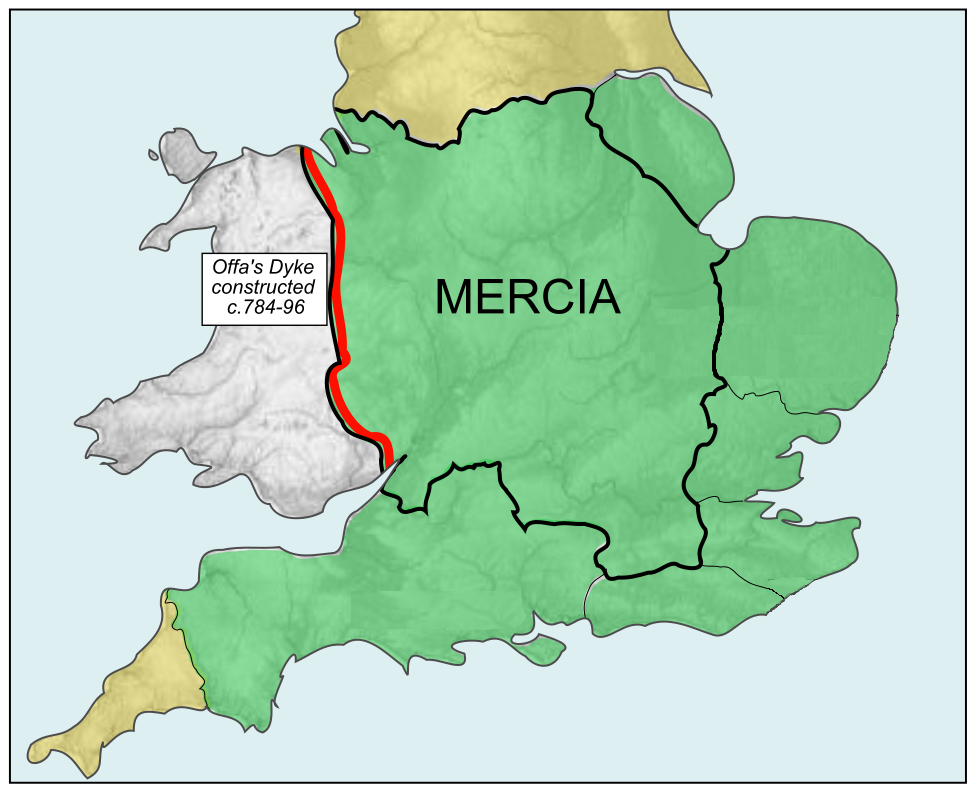
Mercia
RegionWikipedia
248
MENTIONS
64
EPISODES
47
PODCASTS
Search complete. 248 mentions across 64 episodes found for "Mercia".
Oct 26, 2026

Eric LudyHOST
866, Northumbria is going to be conquered.
Eric LudyHOST
And then 867, Mercia is going to become.
Eric LudyHOST
So I'll put it on the map so you can see it.
Eric LudyHOST
865 is East Anglia.
Eric LudyHOST
And then they're going to go up to Northumbria with all the horses of East Anglia.
Eric LudyHOST
And they're going to conquer Northumbria.
Eric LudyHOST
And then the Vikings are going to go south again to Mercia.
Eric LudyHOST
And you see where they're headed? You see Wessex down in the bottom left? That's where Alfred is.

Ruby HartHOST
that England we know today did not yet exist as a single kingdom.
Ruby HartHOST
Wessex stretched across much of the south, while Mercia, Northumbria and East Anglia had their own rulers, loyalties and traditions.
Ruby HartHOST
Although these kingdoms competed with one another, they increasingly faced the common danger from Scandinavian raiders, whose ships allowed them to strike along the coast and penetrate inland through navigable rivers.
Ruby HartHOST
During Alfred's childhood, his father confronted that danger directly.
Ruby HartHOST
Unlike raiding parties that might seize treasure and sail away, this army stayed, acquired horses and began moving between kingdoms, bringing the possibility of conquest wherever it established its camps.
Ruby HartHOST
York fell in 866, and when rival Northumbrian kings attempted to recover it the following year, both were killed.
Ruby HartHOST
The army then moved into Mercia and occupied Nottingham, where King Burgred called upon Wessex for help.
Ruby HartHOST
Æthelred and Alfred brought forces to his assistance, giving the younger prince direct experience of a campaign beyond his own kingdom, although their intervention produced no decisive victory and the Mercians eventually negotiated peace.

Will WyethGUEST
And they sail to the north of England, initially to Teesdale, and then they come to York and they capture York.
Will WyethGUEST
This is when we get the first of the three major battles in 1066, the Battle of Gatefulford, when the earls of Mercia and Northumbria meet Harold, Harold Hardrider, I should say, and Tostig, and are defeated.
Will WyethGUEST
So the north of England is suddenly no longer under English royal control.
Will WyethGUEST
Then we have Harold Godwinson coming from the south, marching south with his armies and defeating and killing Harold Hardrada and Tostig at the Battle of Stamford Bridge.

Beth ThomasNARRATOR
there have been three reprints in modern times of this complete Psalter.
Beth ThomasNARRATOR
Next to this comes the important question of the four Gospels existing in Anglo-Saxon, Northumbrian, and Old Mercian versions.
Beth ThomasNARRATOR
Professor Skeet is of opinion that there was but one Anglo-Saxon version, and that five out of the six manuscripts of the Gospels now left to us, though written in different places, are intimately connected with each other and derived from that original now lost.
Beth ThomasNARRATOR
The six referred to are 1.
Beth ThomasNARRATOR
It was originally copied from the Vulgate by Mac Regal, an Irish priest around 820 AD.
Beth ThomasNARRATOR
The interlinear gloss was added about a century later by two men a scribe named Owen, and Farman, a priest of Harwood, on the river Wharf.
Beth ThomasNARRATOR
It may be mentioned that the gloss in this manuscript, but throughout the first gospel only, is in the Old Mercian dialect, and therefore a peculiar interest as giving us an example of a dialect of which the specimens are extremely scarce, and yet which is closely related to the modern literary language.
Beth ThomasNARRATOR
It may well be at this point to emphasize the fact that the time when the Psalter and the four Gospels were given to the people in their own Saxon tongue was the 7th century, the century described as the time of greatest advance previous to the Norman conquest.

Charlie HigsonHOST
But he didn't start pushing his weight around and belittling these other rulers in the different parts of his kingdom.
Charlie HigsonHOST
There was still a ruler in what was left of the Mercian kingdom, and that was another guy called Æthelred.
Charlie HigsonHOST
He wasn't allowed to give himself the title of king, but he was allowed to stay in charge of Mercia.
Charlie HigsonHOST
And he married King Alfred's daughter Æthelflad, who we will look at in the next episode.
Charlie HigsonHOST
She became the Lady of the Mercians, and she was a fascinating character.
Charlie HigsonHOST
And Alfred also gave the Mercian King Althored control of London.
Charlie HigsonHOST
He was trying to create this network of people who were loyal to him, but could also sort of keep control in their local areas.
Charlie HigsonHOST
And Alfred knew from history that the traditional methods that the Saxons had been using to fight the Vikings were not very effective.

HarryHOST
94% pure English with then a little bit of Dane on top.
HarryHOST
Which is pretty good for Mercia.
HarryHOST
Pretty typical for Mercia.
HarryHOST
No,
NateHOST
I'm higher than that on living DNA.

Tom HollandHOST
Half-imagined wraiths forming in hill mist are no foundation for our history.
Tom HollandHOST
And his thesis is that Nennius literally made it up, that he's responsible for the whole farrago, that he invented Arthur from scratch to serve the propaganda needs of Gwynedd, the Welsh kingdom in the north, that was being menaced at the time by Mercian expansionism.
Tom HollandHOST
And he points out that the themes, not just of the paragraph about Arthur, but the whole Historia Britannum in which that paragraph appears are kind of twofold.
Tom HollandHOST
So firstly, the Britons, aka the Welsh, are the original and rightful people of Britain.

Edmund MatyjaszekGUEST
It was several kingdoms founded by these invaders.
Edmund MatyjaszekGUEST
Wessex, or the West Saxons, Mercia, Northumbria, East Anglia, the North Folk, or Norfolk, and the South Angles and South Folk, or Suffolk.
Edmund MatyjaszekGUEST
Essex, or the East Saxons, Kent and Sussex, the South Sax- Saxons.
Edmund MatyjaszekGUEST
The past still lies around us every day in our county names.
Edmund MatyjaszekGUEST
That's the Church.
Edmund MatyjaszekGUEST
Now, can we stop there for a moment to consider this? There was no England.
Edmund MatyjaszekGUEST
Mercia would fight with Wessex.
Edmund MatyjaszekGUEST
Essex with East Anglia.
Toby LeesHOST
and
Bede MullensGUEST
Mercia, which is to the south of that, so what we would now think of as the Midlands, Birmingham and so on.
Bede MullensGUEST
There are also English speakers in East Anglia and further south.
Bede MullensGUEST
But these are all separate kingdoms.

Sarah BowdenGUEST
It might be just outside what's now Oswald Street on the Welsh border.
Sarah BowdenGUEST
And he was killed in battle by the Mercian ruler.
Sarah BowdenGUEST
Mercy is another big, powerful kingdom at the time, by the Mercian ruler Pender.
Sarah BowdenGUEST
Pender wasn't Christian.
Sarah BowdenGUEST
Oswald was.
54 more episodes mention Mercia.
Create an account to see the whole feed, search across every transcript, and follow the entities you care about.