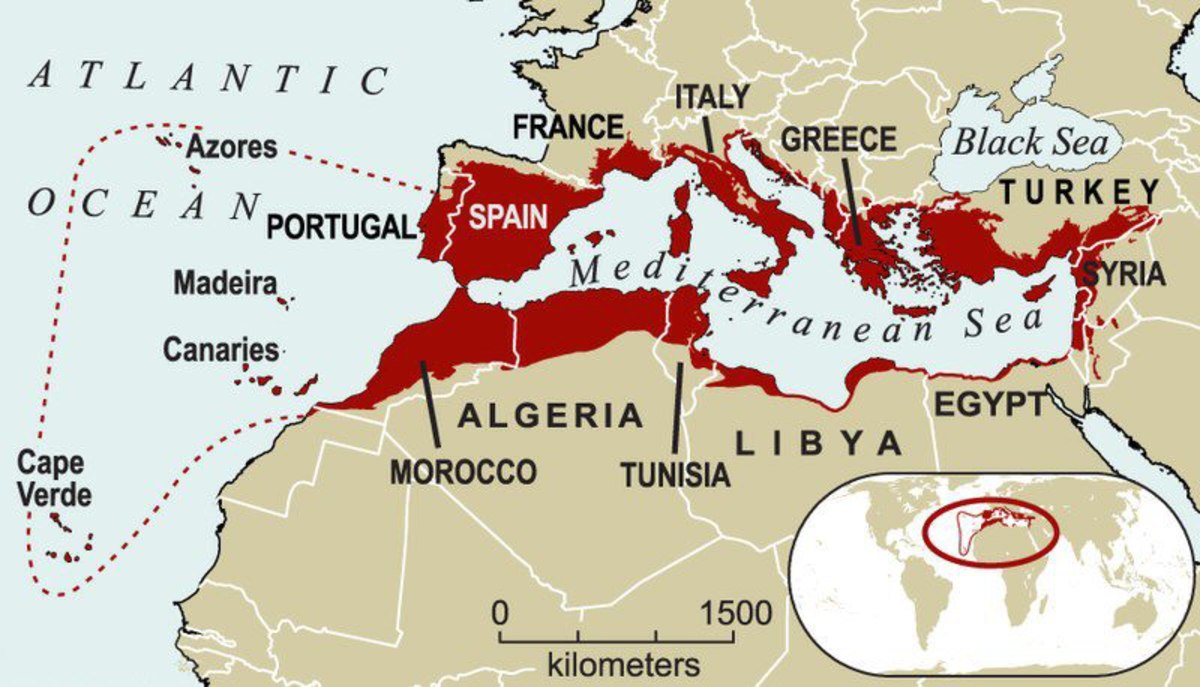
Mediterranean Basin
RegionWikipedia
55
MENTIONS
33
EPISODES
28
PODCASTS
Search complete. 55 mentions across 33 episodes found for "Mediterranean Basin".
Oct 27, 2026

Erik BlankGUEST
They call it California friendly.
Erik BlankGUEST
We pull from the plants from around the various Mediterranean regions around the world, and they have similar properties.
Erik BlankGUEST
weather patterns dry in the summer cool wet winters and that's great so those plants can help us save water provide really beautiful gardens but they don't necessarily support the local insect and you know our local uh fauna population
Cameron BarrettHOST
so when when we're talking about plants and if you're um uh not a great plant grower like me and you're talking about native plants with people who are great plant growers like you we hear a lot about native and non-native but we also hear about invasive now non-natives aren't necessarily invasives is that right

Maxim GaurdHOST
Jan is a climate scientist with a doctorate in ecology and has spent more than last 40 years supporting communities around the world to adapt to challenges, including environmental challenges.
Maxim GaurdHOST
So Jan has worked in Central Europe, in Central Asia, Niger, Burkina Faso, Mediterranean region.
Maxim GaurdHOST
and has been a research scholar for 25 years at the International Institute of Applied Systems Analysis, besides being a lecturer in various other universities and institutes.
Maxim GaurdHOST
Ian is a long-time Zen practitioner in the Quantum School of Zen.

Michael MandoGUEST
of Spanish.
Michael MandoGUEST
The Spanish look like Mediterranean region.
Michael MandoGUEST
People maybe don't know this, but it's very mixed.
Andy RichterHOST
Yeah.
Michael MandoGUEST
So there's a lot of like, you know, in the Spanish south of Spain, south of Italy, south of Greece.
Andy RichterHOST
Yeah.
Michael MandoGUEST
North of Africa, Lebanon and all that Mediterranean region.
Michael MandoGUEST
Yeah.

John BatchelorHOST
As I am told by my colleague, Jonathan Schanzer of the Foundation for Defense of Democracies, we're looking at the remaking of the Middle Eastern map, remade in 1945 when FDR, on his way back from Yalta, leaving Yalta early to Churchill's surprise, stopped to greet Ibn Saud, the father, grandfather, great-grandfather of the Saudi princes.
John BatchelorHOST
And that meeting began the relationship between the U.S. and Riyadh that we see today as determinative of the strength of the Middle East, of Europe, the Mediterranean Basin, etc.
John BatchelorHOST
And the question is, what is to be done right now if that map that FDR and Ibn Saud made is to be recast entirely, with or without, and I'm chiefly entertaining without, the United States of America.
John BatchelorHOST
I welcome my colleague Thaddeus McCotter, American Greatness, from the great city of Detroit, to comment on my general observation that what we have is a brave new world, not the 20th century map that we grew up with, with Saudi Arabia producing oil that was critical to the development of the world after the catastrophe of the Second War.
John BatchelorHOST
Instead, multiple sources of energy were all very expensive, and multiple threats to the Middle East, to the Mediterranean Basin, to Europe, and to the United States and continental North America.
John BatchelorHOST
A new world, maybe.
John BatchelorHOST
That is a very good day to you.

Asha ClearwaterHOST
Is I can sit and have a coffee at, like, 11:00 or 11:00 at night.
Taz ThorntonHOST
So many of the Mediterranean countries actually.
Asha ClearwaterHOST
Yeah, I love it.
Asha ClearwaterHOST
And I'm...

Simon MattacksNARRATOR
This included the Black Death's ancestor, the Plague of Justinian, a major pandemic from the 6th century CE.
Simon MattacksNARRATOR
Named after the Byzantine emperor who caught it and survived, it brought death to the Near East, the Mediterranean basin, and beyond.
Simon MattacksNARRATOR
Furthermore, a study published in 2026 suggests earlier outbreaks, dating back to the late Stone Age.
Simon MattacksNARRATOR
Analysis of cemeteries near Lake Baikal, Siberia, reveal traces of Yersinia pestis in the teeth of hunter-gatherers.
6 MINS LATER
Simon MattacksNARRATOR
Rather, they made it safe to use, ensuring Mongol protection for all who traveled.
Simon MattacksNARRATOR
Subsequently, the Silk Road became the go-to route for merchants, diplomats, and many others besides.
Simon MattacksNARRATOR
It allowed for the possibility of long-distance travel, from Europe and the Mediterranean to the Middle and Far East.
Simon MattacksNARRATOR
Unfortunately, this likely provided an opportunity for infected rats and their fleas to stow away in merchants' caravans.

Sarah LeesHOST
And you might also ask yourself, like, why is a British archeologist excavating in Greece? First of all, imperialism.
Sarah LeesHOST
Second, we should note that much of the sort of Mediterranean Basin had been disputed territory for many years.
Sarah LeesHOST
And in fact, in 1898, I think it was, so just two years before Evans decided to start this dig, Crete had sort of liberated themselves from many years of Turkish rule.
Sarah LeesHOST
So it might have seemed an opportune moment for a British archeologist to go in there and start doing this dig.

Andy StanleyHOST
The first part is about Peter.
Andy StanleyHOST
Second part is about the Apostle Paul, who planted churches all around the Mediterranean Basin.
Andy StanleyHOST
The Apostle Paul is traveling with a friend named Silas.
Andy StanleyHOST
They end up in Greece.

Rick WagnerHOST
But by the third century, they were having trouble controlling things.
Rick WagnerHOST
They had a whole succession of assassinated emperors, military rebellions, barbarians of course this happens all the time but they had economic instability and they had some epidemics too that we record in history sort of the plague stuff that came along and decimated some cities all around the Mediterranean regions and the legions that had once secured Roman civilization increasingly made and unmade emperors according to their own interests and then they sort of abandoned their main responsibility to protect and expand the empire and when we come back going to try and see how this fits into how we look at civilization as a whole all right let's talk a little bit about what was going on in rome and those some of you were listening on the radio at kansas 1100 and 92.7 kgln 980 and 101.3 i'd like to mention that we love our local audience and our podcast has been popular for reasons I'm not quite sure since I feel amateurish here but I really appreciate people that do that and we get a fair amount of people listening on the internet during the show too so I thank all of you very much for your attention.
Rick WagnerHOST
Anyway let's get back to the crisis of the third century and how what we can understand about that and how that applies to the way we live now because all this kind of history applies to the way we live now.
Rick WagnerHOST
Now We're talking about the area of about 270 AD with all of these things.
Rick WagnerHOST
It was just called Gaul at that point.
Rick WagnerHOST
And They controlled a lot of territory there in the West.
Rick WagnerHOST
Now, there was a Queen Zenobia in Palmyra, which is the east part of the Mediterranean there.
Rick WagnerHOST
And she dominated much of the east and pretended to go along with Rome sometimes, but was really a breakaway.
23 more episodes mention Mediterranean Basin.
Create an account to see the whole feed, search across every transcript, and follow the entities you care about.