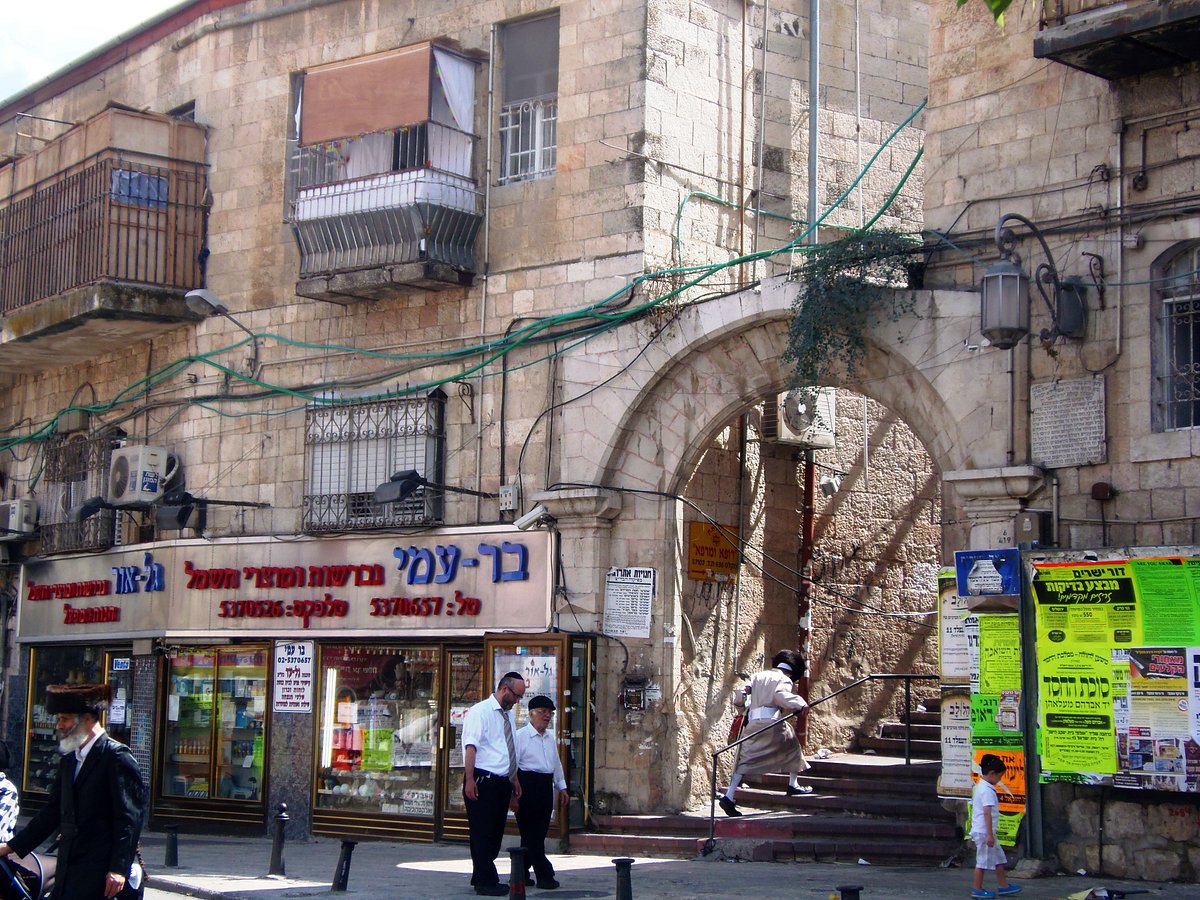
Mea Shearim
Neighborhood in Jerusalem, IsraelWikipedia
12
MENTIONS
11
EPISODES
11
PODCASTS
Search complete. 12 mentions across 11 episodes found for "Mea Shearim".
Sep 23, 2026

Herman PoppleberryHOST
Wikipedia's article on the Black Panthers states it plainly, that Musrara became a neglected area, and it wasn't alone in that.
Herman PoppleberryHOST
Along with Shmuel Hanavi, Mea Sharim, Mamilla, and Yemen Moshe, Misrara was one of the West Jerusalem neighborhoods along the line that were considered dangerous, and became slum neighborhoods populated by indigents, characterized by poverty and neglect.
Herman PoppleberryHOST
So the state housed its poorest new immigrants, Mizrahi families, against a hostile frontier.
Herman PoppleberryHOST
Because that was the housing nobody else wanted.

David AaronGUEST
I listen to Jewish music, but I curate also secular music.
David AaronGUEST
I actually asked my rebbe, Rav Shlomo Fisher, who grew up in Meah Shearim, [laughs] Zecher Avraham, who was a big talmid chacham, and I asked him if I could listen to secular music.
Chavie BrukHOST
Yeah.
David AaronGUEST
And he said yes.

Itai FlesherHOST
You know, when I walk down Salah al-Din Street, I feel like I'm in Jordan.
Itai FlesherHOST
When I walk down Malchei Yisrael in Mea She'arim, I feel like I'm in Little Poland, and there's parts of West Jerusalem that feel like New York or Sydney, and it's all in one city, which is not such a big city as well.
Itai FlesherHOST
And I share that poem because I know we're close to Yom Kippur, but I, I really want to wish all of our listeners who are listening to this podcast about finding our why that in some ways, whether travel is, is something that you do emotionally or in your mind, or travel is something that you do by going to other places, that it's not just seeing the place, but it's also seeing the people and hearing the stories, and asking other people what their why is, because I feel like sometimes there's no better way to find your why than having a sort of Martin Buber-like encounter with a stranger that you've never met before that can end up maybe changing your life.
Courtney Winter-PetersHOST
Thank you again, Itai, and thank you to all of you out there who are listening and coming along for this journey with us.

Ziad Abu HassanGUEST
In the Old City, and we have one near, before Jaffa Street.
Ziad Abu HassanGUEST
They have a house, used to have like, when you go in near, near the Mea She'arim.
Yirmiyahu DanzigHOST
Ah, okay, yes.
Ziad Abu HassanGUEST
They have, they used to have a house there.

Abba PerlmutterGUEST
Yeah, but for true Haredim, forget it.
Abba PerlmutterGUEST
You know, you could think that she, you know, she grew up in Mea She'arim and, like-
Yael Bar turHOST
She didn't?
Chaya Leah SufrinHOST
I am an Orthodox Jewish woman.

Avigdor MillerSOUNDBITE_SPEAKER
And you stuck to Yiddishkeit.
Avigdor MillerSOUNDBITE_SPEAKER
You're the great victor more than someone in Borough Park in Mea Sharim.
Avigdor MillerSOUNDBITE_SPEAKER
Your reward is much greater than those who live in the security of a very firm Torah environment.
Avigdor MillerSOUNDBITE_SPEAKER
In Mea Sharim you have difficulty trying to do the opposite of Yiddishkeit.
Avigdor MillerSOUNDBITE_SPEAKER
So wherever you are in this world, whatever Yetzirah you're dealing with, that's your success.
Avigdor MillerSOUNDBITE_SPEAKER
The one who battles, the one who struggles, is the one who has succeeded the most in this world.

Yehoshua PfefferGUEST
I'm talking about, there was a youth movement, still is, called HaShomer HaTzerir, and they would march.
Yehoshua PfefferGUEST
in Mea Shearim with clubs, you know, get out of this primitive way of life and join us.
Yehoshua PfefferGUEST
And many did, many did join.
Yehoshua PfefferGUEST
And therefore that was a very traumatic time, notwithstanding the euphoria of the state of Israel for the Haredim, that was a traumatic time.

Baruch SimonHOST
No, no, no, I'll tell you because i-it's still a safek because it's, it's only the Rambam shiita.
Baruch SimonHOST
But it, but, but, but he held medina he should keep it as simelacha, right? Even where he lived in, um, well, in Mea She'arim.
NelsonPANELIST
Gula.
NelsonPANELIST
Gula.

TaliaUNKNOWN
Oh, my God.
Eytan KleinbergGUEST
I got it in Meah Shearim.
Eytan KleinbergGUEST
There's two of them, and it, on every parsha, it has like Ten different ideas, and it's a story or just a phrase that someone said, and it's like three lines, an idea.
Eytan KleinbergGUEST
That's beautiful.

Moshe TaraginHOST
It's the nature and history of the Gursh, which is beautiful.
Moshe TaraginHOST
Obviously, it's all beautiful parts of the city, but we felt, what if it's Fuss? And you'll go to Mea Shearim, and you'll see that you're living on Rehov Mesil HaShisharim, or Rehov Sakachav, or Rehov Avnei Nezer, or Rehov...
Moshe TaraginHOST
And then you grow up, and you feel like you're enveloped with Torah.
Moshe TaraginHOST
You're enveloped by ideas that shape your identity.
1 more episode mentions Mea Shearim.
Create an account to see the whole feed, search across every transcript, and follow the entities you care about.