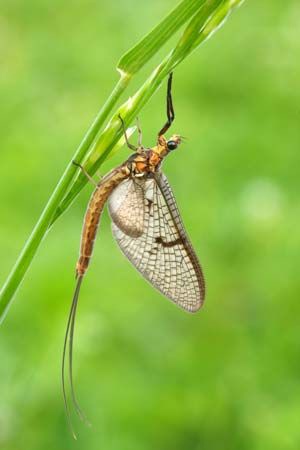
Mayfly
InsectWikipedia
8
MENTIONS
6
EPISODES
5
PODCASTS
Search complete. 8 mentions across 6 episodes found for "Mayfly".
Nov 25, 2026

Spencer DurrantHOST
So, you know, if you're not trying to fish an adult in February or something like that when caddis aren't active, usually they'll still respond to it because they are such a big part of the fish's diet.
Spencer DurrantHOST
But with that said, you're also overlooking the fact that Mayflies, midges, and caddis, they're the three most widely distributed aquatic insects in trout water in the world.
Spencer DurrantHOST
They're literally in every trout river in the world.
Spencer DurrantHOST
If you find a river where there's trout, there are midges, mayflies, and caddis.

IanAUDIENCE
Comment first.
IanAUDIENCE
So I'm a land steward in New Jersey, manage about 10,000 acres of parkland and open space with a wonderful team, and just wanted to talk about something that you discussed with Robert O'Hara a couple weeks ago in the Mayflies podcast.
IanAUDIENCE
Love these conservation-oriented and biodiversity-focused podcast interviews.
IanAUDIENCE
Keep those coming.

LaikaCORRESPONDENT
You know what? I think I will.
LaikaCORRESPONDENT
I'll call it Mayfly.
Matthew CrawleyHOST
Okay, sounds good.
Matthew CrawleyHOST
They only live for a
LaikaCORRESPONDENT
Oh.
LaikaCORRESPONDENT
They live for 24 hours.
LaikaCORRESPONDENT
Watch this space, Mayfly, coming 2029.
LaikaCORRESPONDENT
Okay,

MikeHOST
actually? Yeah.
MikeHOST
Mayfly came early, but then again, the mayfly was very, very good.
MikeHOST
It was probably as good, if not a better mayfly hatch as last year, except last year you got the heat wave and people didn't see the benefit of it.
MikeHOST
This year, I think they did.
Dave FarinaHOST
And finally, Pteragoda contains all the flying insects, which is essentially the vast majority of them.
Dave FarinaHOST
The orders in this subclass are Ephemeroptera, Odonata, Orthoptera, Neuroptera, Phasmatodia, Embioptera, Notoptera, Placoptera, Dermaptera, Zoraptera, Mantodia, Blatodia, Sokodia, Thysanoptera, Hemiptera, Strepsiptera, Megaloptera, Raphidioptera, Tricoptera, Mycoptera, Siphonoptera, Hymenoptera, Lepidoptera, Diptera, and Coleoptera.
Dave FarinaHOST
Let's move forward and start examining these orders one at a time, so that we can truly grasp the diversity in this clade.
Dave FarinaHOST
music music

Dave FarinaHOST
This contains all the flying insects, of which there are many orders, so let's go through them one at a time.
Dave FarinaHOST
Over 3,000 species of order Ephemeroptera are collectively known as mayflies, shadflies, or fishflies.
Dave FarinaHOST
The name Ephemeroptera is a reference to their ephemeral or short lives as adults that can sometimes aggregate in tremendous numbers during the breeding season.
Dave FarinaHOST
Though the adults do not feed, have vestigial mouthparts, and are indeed short-lived, their immature freshwater forms, known as naiads or nymphs, survive as freshwater hunters that eventually molt into a subimago and finally an imago or adult form.
Dave FarinaHOST
The adults are characterized by their long tails and wings that do not fold flat over the abdomen.