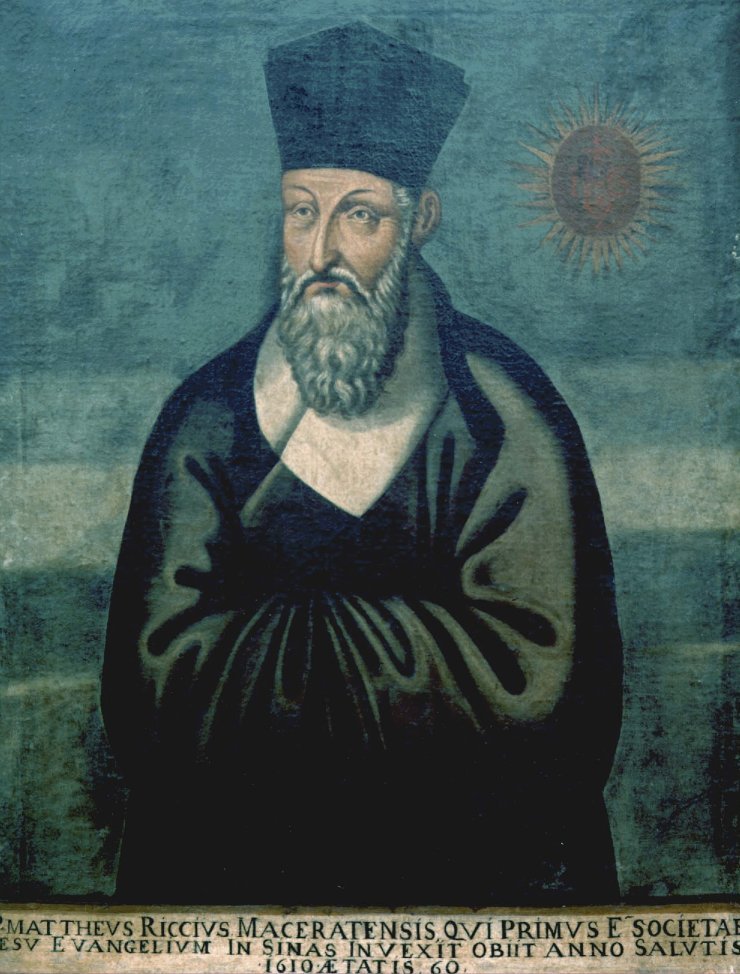
Matteo Ricci
Italian missionerWikipedia
26
MENTIONS
7
EPISODES
7
PODCASTS
Search complete. 26 mentions across 7 episodes found for "Matteo Ricci".
Sep 27, 2026

Johnny CirucciGUEST
So the Jesuits, after their founding, quickly set their sights on Asia and And co-founder Francis Xavier wanted at all costs to get to China and to manipulate China for the Jesuits and for Rome.
Johnny CirucciGUEST
He only got as far as Japan before he died, but Matteo Ricci would reach China and the Jesuits would insinuate themselves there so powerfully, so strongly that Matteo Ricci was basically dictating to the emperor of China his reality.
Johnny CirucciGUEST
He was a royal astronomer, and he helped create the Chinese calendar.
Johnny CirucciGUEST
How about that for matrix reality? The matrix, the Chinese matrix, pardon me, the Chinese reality was delivered by the Jesuits.

Rana MitterPANELIST
But that wasn't the whole story.
Rana MitterPANELIST
You know, a generation or two, perhaps more than a generation, but a century or two before, the I think quite famous and certainly pioneering Jesuit priest, Italian priest, Matteo Ricci, who spent time at the court of the Qing Dynasty in early modern China, did a very great deal to learn complex classical Chinese, to understand Confucian norms.
Rana MitterPANELIST
And also, in terms of trying to bring about conversions, bearing in mind he was a Jesuit, and one of the things we know is that Jesuit orders did their best to try and a little like the late Malcolm X, to get things done by any means necessary.
Rana MitterPANELIST
In other words, adapting what they had to say was often part of the agenda.

Jeremiah JenneGUEST
One is some of the best early writing about China from Westerners actually living in China occurs at the end of the Ming, and for this, we have the Jesuits who arrive in China at the end of the 16th century.
Jeremiah JenneGUEST
In fact, it's around 1600 or so that one of these Jesuits, Matteo Ricci, and some of his compatriots actually make it to Beijing.
Jeremiah JenneGUEST
They ingratiate themselves with the elite at court because they, Matteo Ricci especially speaks a wonderful Chinese.
Jeremiah JenneGUEST
While they never meet the emperor, they have these scholarly communications and connections.
Jeremiah JenneGUEST
They translate Confucius into Latin.

Jeremiah JenneGUEST
And for this, we have the Jesuits who arrive in China at the end of the 16th century.
Jeremiah JenneGUEST
In fact, it's around 1600 or so that one of these Jesuits, Matteo Ricci, and some of his compatriots actually make it to Beijing.
Jeremiah JenneGUEST
They ingratiate themselves with the elite at court because Matteo Ricci especially speaks wonderful Chinese.
Jeremiah JenneGUEST
While they never meet the emperor, they have these scholarly communications and connections.
Jeremiah JenneGUEST
They translate Confucius into Latin.

speaker_4SOUNDBITE_SPEAKER
China was the great center of culture in the East, and so they would go to China to learn Chinese to learn more about culture, to study, and would bring back this knowledge.
speaker_4SOUNDBITE_SPEAKER
And in their trip to Peking, at one point they found the gospel, and they came back with a book of Matteo Ricci, which explained Christian doctrine in Chinese.
speaker_4SOUNDBITE_SPEAKER
And so they began baptizing.
speaker_4SOUNDBITE_SPEAKER
They began, well...

speaker_0NARRATOR
Catholicism was first introduced into Korea via China.
speaker_0NARRATOR
The Jesuit Matteo Ricci was one of the first missionaries to step foot in China and introduce the Catholic faith in 1583.
speaker_0NARRATOR
Father Ricci and his companions attempted to blend into the culture, learn the language, and teach math, science, astronomy, and map-making.
speaker_0NARRATOR
They were the first to translate the Catechism into the Chinese language.
speaker_0NARRATOR
In 1603, a Korean diplomat named Yi Su Wang was introduced to Matteo Ricci's catechism in Beijing and returned to Korea, bringing this material with him.
speaker_0NARRATOR
Over the subsequent century, the Catholic faith was studied, debated by Confucian scholars, and eventually outlawed by the king in the mid-18th century after determining that Catholicism contradicted various Confucian teachings, such as societal hierarchies and ancestor worship.
speaker_0NARRATOR
In 1784, a 28-year-old nobleman named Yi Sung-hun, who had learned about Catholicism in Korea, accompanied his father on a diplomatic mission to Beijing.

Jeremiah JenneHOST
We're going to talk about Mary Slessor and her campaign against what was known as twin infanticide.
Jeremiah JenneHOST
Later missionaries in China, though not necessarily Matteo Ricci, they really had a problem with foot binding.
Jeremiah JenneHOST
Now, these customs, these traditions, let's be clear.
Jeremiah JenneHOST
I mean, those are things that probably need to be opposed.
Jeremiah JenneHOST
Okay.
Jeremiah JenneHOST
So shall we take this chronologically, Sarah?
Sarah KeenlysideHOST
Yeah, why not, Jeremiah? Let's start with Matteo Ricci, shall we?
Jeremiah JenneHOST
I'm a historian of China.